


This joint family vacation planning guide helps multiple households shape a trip around shared priorities, practical needs, and time to unwind. The best plan isn’t always a packed itinerary. It’s an agreement everyone helped shape, with room for grandparents to take it slow, children to play, and everyone to enjoy time together.
Bringing relatives together is a joy, but different energy levels, destination preferences, budgets, and schedules can make decisions feel complicated. Planning can also become one person’s unpaid job. A few clear agreements can help the group share the work and make choices without losing sight of why you’re travelling together.
Start by agreeing on priorities and boundaries before booking. Share planning tasks, then build a flexible itinerary with a few meaningful group moments and time to explore or unwind separately. When comparing places to stay, look for practical gathering spaces and easy ways to enjoy downtime. The goal is a vacation that feels considered, welcoming, and enjoyable for every generation.
Key Takeaways
- Use this joint family vacation planning guide to agree on shared priorities before anyone books.
- Compare dates, destinations, and stays against what matters most to each household, then make trade-offs visible.
- Plan a few shared moments alongside optional activities, so no one has to do everything together.
- Give each planning task an owner and a decision date to share the workload and keep choices moving.
- Choose a group stay with space to gather and room for independent downtime.
Joint Family Vacation Planning Guide: Start With Shared Priorities
A joint family vacation brings relatives from multiple households together for a trip. The challenge isn’t simply choosing where to go. It’s making room for different hopes, needs, and limits before one confident voice, or the first person to start organizing, ends up making every decision.
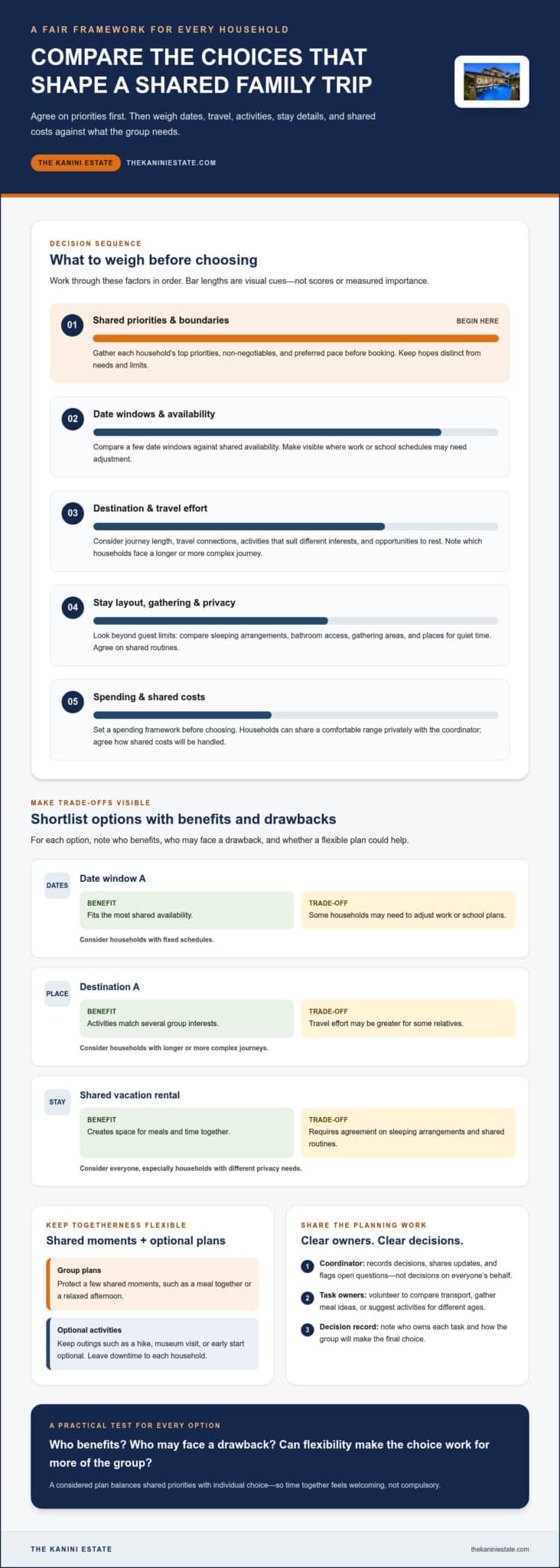
Begin with a short conversation. Ask each household to name its priorities, non-negotiables, and preferred pace. Keep these distinct: a priority is something people hope to enjoy, while a non-negotiable is a boundary that affects whether the trip works for them. One household might value unhurried meals, while another hopes for time outdoors. Both can fit if the group agrees on what matters most.
- Top priorities: The experiences or qualities each household most wants from the trip.
- Non-negotiables: Needs or limits the group should respect while planning.
- Preferred pace: How much activity, rest, and open time feels comfortable.
Then separate shared plans from optional activities. A meal together or a relaxed afternoon can be a group plan; a hike, museum visit, or early start can remain optional. That distinction matters. No one should have to treat every activity as a test of family loyalty.
A successful joint trip combines shared priorities with flexible individual choice.
How do you agree on what the trip should feel like?
Ask each person to describe the feeling they hope to bring home, not just the places they want to see. Invite answers such as “connected,” “rested,” or “curious.” Collect responses privately first, perhaps in a short message or shared form, so quieter relatives can contribute without competing in a lively group conversation.
Next, sort similar answers into themes such as connection, rest, exploration, and celebration. Ask each household to choose its strongest themes, then look for overlap. If connection and rest come up often, for example, protect shared meals while leaving mornings open. This gives the trip a common character without forcing everyone into the same routine.
Who should make which planning decisions?
Choose one coordinator to record decisions, share updates, and flag unresolved questions. Their role is to keep the process clear, not to choose on everyone’s behalf. Then invite relatives to own focused tasks, such as comparing transport options, gathering meal ideas, or suggesting activities that suit different ages.
- Group approval: Reserve it for choices that shape the whole trip, such as dates or the main destination.
- Delegated choices: Let a volunteer research options within agreed limits, then bring back a short selection.
- Personal choices: Leave individual downtime and optional outings to each household.
Write down who owns each task and how the group will make the final decision. A simple record prevents repeated discussions and helps every household see how its priorities shaped the plan.
Choose Dates, Destination, and Stay With a Fair Family Framework
Once the group has named its priorities, compare real options against them. The best choice isn’t always the one with the most votes. A destination may appeal to most relatives but create a long or difficult journey for one household. Look for workable compromises first, then decide which trade-offs the group can accept.
Keep the shortlist focused. Compare a few date windows, destinations, and stay styles rather than asking everyone to react to an endless list. For each option, note who benefits, who may face a drawback, and whether flexible plans could ease it. This makes a joint family vacation planning guide useful in practice, not just a list of ideas.
How can a family compare destination and travel options?
Consider journey length, travel connections, the range of activities, and chances to rest. Mark each preference as essential or optional. For example, if one household needs a slower arrival day, build that into the plan even if others want to begin exploring. Quartz also offers helpful perspective on planning multi-generational family trips effectively.
Use a simple comparison table to keep the discussion grounded:
| Option | Benefits | Trade-offs | Households affected |
|---|---|---|---|
| Date window A | Fits the most shared availability | May require some households to adjust work or school plans | Those with fixed schedules |
| Destination A | Offers activities that match several group interests | Travel effort may be greater for some relatives | Households with longer or more complex journeys |
| Shared vacation rental | Creates space for meals and time together | Requires agreement on sleeping arrangements and shared routines | Everyone, especially households with different needs for privacy |
What should a group stay make easier?
Look beyond the guest limit. Compare sleeping arrangements, bathroom access, gathering areas, and places to take quiet time. Consider whether relatives with different energy levels can enjoy the day in different ways. A stay works well when connection feels easy, not compulsory.
Set a spending framework before choosing. Each household can privately share a comfortable range with the coordinator, who can use that input to guide the shortlist without naming anyone’s limits. Agree on how shared costs will be handled, and distinguish the core stay from optional plans so participation doesn’t depend on everyone making identical choices.
As you compare destinations and stays, use the 2026 Hawaii vacation planning guide to weigh the setting against your group’s priorities. You can also explore the Kanini Estate vacation rental as one option for a full-property group stay.
Handle Different Ages and Opinions Without Overplanning
A good family trip doesn’t require everyone to do everything together. A full schedule can leave relatives tired, rushed, or wishing for time to themselves. A few shared plans can create lasting moments, while open spaces in the day let each person find a pace that feels right.
Think in flexible blocks rather than hour-by-hour instructions. Choose one shared anchor, such as a meal or an easy outing, then leave room before or after it for rest, independent plans, or smaller groups. Allow realistic time to get ready and move between activities. This matters when the group has different mobility needs, attention spans, or energy levels. Ask people what would make an outing comfortable instead of making assumptions based on age.
Planned flexibility protects shared time from becoming an obligation. It gives relatives a clear chance to connect without making every moment a group commitment.
How can a trip work for different generations?
Plan a small number of shared anchors, then offer choices around them. For instance, the group might meet for lunch after a morning with different options: a walk for some, a quiet start for others, and a separate activity for anyone who prefers it. Households can split up and reconnect later, so time apart feels like part of the plan, not a sign that the trip has gone wrong.
Build in pauses and easy transitions. A simple itinerary might include:
- One shared moment: A meal, gentle outing, or relaxed gathering that most relatives can enjoy.
- Choice time: Optional activities with no pressure to join every one.
- A quiet interval: Unscheduled time to rest, read, or enjoy the surroundings.
Keep the plan adaptable. If an outing takes more energy than expected, shorten it or let some relatives head back while others continue. A joint family vacation planning guide should help families create connection, not a timetable everyone must obey.
What can families do when preferences conflict?
When opinions differ, pause before adding another activity or reopening every decision. Restate the group’s agreed priorities, identify any overlap, then choose a compromise or rotate the choice. If some relatives want a lively day and others prefer a slower one, alternate active plans with restful ones instead of trying to satisfy both preferences in every block.
Rotation can also make choices feel fair. One household might suggest a shared outing, while another chooses the next group meal. Keep a short list of optional ideas for free time, rather than placing every suggestion on the main itinerary. Relatives can choose based on how they feel that day.
Before finalizing an activity, make its expectations clear: how long it may take, whether it involves much walking, and where the group can reconnect afterward. Then everyone can decide with the same information. The result is a plan with a gentle rhythm, shared memories, and room for each person to enjoy the trip in their own way.
Use a Simple Planning Timeline to Share the Work
A clear timeline turns a family trip from one person’s ongoing project into a set of shared tasks. Give every task an owner and a decision date. The owner gathers options and reports back; the group decides only where its input is needed. This keeps details moving without making one relative responsible for every choice.
Use this sequence as a flexible starting point. Set actual decision dates together, based on when your group hopes to travel and how much time each choice needs.
- Align priorities. The coordinator gathers each household’s preferences and records the agreed direction. Set a decision date for resolving key differences.
- Settle dates. Ask one volunteer to compare shared availability and return with a short list of workable date windows by the agreed date.
- Choose the stay. Assign a volunteer to compare lodging options against the group’s needs for sleeping arrangements, gathering space, and downtime. Set a date to choose the preferred option.
- Coordinate travel. Give a volunteer responsibility for gathering travel details, such as arrival times and transport plans. Each household can manage its own arrangements while sharing details that affect group coordination.
- Share the plan. The coordinator updates the shared document and sends the settled itinerary, open questions, and optional ideas by a date that gives relatives time to prepare.
What belongs in the shared planning document?
Keep one easy-to-find document as the source of truth. Separate confirmed details from suggestions, so no one mistakes an idea for a commitment. Include dates, travel arrangements, accommodation information, task owners, and decision dates. A volunteer comparing properties can use the Big Island group getaway guide to organize the stay comparison around the group’s needs.
Add a brief coordination section with the agreed communication channel and relevant contact details. Share personal information only with the relatives who need it. Avoid placing sensitive details in a document with a wider audience than necessary.
How do you keep coordination manageable?
Choose one channel for practical updates and decisions, rather than spreading details across separate message threads. Agree on a reasonable response window for group choices. After a discussion, the coordinator can post a short summary: what was decided, who owns the next task, and when the group needs to respond.
Keep responsibilities visible and manageable. One relative might compare transport options, another can collect activity ideas, and someone else can review accommodation details. Tasks should have a clear owner, not an unspoken expectation that the most organized person will do everything. If a volunteer can’t complete a task, reassign it early.
A well-run plan leaves relatives free to look forward to the trip, rather than chase scattered details. If your group is considering a shared stay, explore the Kanini Estate vacation rental as you shape your plans.
Choose a Joint Family Stay That Makes Togetherness Feel Effortless
A group stay shapes how the whole trip feels. The right fit gives relatives an easy place to gather while allowing each household room to settle into its own rhythm. Before booking, look beyond the guest limit. Sleeping arrangements, bathroom access, shared spaces, quiet corners, and activities all affect how comfortably the group can spend time together.
Use this checklist to compare each property with your group’s actual needs:
- Capacity and beds: Match the stated guest capacity and sleeping arrangements to the people travelling.
- Bathrooms: Consider whether access will work for the group’s morning and evening routines.
- Gathering spaces: Look for places where relatives can share meals, conversation, or relaxed time together.
- Separate downtime: Consider whether guests can find a quieter space when they want to rest or recharge.
- Activities: Check whether the property offers different ways to spend time, without requiring everyone to join each one.
An entire-property vacation rental can bring multiple households together, with shared spaces for conversation and room to step away. But no stay suits every family. A group that values long outings may need different features than one hoping for easy days at the property. Compare the full experience, not capacity alone.
How can you tell whether a stay fits the group?
Picture an ordinary day, not only the special outing. Where will early risers gather? Can someone take a quiet break while others enjoy an activity? Do the beds and bathrooms suit the group’s needs? This practical test often reveals more than a listing’s headline capacity. Discuss important needs together before choosing, so the stay supports the trip you want.
How does The Kanini Estate accommodate a shared stay?
The Kanini Estate is a full-property luxury vacation rental in the gated, oceanfront community of Naupaka at Waikoloa on the Big Island of Hawaii. It sleeps up to 16 guests, with 8 king-size beds and 7 bathrooms. Its indoor and outdoor gathering spaces, game room, and full in-home gym offer different ways to spend time together or pursue separate interests.
The estate also features a private pool and hot tub, with the pool heated upon request. The game room includes billiards, shuffleboard, ping-pong, corn hole, and a stocked board-game closet. The in-home gym has a treadmill with iFIT, a Peloton bike, weights, and other exercise equipment. A walking path leads to a white-sand beach in 2 minutes. The beach is nearby, not private.
For shared meals, the gourmet chef’s kitchen has premium appliances and a stocked coffee bar. The indoor-outdoor living area includes a built-in BBQ, serving bar for 10, fire pit, and multiple dining spaces. These features give relatives options for gathering and downtime without requiring everyone to follow the same schedule.
To request a booking, enter your dates on the Book Now page, get a quote, and submit your request with contact and credit-card information. The card holds the reservation and is not charged until the booking team confirms it. The booking team will contact you within 24 hours of your request.
As you compare stays, return to the essentials: comfortable sleeping arrangements, practical shared spaces, and enough choice for relatives to enjoy the day at their own pace. Explore The Kanini Estate as a setting for your family’s time together.
Make Your Next Family Gathering One to Look Forward To
The strongest plans leave room for moments no itinerary can predict: a long conversation after dinner, a quiet morning, or a shared laugh that becomes part of family lore. Treat your decisions as a starting point, not another set of obligations. Agree on the next planning decision, give it an owner, and invite each household to shape what comes after.
A thoughtful joint family vacation planning guide helps create the conditions for everyone to feel welcome while leaving space for the trip to unfold naturally. The Kanini Estate, featured in Forbes as a top Luxury Big Island Vacation Rental, offers a full-property stay in the gated, oceanfront community of Naupaka at Waikoloa on the Big Island of Hawaii.
Explore The Kanini Estate for a memorable shared stay, and start planning time together.
Frequently Asked Questions
What is a joint family vacation?
A joint family vacation brings relatives from more than one household into a coordinated trip. The group may share a place to stay, travel dates, or selected experiences, while still making some plans separately. A useful joint family vacation planning guide helps everyone understand what’s shared and what remains each household’s choice. That clarity makes it easier to enjoy time together without expecting every relative to travel or spend each day in the same way.
How do you plan a vacation when family members have different interests?
Give each person a way to choose activities that suit their interests, then make practical details easy to compare. For each idea, note the expected time, level of physical effort, and whether advance arrangements are needed. This helps relatives decide based on what an activity involves, not just its name. If interests barely overlap, plan separate outings and agree on a convenient point to reconnect afterward.
How should relatives share vacation planning responsibilities?
Give each task a clear scope and ask someone to accept it before adding their name. For example, one relative can gather transport options, while another checks the group’s preferred meal arrangements. Set a check-in date so tasks don’t drift, and name a backup for choices that affect the whole group. If a volunteer can’t finish, they can hand over their notes rather than leaving someone else to start from scratch.
What is a fair way to divide shared vacation expenses?
Agree on the cost-sharing method before making shared commitments. Some households may prefer an even split, while others may want to divide a shared expense by the number of travellers or by how much each household uses it. Keep personal purchases separate from group costs, and record who has paid and what remains due. A clear method matters more than assuming one formula will feel fair to everyone.
How can family members who cannot attend still be included?
Include absent relatives in ways that feel natural to them. They might help choose a shared meal, send a note for a family celebration, or join a short call at a time that suits the group. Share selected photos or a simple trip update afterward, while respecting everyone’s privacy. Avoid making someone feel they must participate remotely to prove they’re part of the family.
What should families agree on before booking a group vacation?
Before booking, make sure everyone understands the dates, expected guest count, payment responsibilities, and which choices are still open. Read the booking terms together, including payment timing and cancellation conditions, so the group understands what a commitment involves. Decide who can approve the booking and how changes will be handled if someone’s plans shift. Keep the agreement in writing, where each household can refer to the same details.