


The best approach to managing different personalities on a group trip is to agree on shared expectations while allowing for different rhythms. Talk openly about the kind of trip everyone wants, make room for varied interests, and address tension respectfully rather than guessing at its cause. A thoughtful plan helps the group enjoy time together without expecting everyone to travel the same way.
It’s natural to hope that good friends or family will fall into step once the journey begins. Yet even close companions can have different ideas about how to spend a day, how much time to share, and when to take space. Those differences don’t have to diminish the pleasure of being together.
Here, you’ll learn how to welcome couples into the group, align expectations before departure, and avoid assumptions about quieter or less predictable travelers. You’ll also find practical ways to navigate conflict and build shared understanding, so the trip offers both easy companionship and room for each person to feel at home.
Key Takeaways
- Welcome couples with a warm first gesture, while making room for connection beyond the pair.
- Discuss travel styles, must-do activities, and spending expectations before plans are set.
- Offer quieter travelers space to join in at their own pace instead of reading silence as disinterest.
- When opinions differ, use calm discussion, a group vote, or negotiation to find a workable path.
- Create simple shared rituals that help the group feel connected as the trip unfolds.
1. Making couples feel welcome in the group
Make the first move when a couple joins your travel plans. Invite both partners into the conversation, then ask each what they hope to enjoy. A warm greeting at breakfast or a shared invitation to explore can help everyone feel included, without putting either person on the spot.
Couples on small-group trips may prefer to spend most of their time together, or enjoy meeting and socializing with others. Treat these possibilities as prompts to ask about preferences, not as labels. For example, ask whether they’d like to join a group dinner or have time together before meeting everyone later.
Choose accommodations by discussing privacy, sleeping arrangements, shared spaces, and everyone’s budget range before booking. Compare options with those needs in mind, then agree on what the group considers comfortable and fair. A couple may value a private room, while another traveler may prioritize lower costs or more time in common areas.
For fair cost-sharing, separate shared expenses from personal choices. Agree in advance how to divide shared lodging or transport, then let each person pay for the optional activities they choose. If room arrangements affect the split, discuss that openly before committing rather than leaving an awkward surprise for arrival.
Assign planning tasks to people whose strengths suit them. One traveler can compare accommodation options, another can organize transport details, and a third can collect activity preferences. Clear roles keep one person from carrying every decision and let couples contribute as individuals, rather than treating them as a single unit.
Different work styles need room, too. An organized traveler may want an itinerary, while a free spirit prefers flexible afternoons. Set essential plans together, such as the departure time for a booked activity, then leave open periods for people to choose their own pace.
For decisions, first clarify what matters most to each person. Negotiate an option everyone can accept, such as choosing a shared dinner venue while allowing separate daytime plans. If the group still disagrees, vote on low-stakes choices and reserve discussion for decisions with lasting effects.
Managing different personalities on a group trip means balancing welcome with choice. Check in with each traveler before plans are fixed, and invite couples to join group moments without expecting them to attend everything. This simple step respects their bond while making space for new connections.
2. Aligning trip goals and expectations
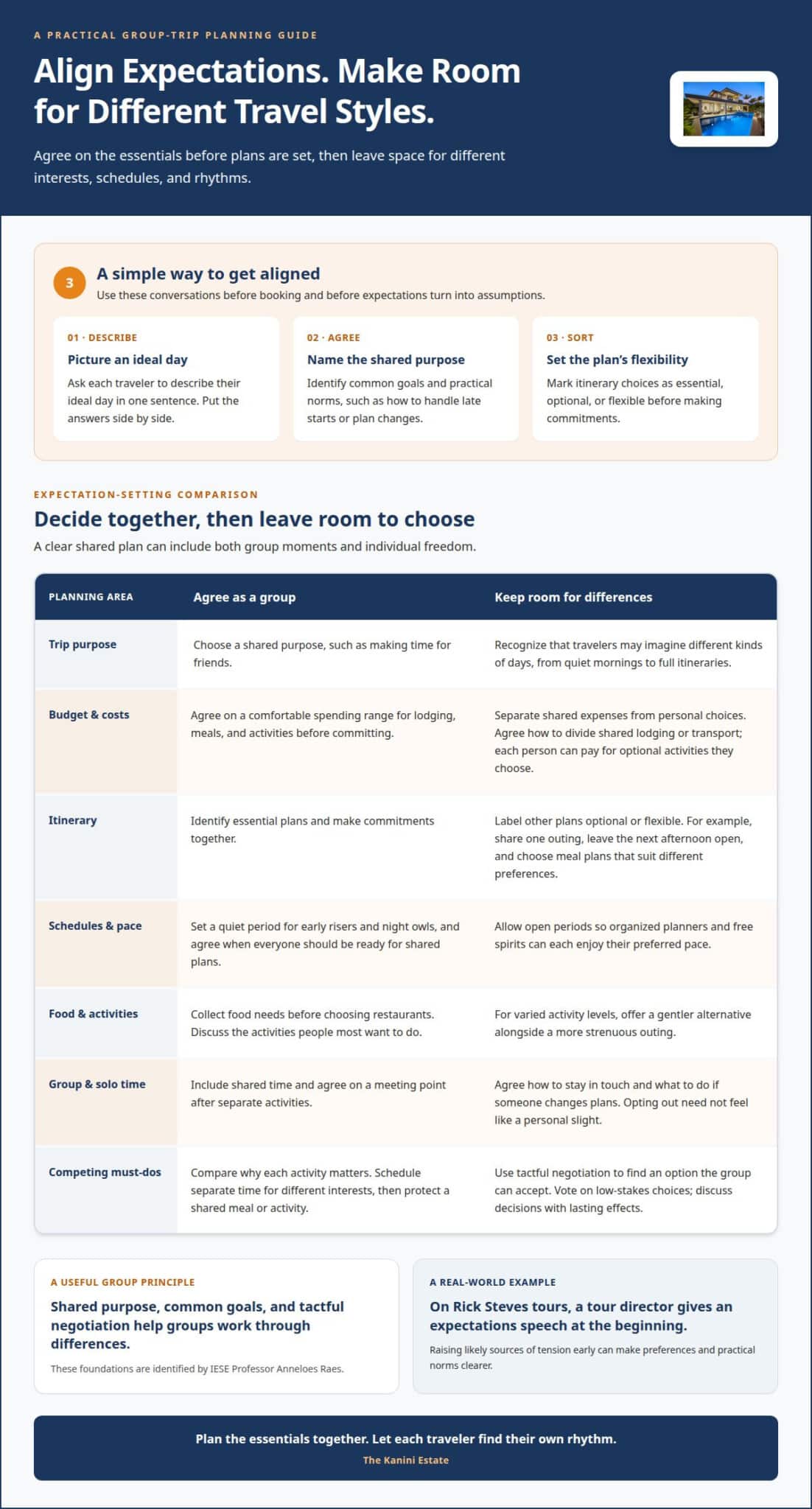
Before booking, ask each traveler to describe their ideal day in one sentence. One person may picture a quiet morning, a nature walk, and an early dinner. Another may want museums, lively evenings, and a full itinerary. Put these preferences side by side to identify shared interests and likely differences. This exercise gives the group a clearer picture than assuming everyone wants the same kind of escape.
Next, agree on a shared purpose and a few practical norms. IESE Professor Anneloes Raes identifies common goals, shared purpose, a team-focused mindset, and tactful negotiation as useful foundations for groups. On a trip, that might mean agreeing that the priority is time with friends, while also deciding how to handle late starts or changes to plans.
Discuss budget, itinerary, and pace together. Agree on a comfortable spending range for lodging, meals, and activities before making commitments. Then label itinerary choices as essential, optional, or flexible. For example, the group might reserve one shared outing, leave the next afternoon open, and choose meal plans that suit different preferences.
Different sleep schedules call for a practical agreement, not a daily debate. Set a quiet period for early risers and night owls, and agree on when everyone should be ready for shared plans. For food preferences, collect needs before choosing restaurants; for varied activity levels, offer a gentler alternative alongside a more strenuous outing.
Balance group time with individual freedom by including both in the itinerary. Choose a shared meeting point after separate activities, such as a café near the afternoon’s main attraction. Agree on how people will stay in touch and what to do if someone changes plans. Then opting out of an activity need not feel like a personal slight.
When must-do activities compete, compare the reasons behind each request. A history-focused traveler may value a guided visit, while a nature lover may prefer a coastal trail. Schedule separate time for those interests, then protect a shared meal or activity that reflects the group’s common purpose. Negotiation works best when everyone understands what matters to others.
For a restorative group stay, choose a setting that supports both conversation and quiet. A private luxury escape can give friends or colleagues room to share time and settle into different rhythms.
Before traveling, discuss expectations and confirm you’re on the same page about preferences, travel styles, and activities everyone wants to do. Talk about options such as luxury, relaxation, nature, partying, or history. Discuss accommodation and food price ranges to avoid awkward money conversations after arrival, and raise likely sources of tension early. On Rick Steves tours, a tour director gives an expectations speech at the beginning.
3. Avoiding assumptions about quiet or surprising travelers
A quiet traveler may need space and time before joining a conversation. Don’t interpret a pause at breakfast as dislike or disinterest. Make a gentle opening, such as asking whether they’d like to walk with you after the meal. If they decline, accept the answer and leave another chance to connect later.
Use a simple approach: notice, invite, then give room. Notice whether someone seems comfortable listening before speaking. Offer an easy way into the moment, such as asking what they thought of the coastal view. Then let them choose whether to answer or keep observing. This shows interest without turning a quiet moment into a test.
Personality labels can prompt conversation, but they shouldn’t become verdicts. On group trips, an ISFJ may be friendly but shy and let others go first. That description can remind the group to make an opening, but it can’t tell you what a particular traveler wants. Ask directly, then follow their lead.
An INTJ may avoid small talk yet prove a capable troubleshooter. If the group can’t find a meeting point, invite their practical ideas without assuming they want to take charge. A direct question about the map or route may work better than extended small talk. Recognize useful contributions, even when they come quietly.
Unexpected behavior also deserves curiosity before judgment. A traveler who skips a museum may still enjoy a long conversation over dinner. Someone who seems reserved on the first morning may become lively during a shared walk. In a new place, a group may need a day or two to establish its dynamics. Let time reveal more than one moment can.
Group leaders can notice patterns without sorting people into fixed roles. One person may often organize plans, while another prefers to decide as the day unfolds. Treat these as current preferences, not permanent traits. Check in before assigning tasks, and offer a choice instead of announcing what someone “always” does.
Use specific, low-pressure invitations to make participation easier. Instead of asking, “Why are you so quiet?”, try, “Would you like to join us for coffee after the walk?” The first question can make someone feel scrutinized. The second names a clear activity and leaves the decision with them.
When someone behaves unexpectedly, pause before explaining it for them. Ask respectfully what they’d prefer, then listen to the answer. This helps everyone feel seen as an individual, not as a personality type, a couple, or the group’s designated planner.
4. Communication styles and conflict
A disagreement about departure time can sound personal when it’s really about different priorities. One traveler may value punctuality, while another wants an unhurried breakfast. Name the issue clearly, then ask each person what matters most. This keeps the conversation focused on the plan, not judgments about someone’s character.
Choose a response that fits the decision. For a low-stakes choice, such as picking between two cafés, a quick vote can settle the matter. For a decision affecting the whole day, negotiation gives everyone room to suggest a workable option. If emotions run high, pause the discussion and return to it after a quiet break.
Ask respectful questions to uncover the values beneath a conflict. If travelers disagree about visiting a cultural site, ask what each hopes to gain from the outing. One person may care about the history, while another wants time outdoors. A shared value, such as learning about the place, can guide a compromise.
Different communication styles can help the group when people make room for them. An INFJ may listen first and ask thoughtful questions during a tour. An ENFJ may help mediate and lead an icebreaker. Neither style should carry the whole conversation. Invite quieter voices before a decision, and let enthusiastic speakers know when others need space.
When a clique forms, address the pattern without accusing anyone. On one tour, cliques emerged after 4 days. A group leader can mix up walking partners or invite everyone to a shared meal, while still allowing close friends time together. The aim is to widen interaction, not to force instant closeness.
A useful conflict check has three steps: describe what happened, explain its effect, and ask for a specific change. For example, say, “We left later than planned, so we missed the guided visit. Could we agree on a departure time tonight?” This stays concrete and gives the group a clear next action.
Group leaders can help resolve tension while keeping the itinerary on track. If two travelers argue about a long walk, acknowledge both concerns, then offer a shorter route or a separate plan. Revisit the shared schedule afterward so everyone knows where to meet. Clear communication protects both the relationship and the day’s plans.
Friends planning a group trip can choose avoidance, voting, or negotiation to handle disagreements, rather than assuming every issue calls for the same response. Explain the approach to the group: voting can settle a choice, while negotiation gives travelers room to discuss options; avoidance is another possibility. IESE recommends respectful discussion of ethical conflicts to help teams identify shared central values. This can keep attention on what matters to the group, even when travelers initially disagree.
On tours, an INFJ may listen first and ask insightful questions, while an ENFJ may help mediate and take charge of icebreakers. These roles can support conversation without making one person responsible for every resolution. Group leaders can help manage differing personalities, ease tension, and keep the itinerary on schedule. Balancing these aims helps them respond to conflict while maintaining the planned flow of the trip.
5. Using rituals to build shared understanding
A small shared ritual gives a group a familiar point of connection. Try a short morning check-in over coffee, where each traveler names one thing they’re looking forward to. Someone might mention a coastal walk, while another hopes for a slow breakfast. Hearing both helps the group notice different moods without turning the moment into a planning meeting.
Keep the ritual simple enough for everyone to join. A daily toast at dinner, for example, can invite each person to share a favorite moment from the day. One traveler may recall a lively conversation; another may remember a quiet view. The routine makes room for different kinds of enjoyment.
Workplace rituals can strengthen a team’s shared sense of reality, a principle associated with Maya Rossignac-Milon. On a retreat, the group could begin each morning with one word describing the day’s intention. “Focus,” “curiosity,” or “ease” gives people a gentle way to understand the mood others bring into the room.
Use a rotating role to make rituals feel shared rather than managed by one person. Each evening, a different traveler could choose a question for dinner, such as, “What surprised you today?” The host can pass the choice along afterward. This small handoff makes participation visible without asking anyone to speak at length.
A shared ritual can also ease transitions. Before an outing, gather at the same meeting place and say the plan aloud. After returning, take a quiet pause before dinner. These repeated cues help early risers, careful planners, and spontaneous travelers move through the day with fewer crossed signals.
Keep rituals welcoming, not compulsory. If someone wants to skip the dinner check-in, let them join later without asking for an explanation. A ritual should be a steady invitation, not another rule to follow. That distinction matters when travelers need solitude after a full day together.
At the end of the trip, invite everyone to share one moment they want to remember and one thing they learned about the group. A first-time traveler might describe feeling more at ease on a walk, while an experienced companion may value a new conversation. These reflections bring separate experiences into a shared story.
For a group retreat, a comfortable setting can give shared rituals room to take root. Explore a private retreat setting for time together, quiet reflection, and memorable conversations.
The Kanini Estate
The Kanini Estate offers a luxury vacation rental on the Big Island of Hawaii for friends, families, and corporate groups seeking time together. A thoughtful setting can give a group room to share experiences while respecting different personalities, preferred rhythms, and ways of connecting. For a family or friends’ trip, it offers an escape to paradise and a chance to make lasting memories. For a corporate retreat, it provides a high-quality, distraction-free thinking environment where colleagues can focus and build shared understanding.
If your group is planning time together in Hawaii, consider whether this kind of retreat suits its goals and travel style. Contact The Kanini Estate to discuss your group’s plans.
Make room for a more thoughtful kind of escape
The next trip can be more than time away. It can be a chance to create a group rhythm that respects each person while leaving room for new memories. Managing different personalities on a group trip isn’t about making everyone alike. It’s about meeting one another with care, even when preferences differ.
The right setting can make that intention feel natural. Shared time can unfold around the moments your group values, while a change of pace lets each traveler return to the gathering with fresh energy. Those small choices can shape a trip people remember for how it felt, not only where they went.
For a group considering a Hawaiian getaway, explore a stay at The Kanini Estate as you imagine what time together could become. Start with the kind of experience you want to share, then let the details follow. Your next journey can make room for everyone.
Frequently Asked Questions
What’s the best strategy?
The best strategy is to agree on a few shared principles, then keep the rest flexible. Before departure, decide what needs group agreement, such as a prepaid reservation, and what each person can choose alone. This keeps small preferences from becoming group votes. When managing different personalities on a group trip, use shared principles as a calm reference when opinions differ, not as rules for every hour.
What are effective ways to handle disagreements during a group vacation?
Address the specific issue before it gathers unrelated frustrations. If two travelers disagree about changing a dinner reservation, pause and identify what can still be changed and who would be affected. Keep the discussion private if a public debate could embarrass someone. Then choose a clear next step, such as keeping the reservation and letting others make separate plans, so the disagreement doesn’t dominate the evening.
How can you set expectations and boundaries with friends before traveling together?
Discuss practical boundaries through real situations, not broad promises. Agree, for example, whether it’s fine to spend an afternoon apart, how much notice people should give before changing plans, and whether anyone needs quiet time after a busy day. Share personal limits without turning them into group rules. Saying, “I’ll join dinner, but I need the afternoon to myself,” gives friends a clear, respectful guide.
What should you do if one person dominates decisions or frequently changes plans?
Set a decision process the group can follow, then apply it consistently. For a fixed booking, agree that changes need the consent of those affected; for flexible plans, set a time to finalize the choice. If one person keeps taking over, invite another traveler to lead the next decision. Address repeated changes calmly and privately, naming their effect, such as missed reservations or extra coordination.