


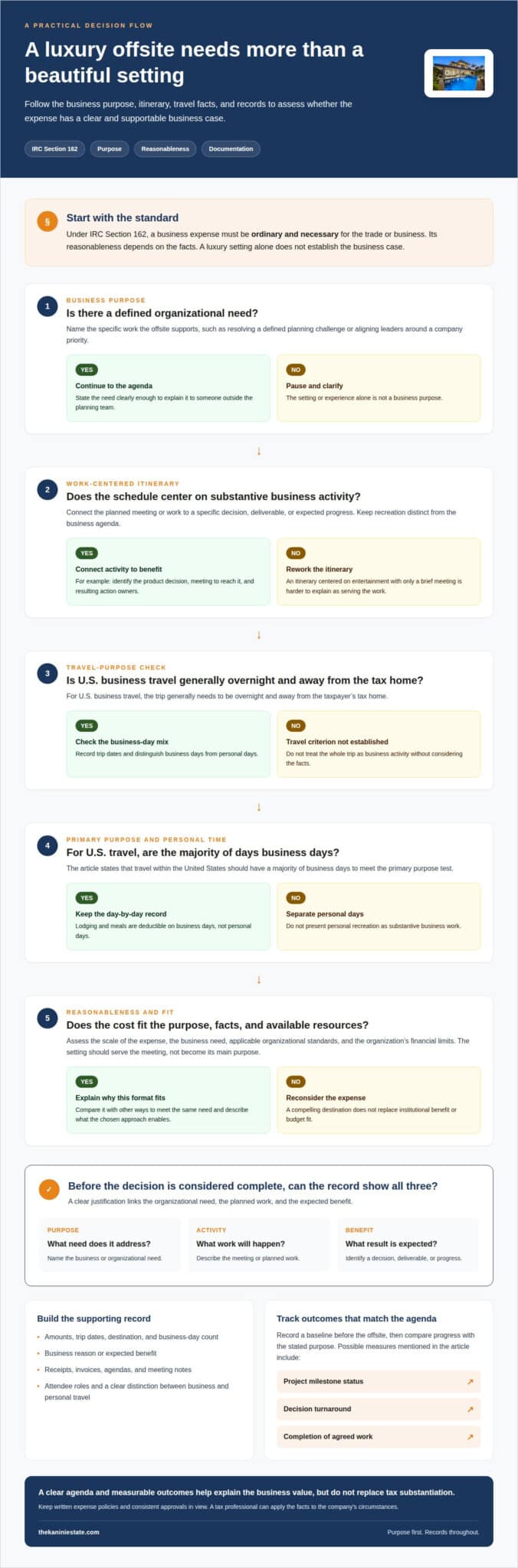
Justifying the expense of a luxury offsite starts with a clear business purpose, not the setting alone. Under IRC Section 162, a business expense must be ordinary and necessary for the trade or business. Its reasonableness depends on the facts, including what the offsite is meant to achieve and how its cost fits the business.
A refined setting can help a team step away from daily distractions, but comfort alone doesn’t establish a business case. The purpose, planned work, expected benefits, and supporting records all matter, as does a budget that reflects the organization’s financial limits.
This guide explains how tax standards shape the decision, what governance and documentation can support it, and how industry norms and budget constraints affect whether an offsite expense is appropriate. You’ll also see why an itinerary should center on substantive business activity, with personal recreation kept distinct. The goal is a considered, defensible decision that serves the work rather than letting the experience overshadow it.
Key Takeaways
- Build the business case around a clear purpose, planned work, and expected benefits, not the luxury setting alone.
- Assess whether the expense is ordinary, necessary, and reasonable in light of the business and the facts.
- Keep receipts and supporting records that connect the cost, travel details, and business activities to the retreat’s purpose.
- Use written expense policies and consistent approval practices to strengthen governance and accountability.
- Weigh the proposed cost against available funds and broader financial plans before committing to the offsite.
IRS standards for ordinary and necessary business expenses
IRC Section 162 requires a business expense to be ordinary and necessary for the taxpayer’s trade or business. A luxury setting alone doesn’t establish that standard; the purpose, activities, and expense records must support the business case.
Business Purpose and Economic Reasonableness
Business purpose explains how an expense serves company work; economic reasonableness weighs its scale against the facts. Both matter when justifying the expense of a luxury offsite, because a clear agenda alone cannot explain every cost. For example, a leadership meeting focused on a documented product launch has a defined purpose, but the company must also show why the location and related spending were appropriate.
Expense Necessity and Business Alignment
A necessary expense is helpful and appropriate for the business, while alignment connects the offsite’s activities to a real company need. A planning retreat may support decisions that require focused discussion; leisure without substantive business work offers a weaker connection. The setting should serve the meeting, not become its main purpose.
Useful outcomes are specific and observable. A company could track whether the meeting produced approved decisions, assigned project owners, or completed strategic milestones. Record the relevant baseline before the offsite, then compare progress with the stated purpose and expected business benefit.
For a clearer value assessment, track the same measures before and after the retreat, such as project milestone status, decision turnaround, or completion of agreed work. Match each measure to the agenda, and keep meeting notes that connect outcomes to the business purpose. These measures help explain value, but don’t replace tax substantiation.
Luxury doesn’t automatically make an expense nondeductible, nor does it automatically make one reasonable. The facts and circumstances matter. For U.S. business travel, the trip generally needs to be overnight and away from the taxpayer’s tax home. Travel within the United States should have a majority of business days to meet the primary purpose test. Lodging and meals are deductible on business days, not personal days.
Family attendance calls for a clear separation between business activity and personal travel. A spouse or family member’s presence alone doesn’t demonstrate a business purpose. Keep the meeting agenda, attendee roles, and travel records clear, and distinguish personal days from business days instead of treating the whole trip as company activity.
A retreat at a luxury destination still needs a work-centered schedule. The business-day count, meeting purpose, and documented outcomes help show whether travel supports company activity. Keep recreation separate from the business agenda.
For each business travel expense, retain the amount, trip dates, destination, business-day count, and business reason or expected benefit. Receipts, invoices, agendas, and meeting notes can connect expenses to their purpose. A tax professional can apply these facts to the company’s circumstances.
Expense appropriateness and institutional purpose
An offsite is appropriate when its purpose serves the organization and its cost supports that purpose. The University of Arizona’s FPM 6.1, General Expenditure Policy, defines reasonable spending and gives examples of allowable and unallowable purchases. This offers a useful governance model: assess the work the expense enables, not simply the appeal of the setting.
Institutional purpose should be clear enough to explain to someone outside the planning team. The University of Arizona says employees should be able to explain how an expenditure benefited the institution, including to a journalist or auditor reviewing the transaction. For a retreat, connect the proposed expense to a business need, such as resolving a defined planning challenge or aligning leaders around a company priority.
That explanation can be tested against three parts of the record:
- Purpose: Name the organizational need the retreat addresses.
- Activity: Describe the meeting or work planned to address it.
- Benefit: State the decision, deliverable, or progress the organization expects.
For example, “improve strategy” is broad. A stronger rationale identifies the product decision the team must make, the meeting planned to reach it, and the resulting action owners. Those details help show why the gathering supports institutional work.
Reasonableness also depends on the full context. A secluded setting may be appropriate when confidential discussion or sustained collaboration is central to the agenda. It is harder to explain when the itinerary centers on entertainment and includes only a brief meeting. The setting should fit the purpose, and the schedule should make that connection clear.
Resource allocation matters, too. A well-framed expense justification helps decision-makers direct funds toward priority work and reduce inefficient spending. Compare the proposed retreat with other ways to meet the same need, then assess whether its format supports the intended work. The comparison isn’t a contest to find the cheapest option; it clarifies what the organization gains from its chosen approach.
The University of Arizona also states that its funds cannot pay for unallowable expenses and that employees aren’t reimbursed for unallowable purchases. That standard underscores why an appealing destination cannot replace institutional benefit. A clear rationale should explain the purpose, the activity, and how the expense fits applicable organizational standards.
For a team whose work benefits from a calm, private setting, a retreat setting designed for focused work may suit a defined agenda. The decision still rests on whether the proposed experience supports the organization’s purpose and spending rules.
Expense justification supports resource allocation by optimizing spending and reducing inefficiencies. Arron Bennett says business owners should devote four hours a day to creating strategy for a retreat to count as a work trip.
Expense governance and accountability
A written travel and entertainment policy gives managers a consistent basis for reviewing offsite spending. It can define eligible expenses, approval roles, documentation requirements, and limits aligned with the organization’s standards. For example, a policy might require advance approval of the retreat’s purpose, planned activities, and budget before reservations are made.
Clear review steps help show that an expense is legitimate and tied to business activity. An expense request should include supporting documents and a rationale. Before authorizing spending, reviewers can compare the request with the meeting agenda, approved budget, and company policy.
For a retreat, governance can cover these practical controls:
- Approval: Record who authorized the gathering and its business purpose.
- Budget: Set spending limits for travel, lodging, meals, and other eligible categories.
- Documentation: Keep receipts, invoices, agendas, and records of business activities.
- Review: Compare submitted expenses with policy and the approved request.
- Reimbursement: Validate employee claims and record reimbursements through payroll processes.
Standard daily travel allowances, or per diems, can make cost controls easier. A company may use them to set predictable daily allowances and simplify accounting. The policy should explain which travel costs they cover and how employees report spending outside the allowance.
Recordkeeping should capture the details needed to explain business travel. For listed property, IRC Section 274(d) imposes substantiation requirements that include dates, destinations, mileage, and business purpose. For an offsite, a travel record can be paired with the agenda and receipts, helping reviewers connect each expense to the trip’s purpose.
Expense-tracking software can categorize transactions and help managers monitor spending against the approved budget. For example, separate categories for lodging, transportation, meals, and entertainment make unusual charges easier to spot. Fraud-pattern analysis can also flag irregular spending for closer review, rather than relying only on the final total.
Accountability matters especially when taxpayers or sponsors fund the work. At the University of Arizona, an expense cannot be charged to a sponsored account when the sponsor prohibits it, even if University policy permits it. This illustrates why an organization’s own approval may not be enough. A legitimate business investment must also comply with the rules attached to its funding.
Finally, management should review expenses regularly and update written procedures when recurring exceptions reveal unclear rules. Consistent records, defined approval steps, and careful review help organizations explain how an offsite’s spending supports business activity.
That investment also depends on consistent rules for mixed-purpose travel. For travel within the 50 states and Washington, D.C., transportation expenses are all-or-nothing based on whether the majority of trip days are business days. A documented review can distinguish business activity from personal time and apply the same policy to comparable claims.
U.S. businesses should develop and follow clear written travel and entertainment policies, including acceptable expenses aligned with industry standards. Travel and expense processes validate employee expenses against organizational policies. Expense-tracking software or apps can categorize and monitor spending while maintaining accurate records. Every University expense requires a valid business purpose statement and supporting documentation. Expense justification can use fraud-pattern analysis to identify irregular spending and improve transaction oversight.
Industry norms and expense reasonableness
Industry norms provide context, but they don’t determine whether an offsite expense is reasonable. The business purpose, attendee needs, itinerary, and total spending matter together.
Luxury and Standard Retreat Costs
A luxury retreat may use a more private setting or higher-end lodging than a standard corporate gathering. That difference matters when the added expense supports the work, such as confidential planning or extended collaboration. There’s no strict IRS definition of lavish or extravagant spending; reasonableness depends on the facts and circumstances. Compare the retreat’s format with its purpose, not just its label.
Cost Per Person
A useful per-person planning measure is total retreat spending divided by the number of attendees. The result varies with destination, travel needs, lodging, itinerary, and group size, so it isn’t a universal U.S. benchmark. Set an internal estimate based on the actual plan, then assess whether it fits the business purpose and budget. The per-person figure helps compare formats, but doesn’t establish deductibility.
Offsite Cost Categories
Build a detailed estimate by separating venue, lodging, travel, meals, and activities. Venue and lodging depend on the chosen setting and length of stay; travel reflects attendees’ routes and transportation. Tie meals and activities to the schedule and treat them separately. Breaking out categories makes the plan easier to assess and helps reveal spending that doesn’t support the retreat’s work.
For a fair comparison, use the same assumptions for each retreat option. Consider attendee count, trip length, travel requirements, meeting space, and planned activities. A standard venue may reduce some expenses, while a remote location may require more travel. The relevant question is whether the difference supports a concrete business need, not whether luxury is automatically justified.
Tax treatment also differs by category. Under IRC Section 162, a deductible business expense must be ordinary and necessary for the trade or business. First-class flights or five-star hotels may qualify when business travel makes them necessary to conduct business effectively. The setting alone doesn’t establish that connection.
Keep entertainment separate from meals and meeting expenses. Under section 274(a)(1), entertainment expenses are generally disallowed. The IRS says qualifying food and beverage costs purchased separately from an entertainment event may be deductible at 50%. If those costs are included in an entertainment ticket price and not separately stated, they’re also nondeductible.
A detailed comparison should show what each category supports, which attendees need it, and how it serves the agenda. This lets decision-makers assess the investment against company standards and the retreat’s expected business value. An expense that is ordinary for one business may be unreasonable for another, depending on their needs and circumstances.
Budget constraints and financial impact
A sound offsite budget weighs the full commitment against available funds and business priorities. Assess expected return alongside cash flow, not instead of it.
Offsite Budget Components
A company offsite budget combines direct event expenses with related travel and planning costs. Include the venue, lodging, transportation, meals, activities, and any required meeting materials. For example, a remote destination may add travel and ground transportation costs. Separating each category shows where the funds go and helps organizers identify costs that don’t support the agenda.
Also account for internal time spent planning and attending. When employees pause other work to travel, that time affects the investment even if it doesn’t appear on a supplier invoice. Keep planned costs and actual spending in separate records. Comparing them can reveal overlooked items, such as local transfers or changes to travel arrangements.
Calculating Offsite Return
Offsite return compares measurable business benefits with the full cost of the gathering. One useful calculation is (estimated benefit minus total cost) divided by total cost. Choose outcomes that match the purpose, such as completed decisions, project milestones, or reduced delays. Assigning a reasonable value to those outcomes helps business owners assess whether the investment supports company goals.
Set a baseline before the retreat, then review the same measures afterward. For instance, a team can record open decisions before a planning meeting and track which are resolved afterward. Don’t count every positive impression as a financial benefit. Connect the claimed return to evidence and a defined period for assessing progress.
Risks and Hidden Costs
Planning risks include travel changes, added transportation, schedule disruptions, and activities that drift from the retreat’s purpose. A budget should identify these possibilities and explain how the organization will handle them. For example, a delayed arrival could reduce meeting time while leaving lodging and travel commitments unchanged. A flexible agenda can protect essential work from disruption.
Cost reduction works best when it preserves the reason for gathering. Organizers can simplify optional activities, shorten the itinerary, or choose a format that meets the team’s actual needs. Avoid cutting the work session or essential travel support when those elements make the meeting effective. Compare each proposed saving with the purpose it might weaken.
Before approval, business owners can review projected spending, expected outcomes, and available liquidity together. Keep tax deductions separate from the operating decision; don’t treat a possible tax deduction as a substitute for sound budgeting. A retreat should fit broader financial plans and leave room for other priorities. For a focused setting that supports corporate retreat work, explore the retreat setting as you shape the plan.
The Kanini Estate: Luxury vacation rental on the big island of Hawaii
The Kanini Estate offers a high-quality, distraction-free thinking environment for corporate retreats on the Big Island of Hawaii. It suits teams whose agenda calls for focused conversation, thoughtful planning, and time away from daily interruptions.
A retreat’s setting should support its purpose. At The Kanini Estate, teams can step into an escape to paradise, while friends and family can gather for meaningful time together. For a company weighing an offsite, the key question is whether a private retreat environment serves the work and the people attending.
If this setting aligns with your retreat plans, contact The Kanini Estate to discuss your stay.
Shape an Offsite Around What Comes Next
Before choosing a setting, decide what the team should take away: clearer direction, shared priorities, or momentum on a specific initiative. That forward-looking aim can guide the agenda and make the experience purposeful from arrival through departure. It also gives the team a meaningful way to reflect on the gathering afterward.
The Kanini Estate offers a luxury vacation rental villa in the gated, oceanfront community of Naupaka at Waikoloa on the Big Island of Hawaii, creating a setting for an escape to paradise and time with friends and family. For a company, the retreat can bring colleagues together in a private environment, with the work itself at the center of the plan.
Thoughtful planning makes justifying the expense of a luxury offsite part of a wider business decision, not an exercise in choosing luxury for its own sake. If the setting suits your team’s goals, contact The Kanini Estate to explore your retreat plans. A considered beginning can help create space for work that continues long after the gathering.
Frequently Asked Questions
How can companies set a per-person budget and spending limits for an offsite?
Set a per-person planning amount based on the company’s approved total and expected attendance, then assign limits to travel, lodging, meals, and activities. Allow for different travel needs rather than assuming everyone will have identical expenses. For example, separate airfare estimates from shared venue costs. Require approval for exceptions before making commitments, and revise the plan if attendance or the schedule changes.
What tax rules apply to corporate retreats and employee offsite expenses in the United States?
For tax reporting, don’t assume every charge connected to a retreat receives the same treatment. Finance teams can sort expenses by category, reconcile submitted charges against payment records, and retain the agenda and approvals with the expense report. This creates a clear record for reviewing how each cost relates to the retreat. Keep company spending approval separate from tax classification, since approval alone doesn’t determine tax treatment.