


The strongest corporate retreat icebreaker ideas match the group’s size, familiarity, and comfort with sharing. For a larger team, Human Bingo gives people an easy reason to mingle, with prompts such as finding someone who has worked at the company for more than 10 years or visited more than five countries. For a smaller or closer-knit group, a shared bio book or a simple paired activity can create room for more thoughtful conversation.
A retreat can bring colleagues together, but an activity that feels forced or takes too long to explain may make people hold back. Choose and guide the exercise with care to help everyone feel more at ease.
Learn how to choose an activity for your group, create a shared bio book, and facilitate with warmth and clear instructions. You’ll also find ways to adapt Human Bingo for a larger team, helping new connections form naturally.
Key Takeaways
- Choose an activity that suits how well participants know one another and how comfortable they are sharing.
- Use a shared bio book to give introductions more depth and help colleagues discover common ground before the retreat.
- Keep instructions clear and the activity brief enough to preserve the group’s energy.
- For a larger team, shape Human Bingo prompts around experiences that invite easy conversation.
- Explore a distraction-free retreat setting when your group needs space for both connection and focused thinking.
Choosing activities by group size and familiarity
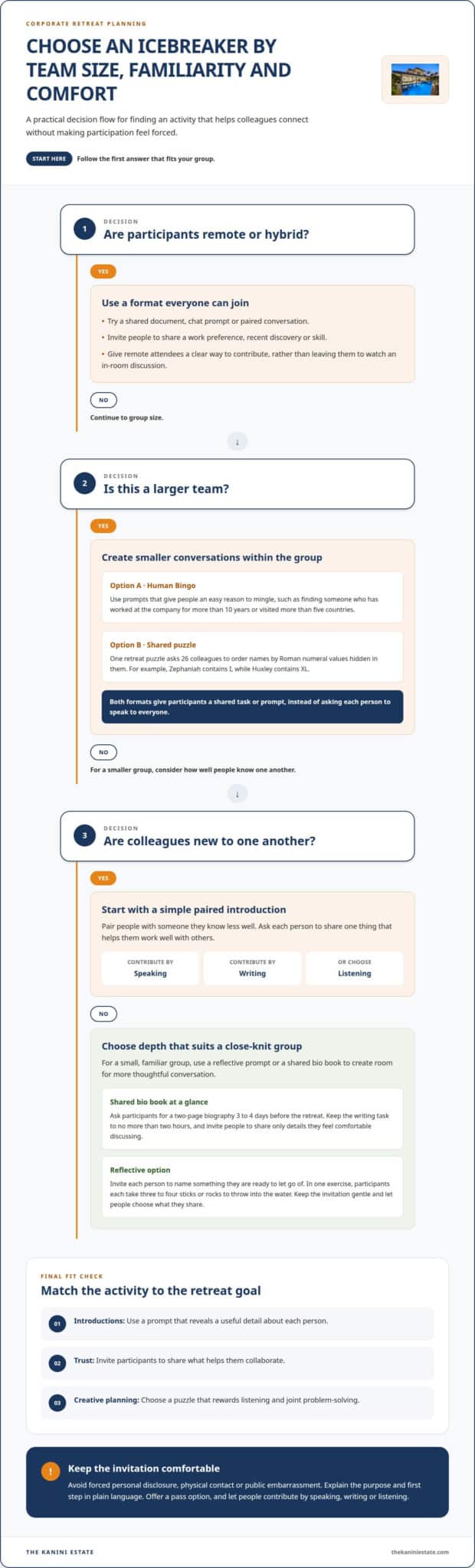
- Start with your group’s size and how well people know one another. A close-knit leadership team may enjoy a reflective prompt, while colleagues meeting for the first time may prefer a simple paired introduction. Choose a format that includes everyone without making participation feel like a performance.
- For a larger group, choose an activity that creates smaller conversations within the room. A puzzle can give participants a shared task instead of asking each person to speak to everyone. One retreat puzzle involves 26 colleagues and asks them to order names by Roman numeral values hidden within them. For example, Zephaniah contains I, while Huxley contains XL.
- For a small, familiar group, choose an exercise that supports the retreat’s purpose. If the goal is reflection, invite each person to name something they’re ready to let go of. In Joan Garry’s nonprofit retreat exercise, participants each take three to four sticks or rocks to throw into the water. Keep the invitation gentle, and let people choose what they share.
- For remote and hybrid teams, use a shared document, chat prompt, or paired conversation that includes everyone. Ask participants to share a work preference, a recent discovery, or a skill they’d like colleagues to know about. Give remote attendees a clear way to contribute instead of leaving them to watch an in-room discussion.
- For an outdoor company retreat at a venue like The Kanini Estate, try a walk-and-talk with one clear prompt, such as “What helps you do your best work?” Joan Garry’s letting-go exercise is another option near water, using three to four sticks or rocks. Choose a setting and activity where everyone can participate comfortably.
- Avoid activities that rely on forced personal disclosure, physical contact, or public embarrassment. Don’t ask colleagues to reveal private stories or compete in a game that singles out slower participants. Offer a pass option, and let people contribute by speaking, writing, or listening.
- Match the activity to the retreat goal before choosing a format. For introductions, use a prompt that reveals a useful detail about each person. To build trust, invite participants to share what helps them collaborate. For creative planning, choose a puzzle that rewards listening and joint problem-solving.
- Make participation easy by explaining the purpose and first step in plain language. For example, say, “Pair with someone you know less well, then share one thing that helps you work well with others.” A clear invitation lets people join at their comfort level and keeps the exercise connected to the retreat’s purpose.
Framing a clear invitation can make the activity feel manageable: explain how the group will begin, what participants are asked to do, and how they can pass or contribute another way. In the name-ordering puzzle, the solution orders participants by the value of the maximum set of Roman numeral characters found in each name. Huxley is the only participant who occupies the same position in the Roman-numeral-value order as in alphabetical order. That distinctive result gives the group a concrete point to discuss, keeping attention on shared reasoning rather than performance.
Using a shared bio book for retreat introductions
A shared bio book introduces colleagues thoughtfully before conversation begins. Use it to turn personal details into easy, respectful ways to connect.
-
Create a Shared Bio Book
Ask each participant to submit a two-page biography 3 to 4 days before the retreat. Joan Garry’s nonprofit retreat activity uses this format to help participants learn about one another in advance. Invite contributors to write in their own voice, and explain how the book will support introductions. Keep the page limit clear, so each biography feels manageable and easy to browse.
-
Explore Interests and Personal Stories
Suggest a few prompts that make it easier to share meaningful details. Ask about a favorite way to spend a free afternoon, a place that shaped someone’s outlook, or a skill they enjoy using. These examples can reveal shared interests without asking for private information. Remind contributors to choose stories they feel comfortable discussing with colleagues.
- Set a gentle time limit for writing. Joan Garry advises that creating a retreat biography should take no more than two hours. Offer simple prompts, such as “What do you enjoy learning?” or “What helps you feel welcome on a team?” A clear scope keeps the task from becoming a polished résumé or lengthy personal essay.
- Make participation welcoming, not compulsory in tone. Joan Garry reports getting 100% participation in her biography-based retreat activity, sometimes with nudging. Send a warm reminder that explains the purpose and gives people a clear way to contribute. If someone prefers not to share a particular detail, let them leave it out and focus on another prompt.
- Use the book as a bridge into conversation, rather than reading every biography aloud. Ask participants to find a shared interest or an unexpected detail, then invite them to talk in pairs. Someone who spots a common love of gardening, jazz, or cooking can start with a natural question. This gives quieter colleagues an opening without putting them on display.
- Close the activity with a prompt tied to the retreat’s aim. If the group is planning together, ask what each person hopes to contribute. If the retreat is for connection, invite people to name one new detail they learned. A quiet, distraction-free setting can also give colleagues room to reflect; consider a retreat environment for focused conversation.
Facilitation and timing
The first 30 minutes can set the tone for the following three days. Plan the welcome, instructions, and activity flow before participants arrive.
- Choose one facilitator to welcome the group and guide each transition. Start with a brief statement of purpose, such as, “We’re using this exercise to learn how we work best together.” Then explain how to take part and how the activity connects to the retreat agenda.
-
Prepare Activity Materials
List everything the exercise needs, then place supplies within easy reach. A biography quiz may need printed questions or a shared digital document; a name-based puzzle may need cards and pens. If no facilitator is available for a biography quiz, Joan Garry recommends asking one or two staff members to assemble it. Avoid supplies that don’t support the activity.
- Keep the activity brief when the agenda is packed. For paired introductions, try three-to-five-minute speed-meeting rounds, then clearly signal when partners should switch. Set out a visible prompt or display a timer so participants can follow the pace. Leave enough time for people to respond rather than rushing through each exchange.
-
Adapt for Accessibility and Team Diversity
Offer several ways to participate, such as speaking, writing, or adding a response to a shared document. For a team with remote colleagues, read prompts aloud and include their answers in the same discussion. Don’t rely only on movement, quick speech, or personal disclosure. Explain the activity plainly and give participants a comfortable way to pass.
- Check the instructions before presenting them to the group. If an exercise takes 10 minutes to understand, its energy can slip before play begins. Break directions into a few clear steps, and give a short example before starting. For a biography quiz, show one sample question and explain how participants will answer it.
- Make the transition from the activity to the next session calm and clear. After a paired exercise, invite each person to share one useful observation, not a full account of every conversation. For a biography quiz, close by naming a theme participants noticed. A clear ending helps the group carry new connections into the retreat’s work.
When deciding where the activity belongs, work backward from the session that follows. Leave a natural stopping point so the group can move on without cutting off a useful exchange. If the agenda is packed, keep a corporate retreat icebreaker short. Choose a simple format and trim directions or extra steps that aren’t essential. The aim is to fit the schedule, not rush participants.
For the retreat quiz based on participant biographies, Joan Garry recommends asking 1-2 staff members to put it together if there is no facilitator. Once the activity is prepared, keep its role in the retreat clear: it can open a conversation, while the next session carries the group into its work. Allow a moment to close the exercise and make the transition, rather than adding another prompt at the last minute. If the schedule changes, simplify the activity instead of letting it expand into the time set aside for the next session.
Human Bingo for large groups
Human Bingo turns introductions into a shared search for common ground. Prompts such as “worked here for more than 10 years” give colleagues an easy opening.
- Create a card with prompts that reveal approachable details about colleagues. Include “has visited more than five countries” alongside work experiences, interests, or skills. A mix of topics gives participants several ways to start a conversation. Keep each square clear so people understand the prompt without extra explanation.
- Choose prompts that invite conversation, not private disclosures. “Has worked at the company for more than 10 years” is easy to answer. “Has visited more than five countries” can lead to a story about travel. Avoid questions about health, finances, family status, or other personal matters that colleagues may not want to share.
- Explain the aim before handing out the cards. Ask participants to mingle, find colleagues who match the prompts, and write each person’s name in a relevant square. Encourage a follow-up question, such as “Which country surprised you most?” That turns a quick match into a real exchange.
- Keep the rules simple enough to remember. Show a sample square and model how to ask about it respectfully. Explain what counts as a match, and discourage guessing about someone’s experience. If a prompt is unclear, replace it before the activity begins instead of debating its meaning during play.
- Help the activity flow naturally by placing cards and pens where people can reach them. Invite participants to move at a comfortable pace or stay seated while others come to them. For remote colleagues, share the same prompts in a digital document and let them connect through the meeting platform.
- Make room for different communication styles. A colleague can ask questions, answer a prompt, or help a partner find a match. Don’t make winning depend on speed alone. The goal is to start new conversations, not reward the person who crosses off squares first.
- Close with a reflection that links the game to the retreat. Ask participants to share a surprising match or a new detail they learned, without requiring anyone to disclose more. Someone might mention discovering a shared interest in travel. Use those connections to ease the group into its next discussion.
What are the best icebreaker activities for a corporate retreat?
Choose an activity that serves the retreat’s purpose and suits the people in the room. These options offer different ways to get started.
- Use the Desert Island Team Challenge to spark shared problem-solving. Give small groups a longer list of possible supplies, then ask them to choose five items. Have each group explain its choices and agree on priorities. The exercise suits retreats focused on discussion and decision-making, not on seeing who reaches an answer first.
- Try a values-based discussion when colleagues need to understand how they work together. Offer a prompt such as, “What helps you contribute your best thinking?” Invite each person to answer briefly, then ask the group to identify common themes. Avoid turning the conversation into a debate about whose work style is best.
- Choose a collaborative drawing activity for a team that wants a light, creative start. Ask each group to sketch what strong collaboration looks like, using simple symbols or labels. Then have them explain one choice. No artistic skill is needed. The drawing gives people a shared topic to discuss without putting anyone in the spotlight.
- Use a “common ground” round when participants need an easy first exchange. Ask pairs to find a shared interest, such as a favorite kind of weekend walk or a skill they enjoy learning. Invite a few pairs to share what they discovered. Keep the prompt open so colleagues can choose what feels comfortable to discuss.
- Try an object prompt when the group would benefit from a personal, low-pressure introduction. Ask participants to choose an everyday object nearby and explain why it matters to their work or routine. A notebook, mug, or travel keepsake can prompt a brief story. Let people pass if they don’t have an object to share.
- Match the format to the retreat’s focus before adding playful details. For planning sessions, choose a challenge that involves joint decisions, such as selecting five supplies for the Desert Island activity. For relationship-building, use paired prompts that reveal interests. For reflection, ask what each person hopes to take away from the gathering.
- End with a short bridge into the next agenda item. After a drawing exercise, ask each group to name one practice it wants to carry into the meeting. After paired conversation, invite participants to share one useful insight. A thoughtful setting can also make it easier to move from informal connection into focused retreat work. Explore a focused retreat setting for your team.
The Kanini Estate: A luxury retreat for focused connection
The Kanini Estate provides a high-quality, distraction-free setting for corporate retreats. The private villa gives groups space to step away from daily routines and focus on shared work.
A team retreat can balance focused discussions with quieter moments to connect. Choose a setting that supports thoughtful conversation and gives colleagues space to spend time together beyond the agenda.
If this kind of retreat setting fits your plans, contact The Kanini Estate to learn more.
Make room for meaningful connection
Let the retreat’s first conversations shape what comes next. Choose a next step that gives your team room to reflect, exchange ideas, and carry new understanding into its work.
As you bring the plan together, consider how the setting can support the tone you want to create. Explore The Kanini Estate for your retreat as you plan a gathering shaped around your team’s priorities.
A thoughtful welcome and clear purpose can set the stage for stronger connections and fresh ideas.
Frequently Asked Questions
What are quick corporate retreat icebreakers for large groups?
Choose a prompt everyone can answer at once, such as one word describing what they hope to gain from the retreat. Written corporate retreat icebreaker ideas can include people who prefer not to speak first. Invite everyone to write on cards, then ask a few volunteers to explain their choices. This gives the facilitator a quick sense of the room without a long round of introductions.
What are low-pressure icebreakers for introverted employees?
Offer a quiet way to participate before inviting people to speak. Ask everyone to write one hope for the retreat, then read a few themes without naming authors. Participants can choose a theme to discuss with a partner. This gives introverted employees time to gather their thoughts and contribute without being put on the spot in front of the whole group.
How long should a corporate retreat icebreaker take?
Keep the activity brief enough to protect the retreat’s main work, and set its length according to the task. Choose corporate retreat icebreaker ideas that leave room for instructions, participation, and a smooth transition to the next session. A single opening prompt needs less time than paired conversation followed by group reflection. End once the activity has helped the group connect, rather than extending it just to fill the agenda.