
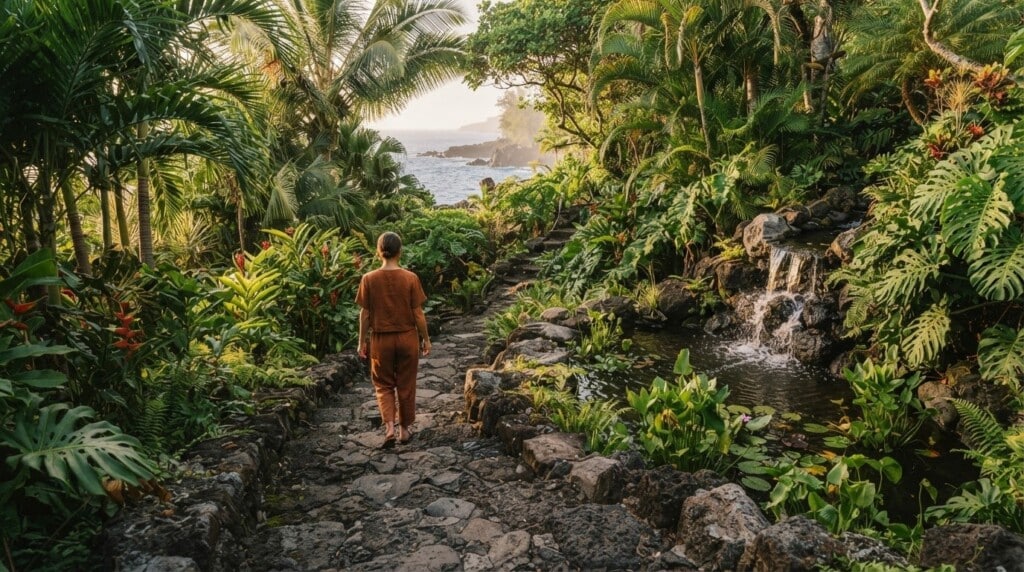

A garden can be more than a beautiful backdrop; it can shape the rhythm of a stay. At The Kanini Estate, a premier Hawaii estate with tropical gardens, the grounds bring together paths across varied terrain, lush tropical plants, waterfalls and ponds, with ocean views beyond the greenery. Each turn offers a different way to take in the Big Island landscape.
It’s easy to picture the coastline first, yet quiet moments on the Big Island often begin among palms and flowering plants. A shaded path, the sound of falling water, and a glimpse of the sea can make this Hawaii property feel like a destination of its own.
Here, you’ll learn how garden paths and terrain shape the experience, what gives a setting its tropical character, and how waterfalls, ponds, and ocean views come together across our estate. These details help you picture the surroundings of your Big Island stay, from sheltered corners to open coastal outlooks.
Key Takeaways
- Plan for a garden walk with varied terrain and more than a mile of stairs, so choose footwear suited to a leisurely outdoor visit.
- Explore how the garden’s 17-acre setting brings paths, tropical greenery, and coastal scenery together.
- Discover the breadth of the plant collections, including 2,500 plant species and over 270 orchid species.
- Learn how waterfalls, ponds, and ocean outlooks shape the garden experience, and what to consider when planning your visit.
- For a private Big Island escape with friends, family, or a corporate retreat, consider The Kanini Estate.
Garden paths and terrain
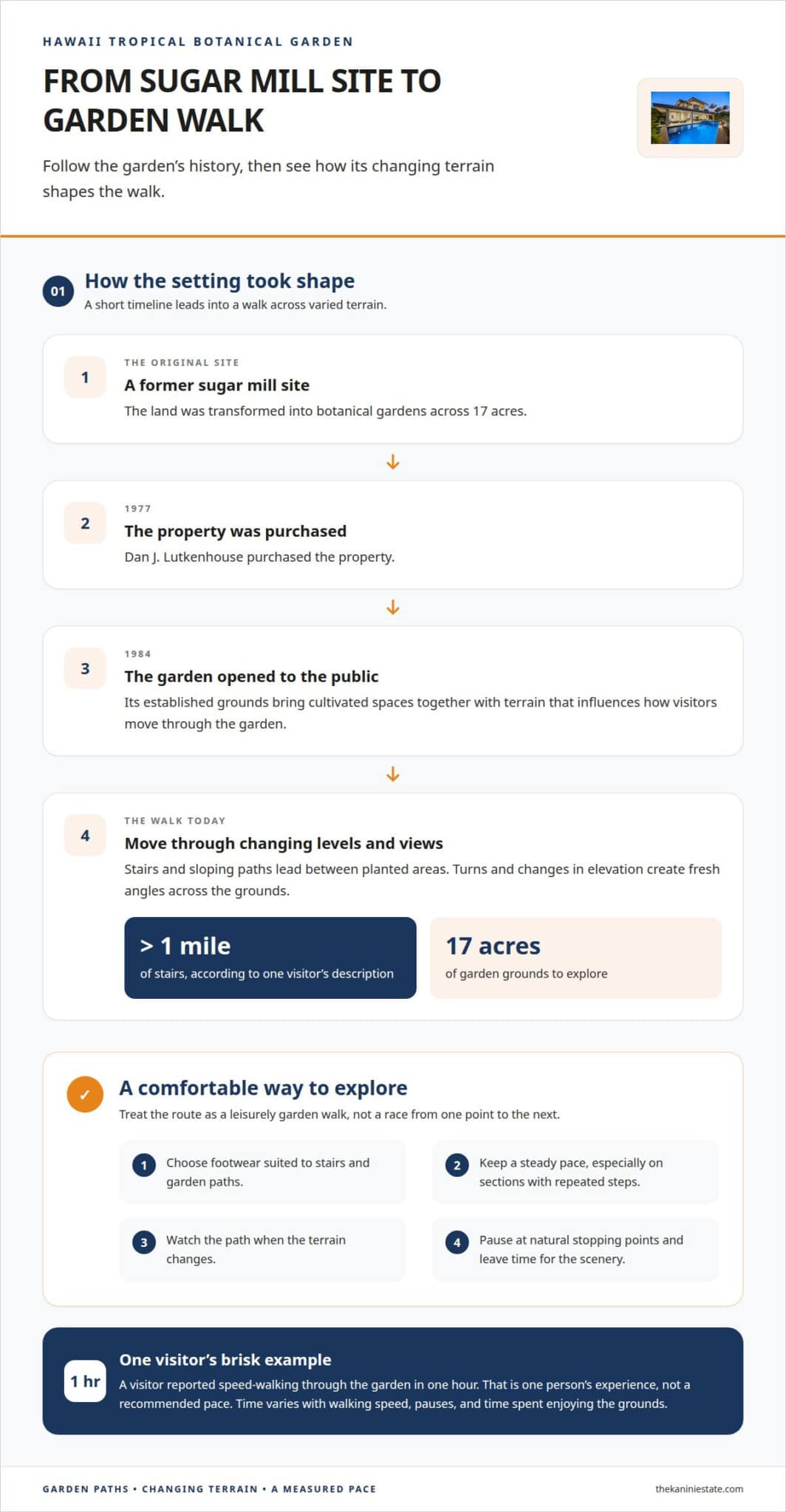
At the Hawaii Tropical Botanical Garden, paths move through a varied, cultivated landscape. Stairs form a notable part of the visit. A visitor described the walk as including more than a mile of stairs. That detail sets expectations: this is a route to explore at a measured pace, not simply view from one level. Each change in elevation asks visitors to shift their attention between the path and the surrounding garden.
The grounds also carry a story of change. A former sugar mill site became botanical gardens across 17 acres. Dan J. Lutkenhouse purchased the property in 1977, and the Hawaii Tropical Botanical Garden opened to the public in 1984. Those milestones help explain why the paths pass through an established landscape. The garden combines cultivated spaces with terrain that shapes how visitors move between them.
Stairs and sloping paths can affect the pace of a visit. Pause where the route changes direction and notice the shift from dense greenery to an open view. Changes in elevation and outlook make each stretch feel distinct. Walking at a steady pace leaves time to take in these transitions, rather than focusing only on reaching the next point.
A few simple choices can make a walk more comfortable:
- Choose footwear suited to stairs and garden paths.
- Set a relaxed pace, especially on sections with repeated steps.
- Pause at natural stopping points instead of rushing between areas.
- Keep your attention on the path when the terrain changes.
- Leave time to enjoy the scenery along the way.
These choices matter on a route described as having more than a mile of stairs. The time needed depends on your pace, pauses and how often you stop to admire the grounds. One visitor reported speed-walking through the garden in one hour, but that brisk example leaves less room to linger. Treat it as one person’s experience, not a recommended pace for every visit.
Garden paths connect planted areas with the surrounding landscape. Stairs lead through changing levels, while turns offer fresh angles on the grounds. If a view opens between plantings, pause before continuing. A slower walk helps you notice the contrast between shaded paths and brighter garden spaces. The route becomes part of the experience, not just a way to cross the grounds.
Garden size and setting
The Hawaii Tropical Botanical Garden is a nonprofit garden with an educational purpose. It protects native and endemic plants while also fostering tourism. That mission gives the setting a purpose beyond scenic display. Visitors can approach the grounds as both a garden experience and a place connected to conservation and learning.
A public garden differs from a private estate. Its role includes education and the protection of native and endemic plants, while a private property offers a more personal retreat. Understanding the distinction helps set expectations. Someone seeking a botanical garden visit has a different goal from someone planning a private stay amid coastal scenery.
As you explore, consider how the garden’s purpose shapes what you notice. A planting can be more than a pleasing view; it can also reflect the garden’s work to protect native and endemic plants. Look around with curiosity and consider the relationship between cultivated spaces and conservation.
Keep these points in mind as you decide what kind of experience suits you:
- Choose a public garden for an outing centered on botanical learning.
- Notice how the garden’s conservation purpose informs the setting.
- Consider whether you want a public visit or a private island retreat.
- Let the landscape guide your attention rather than treating it as a backdrop.
The Hawaii Tropical Botanical Garden is a public setting shaped by education, plant protection and tourism. A private estate serves a different purpose, with its surroundings forming part of a personal stay. Both experiences can connect visitors with a tropical landscape, but they meet different needs. Choosing what best fits your plans makes the setting part of the decision.
If a private stay feels closer to what you’re planning, consider an estate where coastal scenery forms part of the experience. Explore this private estate retreat as a different way to enjoy a tropical setting and time together.
Time and scale can also shape what you expect from a visit. A visitor said it was possible to speed-walk through the garden in 1 hour. That describes a brisk way to pass through, not necessarily the only way to experience the grounds. You may prefer to pause, look closely at plantings, and let the educational and conservation purpose guide your attention. The contrast is useful when deciding whether you want an outing focused on exploring a public garden or a stay where the surrounding grounds are part of your setting. Consider what pace feels right for your plans, rather than assuming that every landscape calls for the same kind of visit.
The Holualoa estate on Hawai‘i Island occupies 2.725 acres. It is also set on nearly three acres of landscaped grounds, a scale that helps frame it as a private setting rather than a public garden visit. These descriptions offer a practical point of comparison without making the two experiences interchangeable. The garden’s role is tied to education, tourism, and protecting native and endemic plants; the estate is presented as a private retreat where coastal scenery forms part of a personal stay. If you are weighing the options, think about whether you want to spend time in a public landscape with a botanical purpose or choose a private setting for time together. In either case, the grounds can influence the pace and character of your experience.
Tropical plant collections
The Hawaii Tropical Botanical Garden brings together 2,500 plant species. That breadth gives visitors a chance to notice contrasts across the grounds. Leaf shapes, flower forms, and growth patterns can make each planting feel distinct. Instead of trying to take in every plant at once, choose a few details to observe. A close look at one leaf can reveal a different texture or outline from nearby foliage.
Orchids form a striking part of the collection. The garden has over 270 orchid species, offering plenty to notice during a walk. Look for differences in flower shape, color, and arrangement. Some blooms draw the eye immediately, while others reward a slower look. These details help turn a broad collection into a series of small discoveries. Take time to compare what you see rather than moving quickly from one display to the next.
A simple viewing routine can make the plantings easier to appreciate. First, choose one feature, such as leaf shape. Then compare that feature across nearby plants. Next, shift your attention to flowers, stems, or the way each plant occupies its space. At the Hawaii Tropical Botanical Garden, this approach gives the 2,500-species collection a more personal scale. It also helps visitors remember details after leaving the grounds.
- Notice the shape and texture of leaves before focusing on blooms.
- Compare orchid flowers by color, form, and how they appear within the planting.
- Pause at a display that catches your eye, then look for smaller details.
- Take photographs where permitted to revisit a plant’s form later.
With over 270 orchid species, it helps to slow down and look carefully. A flower’s outline may stand out first, but nearby leaves and stems add context. The same close attention works across other plantings in the garden. Consider how each plant differs from those beside it, rather than relying only on a name or label. That kind of observation makes a visit more engaging for both casual admirers and keen plant enthusiasts.
The collection also offers a reminder that tropical gardens are shaped by variety, not just vivid color. At the Hawaii Tropical Botanical Garden, 2,500 plant species create many opportunities to compare form and detail. Orchids provide one clear focus, with over 270 species to observe. Leave room in your visit for unhurried looking. A single planting can reveal more when you pause, compare, and notice the details that first escaped you.
The Hawaii Tropical Botanical Garden is a nonprofit organization that promotes education, protects native and endemic plants, and fosters tourism. Keeping these aims in mind can add another layer to a visit. As you move among the plantings, consider not only what makes each specimen distinctive, but also how careful observation can deepen your understanding of plants and their place in a garden. Native and endemic plants invite closer attention, while the garden’s educational role encourages curiosity rather than hurried viewing. Pausing beside a planting can reveal details and prompt reflection on the value of protecting the variety represented in the collection.
Waterfalls, ponds, and ocean views
A waterfall, a still pond and an ocean outlook offer distinct ways to experience a tropical garden. Moving water brings sound and motion, while a pond may reflect nearby greenery. Beyond the garden, an ocean view draws the eye to the horizon. Together, these features create a sequence of intimate and expansive moments, each inviting a different kind of attention.
Begin beside a waterfall. Notice how the sound changes as you move closer or farther away. Look at the surrounding leaves, then watch the water move across the rocks. A short pause can reveal details a quick glance misses. Even when foliage partly screens the falling water, its sound gives the feature a presence of its own.
At a pond, look for reflections before focusing on the water itself. Palm fronds, flowers or open sky may appear on the surface. A small change in viewpoint can alter the reflection. Stand to one side, then take a few steps along the edge. This simple comparison shows how the pond connects with its surroundings, rather than seeming like an isolated feature.
An ocean outlook offers a different scale. A garden path can frame the view, while an open vantage point gives the horizon more room. Pause where the foliage parts and notice where the garden ends and the sea begins. The contrast can make the coastline feel like part of the garden experience. Changing light can also shift the mood, from soft morning color to warm sunset tones.
- Pause near a waterfall and listen before moving on.
- View a pond from different positions to notice changing reflections.
- Look for a garden opening that frames the ocean horizon.
- Return to an ocean outlook as daylight changes.
These stops make a simple viewing route: start with moving water, continue to a pond, then finish with an ocean outlook. Each place invites a different kind of attention: sound at the waterfall, reflection at the pond and distance at the coast. The sequence moves naturally from intimate details to a broad view.
Take time at each setting instead of trying to capture everything at a glance. A waterfall rewards listening, a pond rewards careful observation, and the ocean rewards looking beyond the nearest plants. Together, they show how water and coastline can shape a tropical garden. You may remember a shifting reflection, the soft rush of water or changing light above the sea.
Hawaii Estate Gardens: Directions and Parking
For a garden visit in Hawaii, use the garden’s full name when setting your destination. This helps distinguish the attraction from private estates and other botanical sites. Before leaving, compare the destination in your route with the garden’s visitor information. A clear match can prevent confusion near the end of your journey.
Use this simple arrival plan:
- Enter the garden’s full name in your navigation tool.
- Check that the destination matches the garden you plan to visit.
- Review the final approach before setting out.
- Allow time to arrive, park, and reach the entrance.
Parking is a practical part of planning, but arrangements vary by garden. Use visitor information for your chosen garden to find out where guests should park and how to reach the entrance. Don’t assume roadside spaces or private driveways are for visitors. A little preparation can make arrival calmer, especially when travelling with companions or carrying items for the walk.
Keep your route and arrival details together before setting out. A saved destination makes it easier to find the right place if directions change along the way. If you’re travelling with others, share the garden’s name and planned arrival point. Everyone will have the same reference, making it easier to regroup before entering.
These details can help you prepare:
- Destination: the full name of the garden you intend to visit.
- Route: the final approach shown in your navigation tool.
- Parking: the visitor parking instructions for that garden.
- Arrival: enough time to park and reach the entrance at an easy pace.
A garden visit and a private estate stay serve different purposes. A botanical garden is an outing with its own entrance and visitor arrangements. A vacation rental is a place to stay, with arrival planned around the property. Keeping the plans separate helps you organise the day, especially if your Hawaii itinerary includes both a garden visit and a private stay.
The Kanini Estate: Luxury vacation rental on the big island of Hawaii
The Kanini Estate is a luxury vacation rental for guests seeking time with friends and family. It offers a considered escape from routine, with space to settle into a slower rhythm and enjoy time together.
For a corporate retreat, the estate provides a high-quality, distraction-free environment for focused thinking. For families and friends, it offers a setting for shared moments and a peaceful change of pace.
If this kind of stay suits your plans, contact The Kanini Estate to explore the experience.
Choose the kind of island stay you’ll remember
The right setting can shape more than the view. It can make room for unhurried mornings, shared conversation and the feeling of being away from routine. If your search for a Hawaii estate with tropical gardens is really about finding that sense of ease, let the landscape guide what you want from your stay.
Think about how you hope to spend your days. Perhaps you picture quiet time near the coast or a place where friends and family can settle into their own rhythm. Let those hopes guide your next step instead of trying to plan every moment before you arrive.
The Kanini Estate offers a considered way to experience the Big Island. Explore the property and imagine whether it suits the retreat you have in mind. Explore The Kanini Estate and begin shaping a stay that feels like your own. A meaningful island escape starts with choosing a place that lets you slow down.
Frequently Asked Questions
What tropical plants and garden features can visitors see at Hawaii estates?
Visitors can enjoy tropical foliage, flowering plants, orchids, waterfalls, ponds and ocean outlooks. At the Hawaii Tropical Botanical Garden, look beyond the blooms: compare leaf shapes and textures, then notice how plantings frame water or coastal views. Choose one feature to notice at each stop, such as a flower, a reflection or the sound of falling water. This can make the walk more engaging.
What are the best luxury vacation rentals in Hawaii with tropical gardens?
The best fit depends on whether you value private space, shared amenities or a garden-focused setting. The Kanini Estate is a luxury vacation rental in Hawaii for guests seeking time together, with a private pool and hot tub, gym, game room and beach access. Ocean views, including sunrise and sunset, create a coastal setting for a family stay or a quiet escape. Consider which features matter most to your group.
Where are Hawaii’s notable tropical garden estates located?
The Hawaii Tropical Botanical Garden is at the entrance to Onomea Valley on the coast in Hāmākua, on Hawaii Island. The Holualoa estate is also on Hawaii Island.