
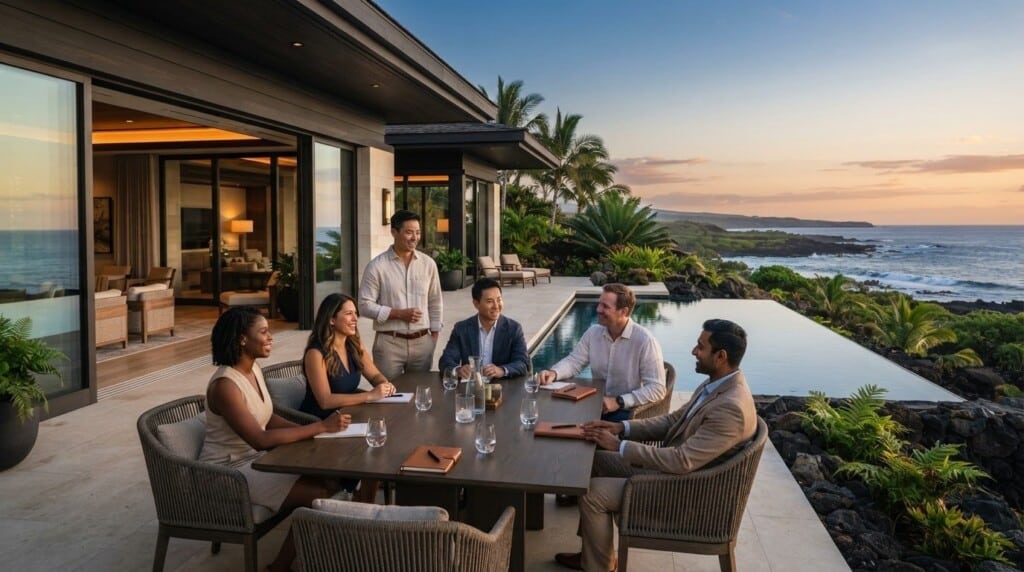

The most practical executive offsite locations in Hawaii depend on what your team needs from the time away. Oahu offers the strongest mix of flight access, hotels, restaurants, and activities, while Maui suits beach-focused retreats, Kauai brings a nature-led setting, and the Big Island pairs outdoor adventure with a quieter pace. Hawaiʻi has more than 50 offsite and outdoor venues across the islands.
Team-building activities and meal plans can reflect your goals, from shared outdoor experiences to focused work sessions. Choose an island and setting that suit the gathering you have in mind, and confirm how meals will be arranged.
This guide compares island settings and venue styles, then covers booking, seasonal timing, and travel logistics. Use it to decide where to host, how to shape the experience, and what to plan before bringing your leadership team together in Hawaiʻi.
Key Takeaways
- Match the island to your retreat’s priorities: Oahu for access and amenities, Maui for beach activities, Kauai for nature, or the Big Island for outdoor adventure.
- Start venue planning three to six months ahead to give your team more choice as you compare settings and fit.
- Choose a workspace based on how your team will use it, from private discussion rooms to larger spaces for presentations.
- Consider April to June or September to November for your retreat, then plan flights and ground travel around your chosen island.
- Use the group’s size, work style, and desired level of seclusion to narrow the venue options before requesting a quote.
Hawaiian island options for corporate offsites
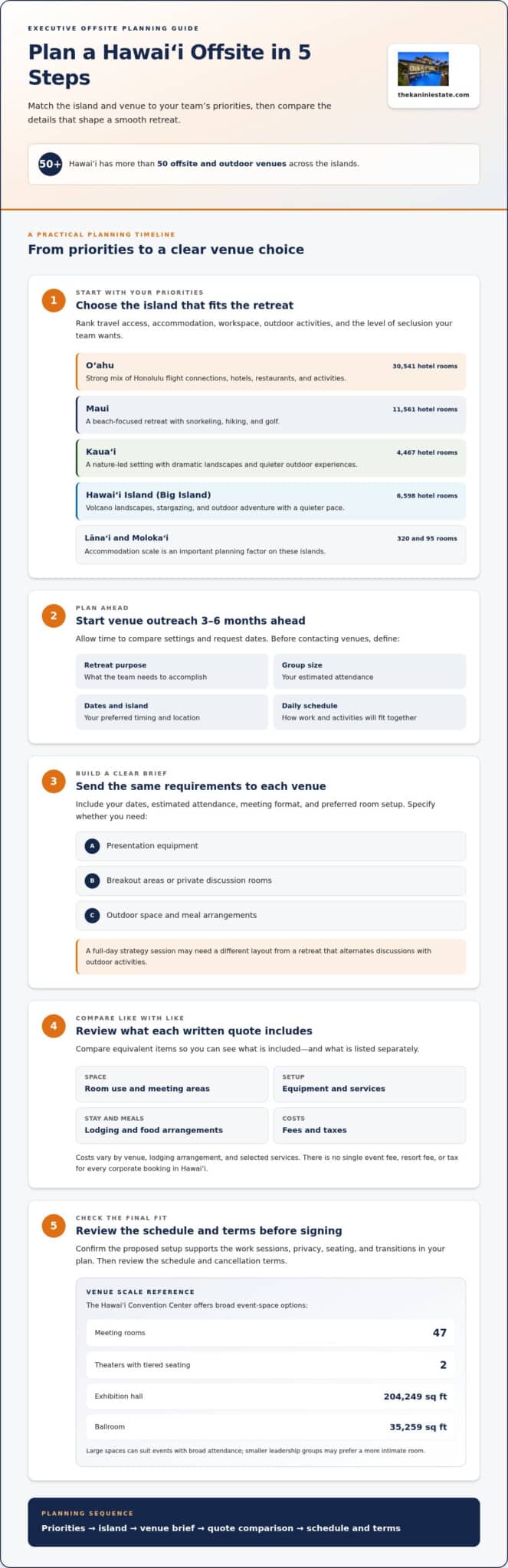
An executive offsite is a planned gathering away from the usual workplace, where leaders focus on decisions, shared priorities, and team direction. Choosing executive offsite locations in Hawaii starts with those goals. Hawaiʻi has more than 50 offsite and outdoor venues, from structured meeting spaces to nature-led settings. Consider how easily the team can arrive, where people will work, and which adventures fit the agenda. The backdrop matters, but so does the rhythm of each day.
Oʻahu is a practical choice for teams that value Honolulu’s flight connections, hotels, restaurants, and activities. The island has 30,541 hotel rooms, giving planners a broad range of accommodation options. Honolulu venues span small meeting rooms for around 10 to 20 people and ballrooms for up to 500 attendees. That range can suit a focused leadership retreat or a larger company gathering. It also gives planners more ways to align the venue scale with the program.
Maui suits a premium beach retreat with time outdoors. Snorkeling, hiking, and golf can complement meeting sessions, giving teams a change of pace between discussions. The island has 11,561 hotel rooms. Kauaʻi, with 4,467 rooms, offers a nature-led setting for groups drawn to dramatic landscapes and quieter outdoor experiences. These islands make the surroundings part of the retreat. Choose Maui for a mix of beach and activity time, or Kauaʻi when nature is central to the team’s experience.
On Hawaiʻi Island, also called the Big Island, volcano landscapes, stargazing, and outdoor adventures shape a distinct offsite experience. Its 6,598 hotel rooms offer a different scale from Oʻahu or Maui. Consider this island when a team wants outdoor exploration alongside focused time away from a busy urban setting. Lānaʻi has 320 rooms, while Molokaʻi has 95, making accommodation scale an important planning factor on those islands.
For Honolulu corporate retreat venues, compare hotels, dedicated meeting facilities, and outdoor spaces by the work each session requires. The Hawaiʻi Convention Center offers 47 meeting rooms, including two theaters with tiered seating. Its exhibition hall measures 204,249 square feet, while its ballroom measures 35,259 square feet. These large spaces suit events with broad attendance, while smaller leadership groups may prefer a more intimate room.
Guest testimonials are most useful when they describe a specific retreat experience, such as the setting, meeting flow, or how a group spent its time. A review of a Honolulu conference, for example, may help you assess whether a formal venue suits your agenda. Treat each account as one perspective and compare it with your team’s goals and preferred pace.
Before choosing, rank priorities such as travel access, accommodation, workspace, and outdoor activities. Compare executive offsite locations in Hawaii against that list. Teams that value urban convenience may prefer Oʻahu, while groups seeking nature and outdoor experiences may lean toward Kauaʻi, Maui, or Hawaiʻi Island.
Venue booking and quote requests
Start contacting venues three to six months before the retreat to allow time to compare settings and request dates. First, define the meeting purpose, group size, preferred island, and daily schedule. Then shortlist venues that fit. A Waikīkī resort may work for teams seeking hotel rooms, meeting space, and nearby activities. An outdoor setting may better suit groups looking for open-air sessions and cultural experiences.
No single event fee, resort fee, or tax applies to every corporate booking in Hawaiʻi. Costs depend on the venue, lodging arrangement, and services selected. Review the written quote and its line items before committing.
Make each quote request specific. Include your dates, estimated attendance, meeting format, and preferred room setup. Explain whether you need presentation equipment, breakout areas, or outdoor space. A leadership group planning a full-day strategy session, for example, needs a different layout from a team alternating discussions with outdoor activities. Clear details help venues suggest relevant options.
Compare Waikīkī hotel and resort venues by the time they save and the experience they offer. A central setting can bring accommodation, meeting rooms, and nearby restaurants together. Request a written breakdown of room use, equipment, food arrangements, service charges, and taxes. Compare equivalent items: a quote that includes meeting essentials is different from one that lists only the room.
Maui resort venues can combine meeting sessions with a coastal setting. Before requesting a quote, decide how much of the retreat should take place indoors and outdoors. If your agenda includes cultural activities or time outside, ask how those elements fit into the schedule. Check that the proposed setup meets your work needs for privacy, seating, and transitions between sessions.
Use this sequence to keep decisions clear:
- Set the dates, attendee estimate, island, and retreat goals.
- Send the same requirements to each shortlisted venue.
- Compare included space, equipment, lodging, services, fees, and taxes.
- Review the schedule and cancellation terms before signing.
For a corporate retreat shaped around a quieter Big Island backdrop, consider this Big Island retreat setting as you compare venue styles. A clear brief makes it easier to judge whether a resort, hotel, or outdoor venue supports your team’s priorities.
Venue workspace and capacity options
Match the venue layout to the work your group needs to do. A leadership retreat may move between full-group discussion, small breakouts, and individual work. Request a floor plan and map each session to a space. For example, hold the main discussion in a private room and use another area for paired planning. A clear flow makes it easier to shift between focused work and informal connection.
Room capacity depends on layout as well as the venue’s stated maximum. Boardroom seating supports conversation; theater seating suits presentations with limited discussion; classroom tables give attendees space for notes and devices. For a workshop, request a setup that lets groups face one another and reach shared materials. A room designed for lectures may be less effective for collaborative planning.
Hawaiʻi Convention Center illustrates how venues can combine formal workspace with outdoor surroundings. Its rooftop garden covers 2.5 acres, offering a landscaped setting for a pause between indoor sessions. Treat outdoor areas as part of the schedule, not as a substitute for the meeting room. A garden can support a short reset or informal conversation, while focused work still needs suitable seating, sound conditions, and presentation space.
For an offsite in Hawaiʻi’s landscapes, choose a workspace that suits the activity. A valley or coastal view can create a memorable backdrop, but account for sun, wind, and noise when planning outdoors. Keep sensitive discussions in a private indoor room. Open-air settings are better suited to lighter conversations, reflection, and group bonding, where the surroundings complement rather than disrupt the agenda.
Before confirming a venue, compare its room plan with your schedule. Share the expected group size and ask how the space can be arranged between sessions. Then review these practical details:
- Conversation: Can every participant see and hear the speaker?
- Breakouts: Is there a separate place for smaller groups to work?
- Materials: Can the room support screens, notes, and shared documents?
- Movement: Can attendees shift between indoor sessions and outdoor breaks easily?
Compare venues by both capacity and purpose. A large hall may suit a presentation, while a smaller private room may better support candid executive discussion. If the retreat involves different kinds of work, look for adaptable spaces instead of expecting one room to meet every need. The right setting can support decisions, collaboration, and time together.
Airport access and island travel logistics
Start by choosing the island, then plan flights and ground transport around the retreat schedule. Most teams fly into Daniel K. Inouye International Airport in Honolulu, airport code HNL. Hawaiʻi has nonstop service from more than 40 global gateway cities, giving many groups a direct route to the state. Your final destination may still require travel beyond Honolulu, so align arrival plans with the island hosting the retreat.
For a Waikīkī meeting, Honolulu Airport is about a 30-minute ride from the hotels and resorts there. That makes Oʻahu a straightforward option for teams whose venue is in Waikīkī. Build the transfer into the arrival plan, and share the destination and transport details with attendees before departure. A clear itinerary helps colleagues move from the airport to check-in without confusion.
When choosing another island, plan the entire journey, not just the first flight. Traveling through Honolulu to a separate island destination requires coordination for connecting flights and onward ground transport. This can affect arrival times, particularly when attendees come from different cities. Ask travelers to share their routes with the retreat planner, then build a schedule that allows for varied arrival times.
Keep the first scheduled session separate from travel time. If executives arrive at different times, for example, use the opening period to settle in rather than start a decision-heavy workshop. This gives everyone time to shift from airport logistics to collaboration. A scenic drive can be part of the island experience, but it is not meeting time.
Before travel, prepare a shared itinerary with:
- Arrival details: List each traveler’s airport and scheduled arrival.
- Transfer plan: State how attendees will reach the venue from the airport.
- Meeting location: Give the venue name and island clearly.
- Schedule: Separate travel, arrival, and work sessions.
For leaders flying into HNL, Waikīkī’s approximate 30-minute airport ride can make central lodging and meetings easier to coordinate. For teams choosing a different island, compare the complete route with the retreat agenda before setting the first session. The most beautiful destination supports better collaboration when the travel plan leaves enough space for people to arrive, settle, and focus.
What are the best Hawaii offsite locations for groups of 10-50 executives?
For a group of 10 to 50 executives, the best fit depends on how the team will work. Oʻahu suits groups that value city access and a wide choice of meeting formats. Maui suits a beach-centered retreat with outdoor activities. Kauaʻi offers a nature-led setting, while Hawaiʻi Island brings volcanic landscapes and outdoor adventure. Choose the island that supports the agenda, not just the arrival photograph.
Start with the meeting style. A 10-person leadership team may need privacy and room for candid discussion more than a large presentation space. A group closer to 50 may benefit from a main meeting room plus space for breakouts. Ask venues to describe the room setup for your actual schedule. Capacity alone won’t show whether a space supports debate, planning, or smaller working groups.
For Oʻahu, compare hotel meeting rooms and dedicated conference spaces around Honolulu. Some Honolulu venues have small meeting rooms for around 10 to 20 people, which can suit a compact executive group. For a larger team, ask how the venue can arrange seating and breakouts. A room that works for a presentation may not serve a collaborative workshop equally well.
Maui may suit a group looking to balance meetings with snorkeling, hiking, or golf. Schedule work sessions first, then choose activities that match the retreat’s pace. Kauaʻi may appeal to executives who want nature woven into the experience, while Hawaiʻi Island can offer shared outdoor adventures beyond the meeting room. Each island creates a different feel, so match the choice to your team’s goals.
Use these steps to narrow the shortlist:
- Set the group size: Plan for the expected attendance, not the maximum invite list.
- Define the work: Separate presentations, private discussions, and breakout sessions.
- Choose the setting: Compare urban convenience, beach time, nature, and adventure.
- Review the flow: Consider how attendees move between lodging, meetings, and activities.
For a group of 10 to 50, a resort may suit teams seeking structured meeting space and nearby amenities. A private vacation rental can better fit a leadership group seeking a shared setting and fewer daily distractions. Consider a Big Island retreat setting if your team wants a private rental as its base. Compare each option against the agenda, desired privacy, and the time reserved for the team together.
The Kanini Estate: Luxury vacation rental on the big island of Hawaii
The Kanini Estate is a luxury vacation rental on the Big Island, located in the gated, oceanfront community of Naupaka at Waikoloa. It offers teams a private, distraction-free setting for focused discussion, shared time, and a retreat away from routine. Rather than a conventional conference venue, the full-property rental gives leaders room to work and spend time together.
Choose this setting when your retreat priorities lean toward privacy and a change of scene, rather than a large conference program. It also offers a place to enjoy time with friends and family beyond work gatherings. The Big Island’s ocean views, sunrise, and sunset create a memorable backdrop for the stay.
Explore The Kanini Estate for your retreat and take the next step by submitting a booking request.
Shape the retreat around the work that matters
Before choosing a venue, agree on what your leadership team should take away: a decision, shared direction, or stronger connection. That purpose can guide your choice among executive offsite locations in Hawaii, from the meeting format to the pace between sessions.
The Kanini Estate combines a luxury Big Island vacation rental with privacy and space for groups to spend time together. For a leadership retreat, it can offer room to step away from routine and focus on conversation. Choose a setting that reflects your team’s priorities, rather than simply building the most impressive itinerary.
Consider whether this private setting suits the way your group wants to work and spend time together. Explore The Kanini Estate for your retreat as you shape the next gathering. A thoughtful setting can help your team return with fresh perspective and a stronger sense of shared purpose.
Frequently Asked Questions
Can I customize the retreat experience with team-building activities and catering?
Yes. Shape the schedule around your goals, preferred activities, and work sessions, such as pairing focused planning with a shared recreational activity. Arrange meals separately: The Kanini Estate is a private vacation rental and does not provide on-site commercial catering. Plan food alongside the retreat activities and meeting agenda.
What amenities do these properties offer for work sessions during the retreat?
Match a property’s work features to your agenda. The Kanini Estate has high-speed internet for connected work, as well as a game room and full in-home gym for time outside formal sessions. If your team needs presentation equipment, breakout rooms, or a dedicated meeting space, account for those requirements when choosing a venue. A vacation rental can support a retreat without serving as a conference facility.
What are the best executive offsite venues in Hawaii?
The best venue depends on whether you need a formal meeting setup, shared accommodation, or a private retreat atmosphere. Hotels and conference facilities suit agendas built around dedicated meeting rooms. A full-property vacation rental may suit a group seeking privacy and time together. The Kanini Estate is a luxury rental with a distraction-free setting for corporate retreats, not a conventional event venue.
Which Hawaiian islands are best for an executive offsite?
Choose an island that fits your team’s priorities and preferred pace. Oʻahu may suit groups focused on city access; Maui offers a beach-oriented setting, while Kauaʻi can fit nature-focused plans. Hawaiʻi Island may appeal to teams seeking outdoor experiences and a quieter retreat rhythm. Consider how the atmosphere, travel connections, and planned activities support the outcomes your leaders want.
How much do executive offsite venues in Hawaii cost per night?
Rates depend on the property type, dates, length of stay, group size, and what the booking includes. For The Kanini Estate, rates vary by season, and published rates apply to a maximum of 12 guests. Request a quote to understand the applicable total and included terms. Compare lodging with any separate costs for meeting space, activities, transportation, or food before setting your retreat budget.
Which Hawaii venues offer private meeting spaces and team-building activities?
Hotels and dedicated conference venues may offer private meeting rooms; activity options depend on their location and arrangements. A vacation rental offers a different format. The Kanini Estate provides a private setting with high-speed internet, a full in-home gym, private pool, hot tub, and game room. These amenities can support time together, but the property is a rental, not a dedicated meeting-space or event venue.
What are the risks of planning an executive offsite during Hawaii’s rainy or hurricane seasons?
Key planning risks include weather-related changes to outdoor activities and travel disruption. Build flexibility into the schedule: hold essential discussions indoors and keep outdoor plans adaptable. Share the itinerary with attendees, including meeting locations and transport details. If the retreat depends heavily on outdoor activities, identify an indoor alternative that can keep the group’s plans on track if the weather changes.