
A beautiful setting can invite connection, but it can’t build a stronger culture on its own. The most useful case studies of successful corporate retreats show how thoughtful activities, the right length of stay, a well-matched location, and a comfortable group size can shape what people carry back to work.
A retreat is more than time away from the office. It gives colleagues space to speak beyond their usual roles, share ideas, and build relationships that can make everyday collaboration feel more natural. It works best when its design reflects the team’s needs and company culture.
Here, you’ll see how real retreat examples connect setting and structure with outcomes such as engagement, communication, productivity, and professional relationships. We’ll look at what different teams did, why the choices mattered, and what to consider when planning a retreat that feels purposeful as well as restorative.
Key Takeaways
- Shape retreat activities around employees’ needs and the culture you want to strengthen, balancing shared experiences with time to reflect.
- Use a multi-day format to make room for meaningful conversations and social connection, not just scheduled sessions.
- Set clear goals before the retreat, then assess communication, engagement, and productivity afterward.
- Create natural opportunities for colleagues across teams to meet and build professional relationships.
- Choose a location and group size that support the kind of connection, focus, and participation your team needs.
Customizing activities to employee needs and company culture
What activities and formats work best for corporate retreats? Choose activities that match employees’ needs and the culture the company wants to build. A balanced agenda might combine team challenges and skill-building workshops with restorative experiences, quiet time, and opportunities for discussion.
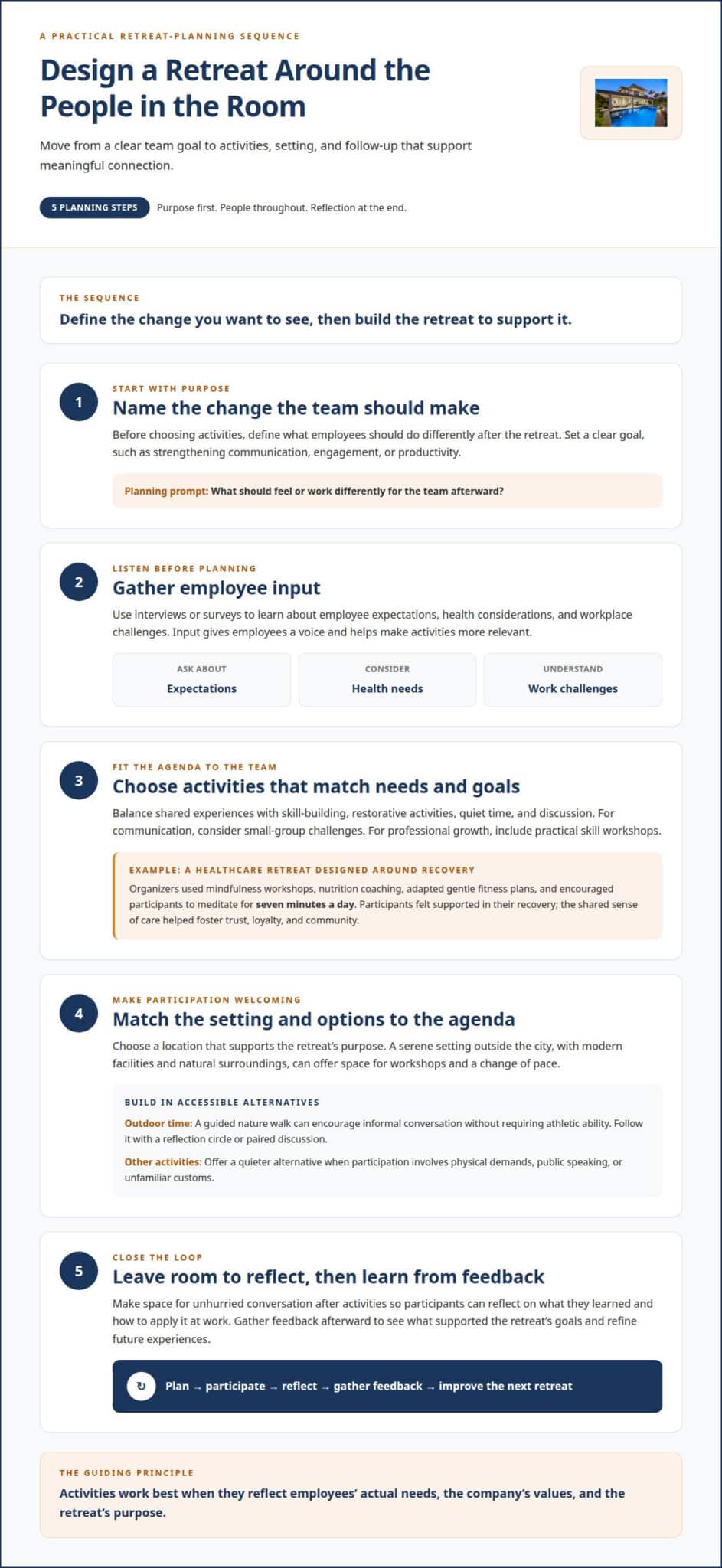
What steps should organizers follow to plan a successful corporate retreat? First, define the change the team should make after the retreat. Then gather employee input, choose suitable activities and a fitting location, and leave room in the agenda for meaningful conversation.
A healthcare retreat designed around recovery
Situation: Employees facing health challenges, including cancer recovery, needed a retreat that respected varied abilities. A demanding fitness schedule could have excluded participants rather than helping them connect.
Action: Organizers tailored the experience with mindfulness workshops, nutrition coaching, and adapted gentle fitness plans. Participants were also encouraged to meditate for seven minutes a day.
Result: Participants felt supported in their recovery. This shared sense of care helped foster trust, loyalty, and a stronger sense of community within the company.
This example shows why activities should reflect employees’ actual needs, rather than assumptions about what a team enjoys. Interviews and surveys can reveal expectations, health considerations, and workplace challenges before organizers shape the agenda. They also give employees a voice in planning, helping activities feel more relevant and encouraging participation.
Build a thoughtful, inclusive agenda
Let the retreat’s goal guide each choice. To strengthen communication, create small-group exercises in which colleagues solve a shared challenge. For professional growth, schedule practical skill workshops. Allow time afterward for unhurried discussion, so participants can reflect on what they learned and how to apply it at work.
Outdoor experiences can add movement and shared discovery. A guided nature walk, for example, can encourage informal conversation without requiring athletic ability. Follow it with a reflection circle or paired discussion. This rhythm gives the group energy as well as room to process the experience.
Local cultural experiences can also help a group connect with its destination. Consider a guide-led introduction to regional history, food traditions, or local crafts. Make participation welcoming by offering a quieter alternative when an activity involves physical demands, public speaking, or unfamiliar customs. Thoughtful choices respect both the place and the people taking part.
Finally, choose a location that supports the agenda. A serene setting outside the city, with modern facilities and natural surroundings, can provide both space for workshops and a change of pace. Match the activities to employees’ abilities, the company’s values, and the retreat’s purpose. Then use participant feedback afterward to refine future experiences.
How Does a Multi-Day Retreat Build Culture and Engagement?
A multi-day retreat gives employees room to talk, reflect, and connect beyond scheduled sessions. Company offsites often happen once or twice a year, so planned social time can help sustain relationships between gatherings.
In-person retreats bring colleagues together in one shared setting. Hybrid formats combine in-person sessions with remote participation, while virtual retreats rely on online meetings and planned informal breaks. The right format depends on where employees work and how they can participate.
Retreat examples across the United States
Situation: Newsela brought 400 employees together during a CEO transition. Action: The company used a retreat to gather employees during a period of change. Result: Participants reported increased job satisfaction and a stronger sense of belonging afterward.
A U.S. law firm’s annual offsites also created opportunities to build relationships across practice groups. Partners who attended formed more connections with lawyers in other groups than with colleagues on their own teams. The example illustrates how shared time can encourage connections beyond everyday work circles.
Only 2 in 10 U.S. employees feel connected to their company culture. Employees who feel highly connected are 4.3 times as likely to be engaged at work. They are also 62% less likely to feel burned out often or always, and 47% less likely to be job hunting. These findings make cultural connection a useful outcome to consider when shaping an offsite.
Legal, accessibility, and safety needs depend on the retreat’s location, activities, and participants. Organizers should account for applicable local requirements, accessible participation, medical needs, transportation, and emergency procedures.
There is no single U.S. cost per employee. Expenses depend on travel, lodging, duration, group size, meals, and activities; pricing is provided after a quote request.
Retreats can lose focus when activities lack a clear purpose or exclude employees. Define the intended change, gather employee input through a survey, and make time for social connection. A follow-up survey can show what supported engagement and what needs adjustment.
For teams seeking a quiet in-person setting for shared work and conversation, explore this distraction-free retreat environment.
Employees highly connected to workplace culture are 5.3 times as likely to recommend their company as a great workplace. The survey about company offsites included 2,000 full-time employees from a range of industries.
The share of companies hosting no offsites fell to 4% in 2024, compared with 16% in 2019. Lawyers who attended an offsite formed about one more new connection per month afterward than those who did not attend. Offsites also helped attorneys form more connections with lawyers in other practice groups than with lawyers on their own team.
Retreat productivity and communication outcomes
A retreat’s value is easier to assess when its purpose is linked to observable changes at work. If the goal is stronger collaboration, track cross-team projects, shared decisions, and communication after the gathering. If the goal is employee engagement, ask whether people felt heard, included, and ready to contribute.
Case study: Pathpoint’s Vail retreat
Situation: Pathpoint wanted better communication between departments and stronger company performance. Action: The company brought its team together for a retreat in Vail. Result: Two weeks after the retreat, Pathpoint broke company performance records, and communication between departments had noticeably improved.
That sequence offers a useful measurement model, not proof that a retreat alone caused every outcome. Before the event, define the business purpose and record current indicators of progress. Afterward, compare the same measures over a planned period. For Pathpoint, performance records and interdepartmental communication were relevant signals because they aligned with the retreat’s stated aims.
Measure wellness and team outcomes
A two-hour team-building meditation retreat calls for a different set of measures. Eight participants took part, and facilitators reported that every participant remained committed to meditation one week later. This follow-up captures a specific behavior rather than relying only on participants’ immediate impressions.
For a wellness retreat, choose measures that fit its purpose. A stress-reduction focus calls for participant feedback about stress and well-being. A fitness focus might track participation and continued activity. For an engagement goal, ask employees whether they feel more connected and supported. Collect feedback soon after the retreat, then follow up to see whether changes last.
Researchers also tracked more than 700 partners at a large U.S. law firm across eight years, from 2005 to 2012. Partners attended or skipped annual retreats, allowing researchers to compare later collaboration patterns. New collaborations on billable work increased after offsites. Attendees also formed more connections across practice groups than within their own teams. This example suggests that professional outcomes can include who works together, not only how much work gets done.
Use a compact evaluation plan to keep results connected to the retreat’s purpose:
- Before: Define the intended change and record relevant engagement, communication, or productivity indicators.
- After: Gather employee feedback through surveys and one-on-one interviews.
- Follow up: Review the same indicators and identify actions that support continued collaboration.
These steps help distinguish a memorable experience from a useful one. If feedback shows employees valued discussion but lacked time to follow through, organizers can reserve time for action planning at the next gathering. This gives employee engagement a clearer path into everyday work.
How company retreats help colleagues build professional networks
A retreat can widen professional relationships by creating time for colleagues to meet outside their usual teams. A study of company retreats found that almost 17% of new working relationships formed afterward continued over the following two years. That lasting connection offers a practical reason to make networking part of the retreat strategy.
A case of relationships that lasted
Situation: Retreat participants formed new working relationships during shared time together. Action: The retreat created opportunities for employees to connect beyond their usual circles. Result: Almost 17% of those new relationships continued over the following two years. The finding points to a useful measure: whether a connection becomes an ongoing working relationship.
Leaders can make these encounters purposeful without turning every moment into a formal exercise. For example, pair employees from different teams to discuss a shared challenge, then invite them to continue the conversation over a meal or walk. The activity gives colleagues a reason to connect, while relaxed time lets discussion develop naturally.
Team-building activities can also help colleagues discover one another’s skills. A cross-functional exercise might ask a small group to solve a fictional customer problem. A designer, analyst, and account lead can each contribute a different perspective, creating a practical starting point for future collaboration.
For a retreat to support lasting relationships, organizers can plan three kinds of connection:
- New introductions: Pair employees from different departments for a short conversation about their work.
- Shared problem-solving: Form mixed groups around a challenge the company already faces.
- Informal time: Leave open space after a session, so colleagues can continue conversations without a facilitator.
Design groups thoughtfully. Avoid keeping every department together throughout the retreat. Rotate partners between sessions and give each group a clear prompt. A question such as “What does your team need from other teams to do its best work?” can uncover useful connections and shared needs.
Follow-up can turn an introduction into a working relationship. After the retreat, invite participants to identify one person they want to work with and one next step. That might be a short meeting, a shared project review, or an introduction to a colleague. Keep the action voluntary and relevant to their work.
Finally, evaluate the result without relying only on attendance or enthusiasm. Ask employees whether they made useful contacts, then review whether cross-team conversations or projects continued. The almost 17% finding offers one example of a longer-term relationship measure. For each retreat, define the outcome first, then choose a follow-up that makes continued connection easy.
Retreat locations and group sizes
A retreat’s setting and group size affect how the agenda works in practice. Larger gatherings can bring employees together around shared priorities, while smaller groups allow for more direct conversation. Choose a location that supports the purpose: focused work needs suitable discussion spaces, while a social agenda benefits from room to gather informally. Consider these needs before settling on a format.
Large gatherings need smaller circles
Situation: Webflow planned a 2026 kickoff retreat for over 650 team members. Action: It brought the group together for a company-wide gathering. Result: The event created a shared occasion for a large team. At this scale, organizers can pair full-group sessions with smaller conversations, so employees have room to contribute and exchange ideas.
Equativ’s first global gathering brought 570 team members together, while EvenUp Law held a retreat for 365 employees. These examples show the range of group sizes companies bring to offsites. For large groups, organizers can use a main session to share common context, then break into smaller circles for discussion. Clear prompts help keep those conversations focused.
Choose a setting that supports the work
Situation: Salesloft planned a retreat for almost 400 employees. Action: The company held a three-day gathering. Result: The team had a defined period to meet in person. A multi-day schedule at this scale needs deliberate pacing, with time for shared sessions as well as smaller conversations.
Group size also affects the location’s practical demands. A team of 570 needs enough space for everyone to meet, while cross-functional discussions call for smaller breakout areas. A group of almost 400 may benefit from rotating discussion groups, so employees can hear more than one perspective. The best layout depends on the agenda, not just the headcount.
Use a simple planning sequence: estimate attendance, identify the largest planned gathering, then map spaces for smaller sessions and informal conversation. Consider travel needs and the setting’s role in the retreat. A quiet environment can support focused work, while shared spaces can make informal connection easier. These choices help the location serve the gathering rather than dictate it.
For a focused setting that gives teams space to work and connect, explore a private estate for team gatherings.
The Kanini Estate: High-quality, distraction-free thinking environment for corporate retreats
The Kanini Estate provides a high-quality, distraction-free environment for corporate retreats. Its ocean views and calm surroundings give teams room to focus on meaningful conversation, shared ideas, and time together away from everyday demands.
Choose The Kanini Estate when your retreat calls for focused work alongside a restorative escape. This luxury vacation rental gives groups a private setting to gather, reflect, and enjoy time together.
Contact The Kanini Estate to discuss your corporate retreat.
Shape your next retreat around what comes after
A retreat’s value can carry into the choices a team makes after returning to work. Consider what you hope will feel different in the weeks ahead, whether that means more open conversation, renewed focus, or a stronger sense of shared purpose. Let that intention guide the setting and the time your team spends together.
The Kanini Estate offers groups a calm setting in which to think and reconnect. A change of pace can help colleagues step back from familiar routines and give fresh ideas room to surface. Choose a place that supports the conversations your team wants to carry forward.
Contact The Kanini Estate to discuss your retreat plans. A thoughtful gathering can be the beginning of something lasting.
Frequently Asked Questions
How can I tailor activities to my team’s needs?
Offer activities that reflect different energy levels, work styles, and comfort zones. For example, pair a hands-on problem-solving session with a quiet reflection option instead of making every activity highly social. Give employees a choice in how they participate, such as speaking in a small group or sharing written ideas. This helps make the retreat relevant to more people while keeping activities connected to the team’s purpose.
How long should an effective company retreat last?
An effective company retreat should last at least two days and one night. This gives the group time to move beyond formal sessions and have less structured conversations. Use the first day to set shared priorities, then leave room for discussion and connection. The second day can focus on turning ideas into next steps. The agenda matters as much as duration, so avoid filling every moment with scheduled activities.
What are examples of successful corporate retreats and their outcomes?
Several case studies of successful corporate retreats show how activities can serve distinct goals. One technology company held a wellness retreat featuring daily yoga, guided meditation, and sound healing. Employees reported reduced anxiety, improved focus, and greater mental clarity afterward. A marketing firm used group exercise, fitness competitions, and nutrition seminars. Employees adopted healthier routines and reported stronger morale and collaboration across teams.
How did companies plan and structure successful corporate retreats?
Successful planning starts by defining what the team should change after the retreat. Organizers can then shape the agenda, coordinate practical needs such as transportation and accommodation, and prepare for changes on-site. A skilled facilitator can read group dynamics, adjust the pace, and step in when discussion stalls. If a session uncovers a difficult issue, for example, the facilitator can make room for thoughtful conversation instead of rushing to the next activity.
What goals did successful corporate retreats achieve, and how were results measured?
Case studies of successful corporate retreats often link clear goals to observable signals. Goals might include stronger collaboration, better communication, improved well-being, or clearer shared priorities. A team seeking clearer priorities, for example, could review whether project plans reflect decisions made during the retreat. A wellness-focused group could gather employee feedback about energy and stress, then use those insights to guide future planning.
How do corporate retreats improve team building, communication, or employee engagement?
Retreats create shared experiences that can make it easier for colleagues to approach one another afterward. A cross-functional group might work through a realistic client scenario, then discuss how each role contributes to a solution. This helps employees understand who can support future work. Informal conversations between sessions can also make later questions feel more natural, supporting communication and a stronger sense of involvement.