


The most useful board retreat setting may be quieter and more intimate than a formal conference room. A board of directors retreat venue in Hawaii might be a dedicated meeting room, a ballroom, or a private setting. A full-property rental means reserving an entire property for one group rather than sharing it with other guests.
Look beyond the view when comparing venues. Privacy, meeting space, lodging, travel logistics, and the total cost all help determine whether a setting suits the board’s needs.
This guide explains how to compare meeting space, overnight stays, privacy, costs, and full-property rentals, then plan dates and registration. Use these practical criteria to choose a setting that supports focused work and an unhurried stay.
Key Takeaways
- Match the setting to the board’s priorities: focused discussion, privacy, convenient travel, or room for a larger gathering.
- Build a realistic budget by weighing meeting space, lodging, travel, and the format of the retreat together.
- Set dates and registration plans around the group’s stay, and align the proposal with the retreat’s goals.
- Consider whether a full-property buyout suits the group’s need for a more private, shared environment.
- Compare Hawaii venues by how well their setting and accommodations support the work, not just by appearance.
Venue privacy, distance, and meeting space
Travel access varies by property, so compare the arrival airport, ground transfer, and final route. Weigh privacy, meeting layout, lodging, and the board’s agenda when choosing a board of directors retreat venue hawaii.
Venue Privacy and Travel Distance
Privacy depends on how the group uses a property, not just its setting. Review shared entrances, nearby activity, and whether other groups use the same meeting areas. Map each attendee’s route from the arrival airport, including transfers and the final drive. A more secluded setting may offer greater separation but require more coordination for arrivals.
Venue Capacity and Meeting Spaces
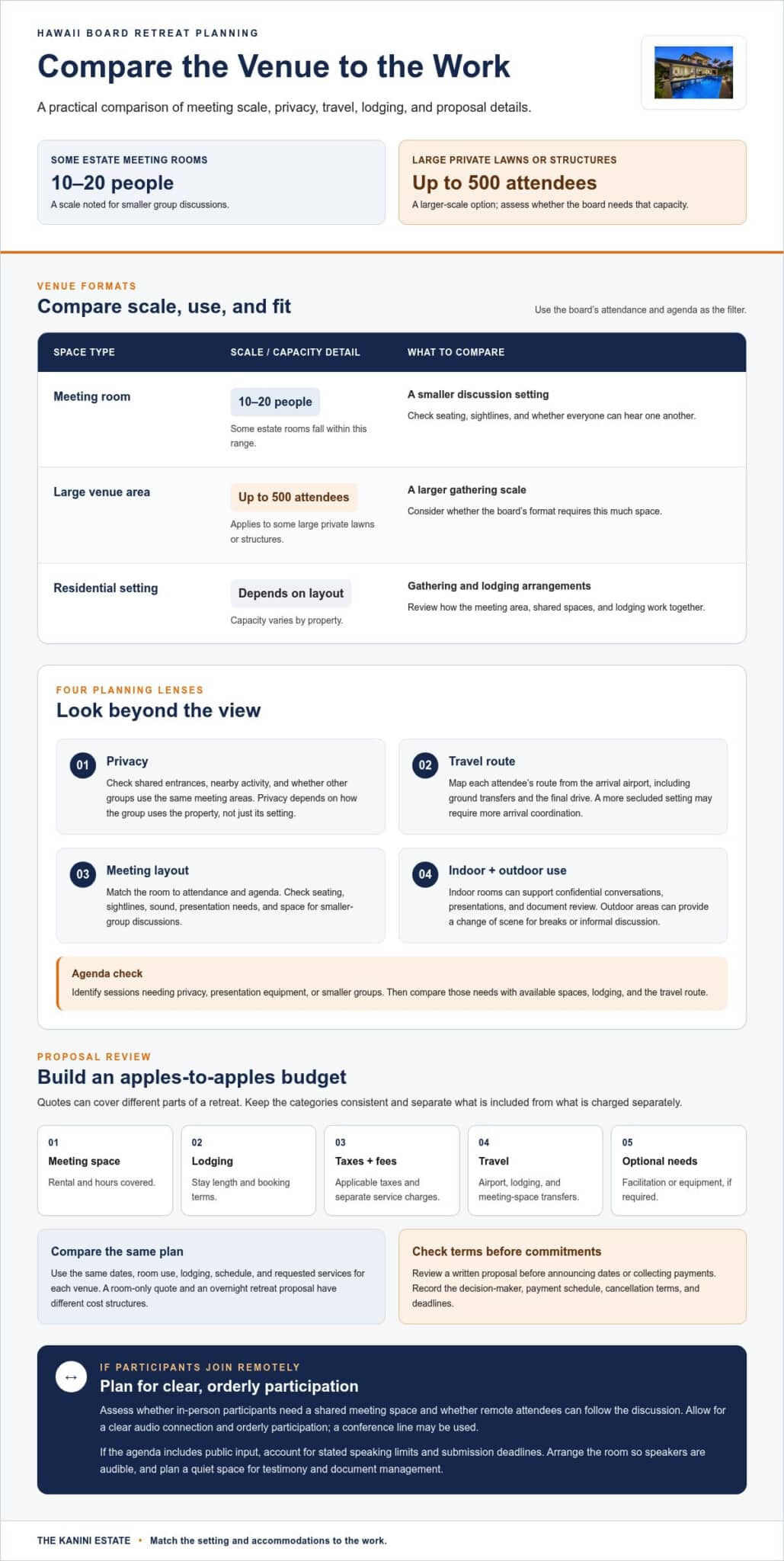
Match the room to the board’s format and attendance. Some estate meeting rooms suit groups of 10 to 20 people, while large private lawns or structures can hold up to 500 attendees. The table shows how scale can guide an initial comparison.
| Space type | Capacity detail | Useful consideration |
|---|---|---|
| Meeting room | 10 to 20 people in some estate rooms | Suited to smaller group discussions |
| Large venue area | Up to 500 attendees | Consider whether the board needs that scale |
| Residential setting | Depends on the property’s layout | Review gathering and lodging arrangements |
Check seating, sightlines, and whether everyone can hear one another during discussion.
Indoor and Outdoor Event Spaces
Indoor rooms provide a defined space for confidential conversations, presentations, and document review. Outdoor areas can offer a change of scene for breaks or informal discussion. For example, keep sensitive agenda items indoors, then move casual conversation outside. Check that the schedule works in both spaces.
Depending on the layout, luxury accommodations may place sleeping areas close to shared gathering spaces. Check the route between lodging, the main meeting area, and any quiet spaces for reflection or preparation. A board member preparing remarks, for example, may appreciate a calm spot away from group activity.
Map the agenda to the venue before choosing. Identify sessions that need privacy, presentation equipment, or smaller groups, then compare those needs with the available indoor and outdoor spaces, lodging, and travel route. This review helps organizers select a setting that supports focused work and comfortable transitions.
For a board meeting designated as virtual, organizers should also assess whether a physical meeting space is needed for participants who gather together, and whether remote attendees can follow the discussion. A board meeting can be scheduled for a fixed window, which helps determine whether a venue is needed for the full session or only for preparation and follow-up. The meeting could be joined by calling a conference line in the United States, so any venue plan should leave room for a clear audio connection and orderly participation.
If the agenda includes public input, account for any stated limits and submission deadlines when planning the session. Oral testimony at a formal board meeting may be limited by time per testifier for each agenda item. Written testimony received after the board packet is issued should arrive well in advance to be included in the packet. A quiet space for testimony and a reliable document-management process can support an orderly session. Arrange the room so speakers are audible to participants. These details matter whether members attend together or connect remotely.
Budget and proposal fit
Venue rules, taxes, and service fees depend on the booking terms. Before approval, compare itemized proposals and separate venue rental, lodging, taxes, and service charges.
Start with the meeting space. These figures reflect different venue scales, not a standard package.
For a board of directors retreat venue in Hawaii, proposal details matter as much as the headline total. One quote may cover meeting space alone, while another may address more of the retreat’s needs. Compare the same dates, room use, lodging, schedule, and requested services. Note what each proposal includes and what it charges separately.
Build a comparable budget
Use one worksheet for every venue. Keep the categories consistent so the board can see what shapes each total:
- Meeting-space rental and the hours covered
- Lodging, stay length, and booking terms
- Applicable taxes and separately listed service fees
- Travel between the airport, lodging, and meeting spaces
- Optional needs, such as facilitation or equipment
For example, compare a room-only quote with a proposal that includes overnight lodging, separating the costs before weighing totals. A day-use plan and a residential retreat have different cost structures.
Check proposal fit before committing
Match each proposal to the board’s purpose and schedule. A focused planning session may need daytime meeting space; a longer retreat also needs lodging and shared spaces throughout the stay. Record expected attendance, agenda format, arrival plan, and privacy needs, then identify gaps between the board’s plan and each proposal.
Before announcing dates or collecting payments, secure a written proposal and review its booking terms. An inquiry alone does not hold dates. Record the decision-maker, payment schedule, cancellation terms, and deadlines in the planning notes. For a board of directors retreat venue in Hawaii, this gives members a clear basis for comparing options and approving the plan.
For a board seeking a quieter setting than a conventional meeting room, include a private Big Island retreat setting in the venue review.
Use a written proposal to check a venue’s offer against the retreat plan instead of relying on an inquiry or an unitemized estimate. Wait for the proposal before advertising retreat dates or collecting guest payments. This keeps public commitments and payment requests aligned with terms the board can review. Confirm that the document identifies the space, lodging arrangement, schedule, and services under consideration, and note unresolved items before seeking approval.
Use the review to distinguish a workable fit from a price that looks attractive only because key needs remain unaddressed. Consider whether the proposal supports the agenda, attendance, privacy, and arrival plan, as well as its stated costs and booking conditions. If details are unclear, seek clarification and update the comparison before deciding. Keep the written terms with the planning notes so the approved choice can be traced to the proposal reviewed. This gives the board a deliberate basis for proceeding, revising the plan, or comparing another setting.
Board retreat cost and lodging
Retreat costs depend on duration, venue, lodging, and facilitation. Compare the full stay, not just the meeting-room charge.
Board Retreat Costs
An overnight retreat with professional facilitation typically costs in the mid four to five figures. These estimates describe different formats, so compare the schedule and included services before weighing totals.
Duration affects more than the room booking. One full day works for most board retreats, while a day and a half with an overnight can suit difficult topics or boards whose members don’t know one another well. Three days is almost always too long for a board retreat. Match the schedule to the work instead of adding time without a clear purpose.
Use a simple cost plan to make the board’s decision easier:
- Separate venue, lodging, facilitation, and travel expenses.
- Record which costs are shared and which attendees pay individually.
- Compare a one-day schedule with an overnight format.
- Set aside time to review the proposed agenda against the planned stay.
For example, a board choosing between a day meeting and an overnight should compare both budgets against its goals. The longer option makes most sense when shared time supports the work.
Board Retreat Lodging
Lodging shapes how the board moves through the retreat. A planned stay can give members time to arrive, meet, and rest between sessions. Retreat inquiries may ask organizers to choose a stay length, with 2-3 nights offered as an option. Use the agenda and travel plan to decide whether an overnight adds useful time.
Before registration opens, write down the lodging plan and the costs each attendee should expect. Include arrival and departure dates, the number of nights, and how guests will be assigned accommodations. Share these details with the board alongside the meeting schedule. Clear information helps members plan travel without confusion.
A residential format also changes the rhythm of the agenda. A day and a half, for instance, can leave room for an evening conversation before the next morning’s session. Schedule the most difficult agenda item for mid-morning or early afternoon, rather than the final hour. Send the board retreat summary within a week, while decisions and next steps remain fresh.
Full-property buyouts
A full-property rental reserves an entire property for one group during an agreed stay. For a board retreat, it can bring lodging and shared gathering areas together in one setting. Its value depends on how the board will use the privacy. Compare the arrangement with the agenda, group size, and need for shared time.
Map the retreat’s activities to the spaces the group expects to use. Identify where the board will hold formal discussions, take breaks, and continue informal conversations. A full-property rental may suit a board that wants members to stay together between sessions. It may be less useful when attendees need separate locations or the group plans only a short meeting.
Privacy requires clear boundaries. Review which areas are reserved for the group, which are shared, and whether access changes during the stay. Consider how arrivals, housekeeping, and other scheduled activity could affect confidential conversations. Specify the expected use of each area in the written terms rather than assuming “exclusive” explains every detail.
Compare the whole-stay proposal with a meeting-only plan. Include lodging, shared spaces, length of stay, and any separate services the board needs. A full-property rental can bring the setting together, but it doesn’t automatically simplify every part of the retreat. Organizers still need to coordinate travel, registration, the agenda, and any outside facilitation.
Use this review before deciding:
- List the retreat’s sessions and the spaces each one needs.
- Separate private board discussions from informal group time.
- Review the written terms for access, included areas, and stay dates.
- Compare the full-property plan with a room-only or meeting-only arrangement.
- Assign one organizer to share the final schedule and arrival details.
Test the rental against the board’s real priorities. A board handling sensitive planning may value a setting with fewer interruptions. A board with a brief agenda may gain little from reserving spaces it won’t use. Let the agenda guide the decision: if shared time, privacy, and lodging all support the work, a full-property rental may be a coherent format.
Present the decision in terms board members can weigh. Summarize the intended use, boundaries of exclusive access, stay dates, and alternative considered. This concise comparison helps the board approve a setting for its purpose, rather than choosing a full-property rental simply because it sounds more private.
What are the best venues in Hawaii for a board of directors retreat?
The best venue is the one that fits the board’s work, not simply the most impressive setting. Compare a conference room, ballroom, and private residential property by the format each supports. A conference room may suit structured work; a ballroom can serve a larger formal gathering; a private property may suit a board seeking a residential retreat experience.
Start with the board’s purpose. If members need to review detailed materials, prioritize a quiet room with a layout suited to sustained discussion. If the retreat includes presentations for a wider audience, consider a formal meeting space designed for that format. For a board that values informal conversation between sessions, a residential setting may better match the desired pace.
Next, assess practical requirements that could shape the experience. List the equipment, room setup, access arrangements, and meal plan the agenda depends on. A presentation-heavy schedule, for example, needs a different setup from a workshop built around small-group discussion. Include these requirements in the venue comparison instead of choosing by photos alone.
Use this decision sequence:
- Write the retreat’s goals and the decisions members need to make.
- Choose the meeting format, such as discussion, presentations, or workshops.
- List the space, equipment, and lodging requirements that follow from that format.
- Compare each venue’s written proposal against the same requirements.
- Choose the setting that supports the work without adding unused features.
Hawaii offers distinct settings across its islands, so consider the atmosphere the board prefers. A city venue may fit a schedule centered on formal meetings and organized sessions. A more secluded property may appeal to groups seeking fewer outside distractions. Neither is automatically better; consider how the surroundings support the board’s work and time together.
Before selecting a venue, have the board review the proposed schedule alongside the space plan. This helps members spot conflicts, such as a session that needs more privacy or a format that calls for a different setup. A clear comparison gives decision-makers a shared basis for choosing, rather than relying on personal preference alone.
If a private residential setting aligns with the board’s goals, explore a Big Island retreat property as one option.
The Kanini Estate: Luxury vacation rental on the big island of Hawaii
The Kanini Estate is a luxury vacation rental in the gated, oceanfront community of Naupaka at Waikoloa on the Big Island of Hawaii. It provides a private residential setting and a high-quality, distraction-free environment for corporate retreats, suited to focused discussion and time together rather than a conventional meeting-room format.
For boards balancing strategic work with meaningful time as a group, The Kanini Estate offers an escape to paradise. Its shared retreat atmosphere can also suit gatherings centered on connection, including time with friends and family. Consider it when privacy and time together support the board’s goals and preferred pace.
Review the meeting purpose, travel plan, and lodging needs together before choosing a setting. If a residential retreat fits your board’s plans, visit The Kanini Estate’s website to explore the property.
Shape the retreat around what comes next
Choosing a board of directors retreat venue in Hawaii is part of a larger decision: how the board wants to think, connect, and move forward together. Before confirming plans, agree on the retreat’s purpose and the conversations that need room to unfold. A shared intention helps make the setting purposeful, not simply beautiful.
Give the agenda a clear path from discussion to action. Identify the decisions the board hopes to make, who will record them, and how members will carry them into their next meeting. This preparation helps turn quiet moments into useful work, with space for reflection as well as focused conversation.
If a private Big Island setting feels aligned with your group’s plans, contact The Kanini Estate about your retreat. May your gathering create the clarity and connection your board is ready to carry home.
Frequently Asked Questions
What can a hosted group use?
It depends on the property and booking arrangement. At The Kanini Estate, a hosted group can stay together in a full-property rental with space for up to 16 guests. The group can use the private pool and hot tub, gym, game room, and beach access from a gated community. These shared amenities can shape breaks and informal time around the retreat schedule.
What is the average cost per person for a Hawaii board retreat venue?
There isn’t one useful average per-person figure because venue type, stay length, travel, and facilitation change the total. To estimate your group’s share, add the retreat expenses, then divide by the number of attendees. At The Kanini Estate, published rates apply to a maximum of 12 guests and vary by season, so use the booking quote for your dates.
What are the best venues in Hawaii for private, confidential board meetings?
Choose a setting that gives the board private use of its meeting area and limits interruptions from unrelated activity. The Kanini Estate is a full-property rental in the gated, oceanfront community of Naupaka at Waikoloa on the Big Island of Hawaii, with a distraction-free environment for corporate retreats. Plan where sensitive discussions will happen and keep confidential materials within the board’s control.
What are the best times of year to book a board retreat venue in Hawaii?
The best time is when board calendars, attendee travel plans, and the retreat’s purpose align. Set dates around key governance deadlines, then allow time to coordinate travel and registration. Rates vary by season, so timing also affects the budget. Compare the dates that suit your group with the applicable seasonal rate for The Kanini Estate.