
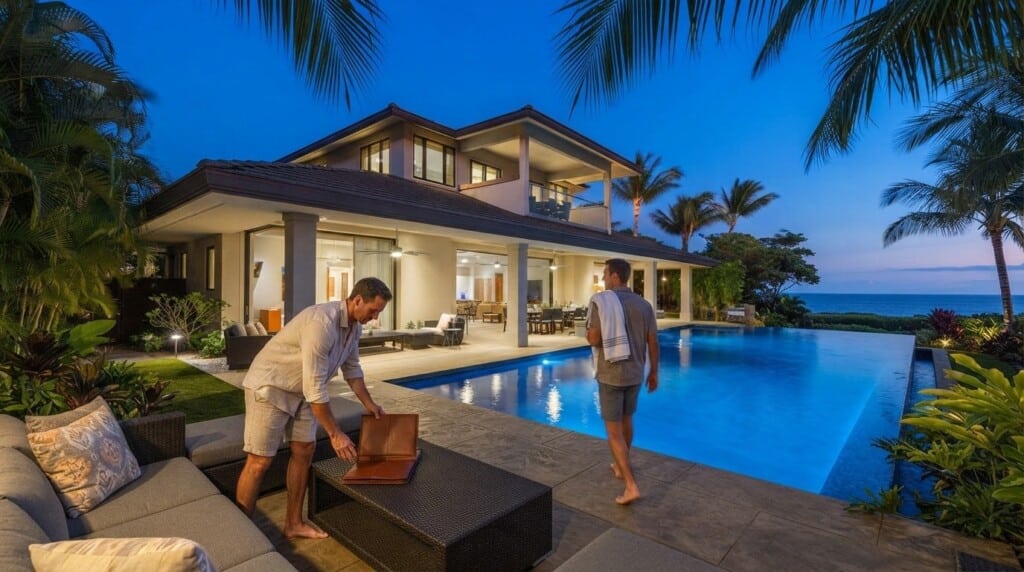

A work trip to Hawaii can leave room for more than meetings. Blending business with leisure in Hawaii works best when you set clear work hours, then give your time off its own space in the itinerary.
It’s natural to want both a productive trip and time to slow down. With a little planning, you can protect focused work hours and still enjoy Hawaii at an unhurried pace.
This guide explains how to add leisure days around work commitments, choose a stay that supports work and relaxation, and set a remote-work routine that doesn’t take over your time away. You’ll also find ways to enjoy the Big Island, from finding a calm setting for calls to saving time for ocean views, sunrise, and sunset.
Key Takeaways
- Separate business commitments from leisure time so work doesn’t quietly fill every day of your stay.
- Consider adding leisure days around your meetings to enjoy Hawaii at a more relaxed pace.
- Choose a stay with spaces and amenities that suit both focused work and time to unwind.
- Set a remote-work routine with clear start and stop times to protect your time off.
- Compare the Hawaiian islands by the setting and pace you want for your work and leisure plans.
Adding leisure days to business trips
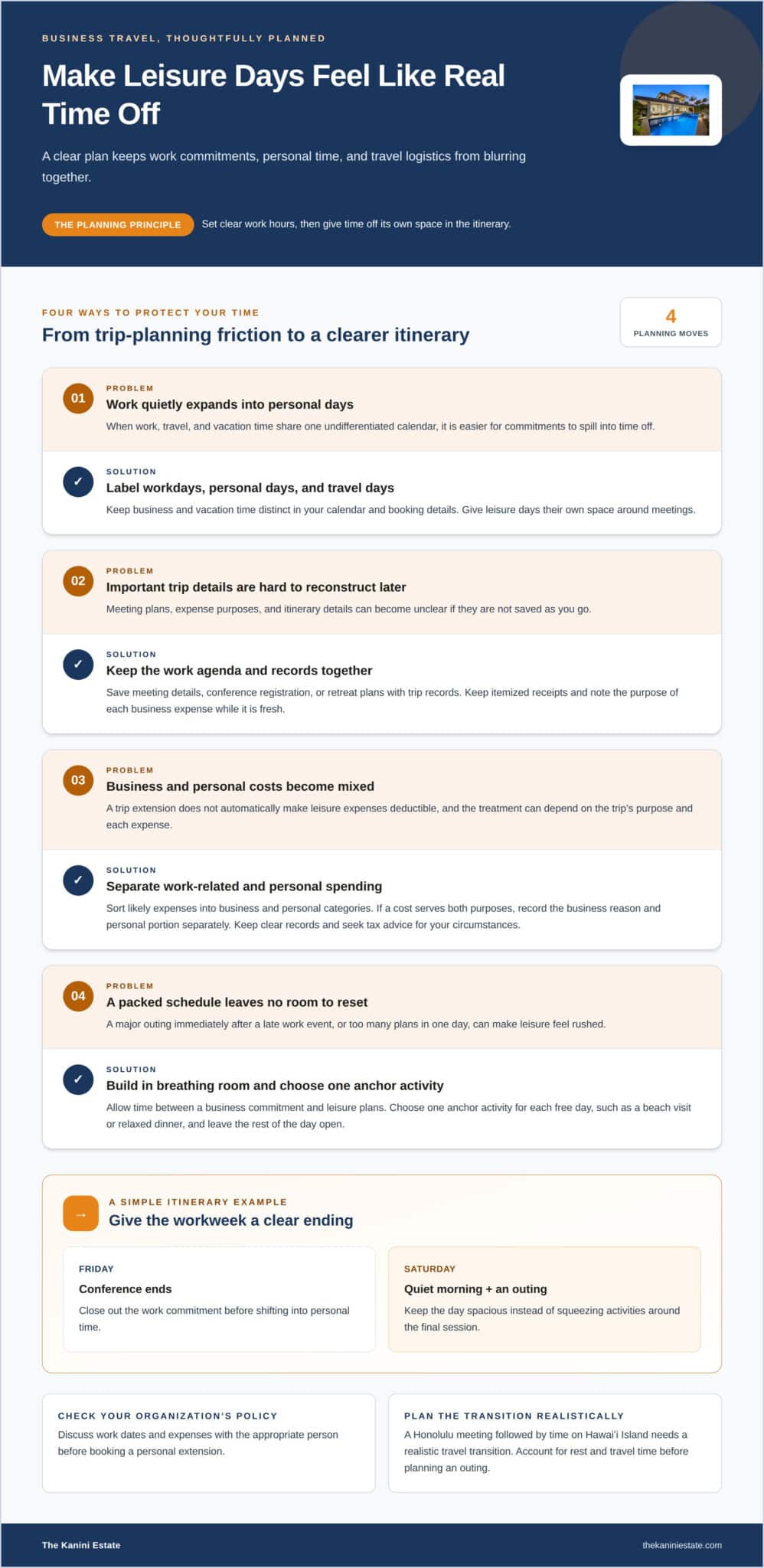
Adding personal days before or after a work commitment gives you time to explore Hawaii without squeezing every experience between meetings. Keep business and vacation time distinct in your calendar, booking details, and expense records. If a conference ends on Friday, for instance, you could reserve Saturday for a quiet morning and an outing instead of trying to fit both around the final session.
For U.S. tax purposes, extending a trip to Hawaii doesn’t automatically make leisure expenses deductible. Keep business and personal costs distinct: expenses that meet applicable business-travel rules may qualify, while personal vacation costs generally remain personal. The treatment can depend on the trip’s purpose and each expense, so keep clear records and seek tax advice for your circumstances.
Start with the work agenda. Mark the dates and locations of meetings, conferences, or retreat sessions, then plan leisure days around them. A Honolulu meeting followed by time on Hawaiʻi Island, for example, requires a realistic travel transition. Avoid planning a major excursion right after a late work event. Rest and travel time both affect how much you can enjoy the day.
Before booking, sort likely expenses into business and personal categories. Save itemized receipts and note the purpose of each business expense while the details are fresh. If a cost serves both purposes, record the business reason and personal portion separately. This creates a clearer record than trying to reconstruct your itinerary after returning home.
- Set the boundary: Label workdays, personal days, and travel days in your calendar.
- Keep the agenda: Save meeting details, conference registration, or retreat plans with trip records.
- Separate spending: Use itemized receipts to distinguish work-related costs from vacation purchases.
- Leave breathing room: Allow time between a business commitment and a leisure activity.
Adding leisure days also changes the trip’s rhythm. A packed schedule can turn a beautiful destination into a backdrop for constant rushing. Instead, choose one anchor activity for each free day, such as a beach visit or relaxed dinner, and leave the rest of the day open. On Hawaiʻi Island, this gives you time to enjoy the landscape without treating time off like another work agenda.
A personal extension of a business trip needs to fit your employer’s travel policy as well as your own schedule. Discuss work dates and expenses with the appropriate person at your organization before booking. When the work portion is planned and personal costs are kept distinct, leisure days can feel like genuine time away, not an ambiguous add-on.
Blended work and leisure travel
A blended trip brings work commitments and personal time into one itinerary. To plan blending business with leisure in Hawaii, start with your meeting location and give leisure activities their own space. Respect local customs, prepare for changing weather, and follow posted ocean and trail guidance. Conditions vary across the islands, so keep outdoor plans flexible.
Choosing an Island for Business and Leisure
Choose an island by matching your work location and preferred setting for leisure. Extra transfers can take time from both work and rest. Oahu may suit a schedule centered on Honolulu, while the Island of Hawaii offers a different pace and varied landscapes. Maui and Kauai may suit other plans, depending on meeting locations and preferred activities.
Start with the fixed point: your office, conference, or retreat. Then consider nearby leisure options instead of adding another island around a short free window. A Honolulu meeting followed by an afternoon at a nearby beach, for example, can keep the day simple. On the Island of Hawaii, plan activities around where you’re staying. Don’t assume every outing is close.
Local Customs for Bleisure Travelers
Local customs are everyday ways to show respect for people, place, and culture. Tourism affects host communities as well as visitors, so treat sacred and cultural sites with care, follow posted access signs, and ask before photographing people or private spaces. Learning place names and using them thoughtfully can help you approach each visit with respect.
Weather can differ from one location to another, so keep outdoor plans flexible. Pack for sun and rain, and adjust a hike or beach visit if conditions change. For ocean activities, follow posted warnings and local guidance. Don’t enter the water when conditions appear unsafe. On trails, stay on marked paths and carry water. A flexible plan helps you avoid rushing to keep up with your itinerary.
For travelers blending business with leisure in Hawaii, thoughtful pacing matters as much as the destination. Leave space between calls and cultural visits. Rather than treating a sacred site as a quick photo stop, take time to understand its significance and follow local guidance. Arrive promptly for meetings, listen to your hosts, and let the island’s rhythm shape your time off.
For a stay based on the Island of Hawaii, consider a Big Island luxury vacation rental as a setting for focused work and time away. A considered home base can help you keep work grounded while leaving room to experience the island at a natural pace.
That broader context matters when planning a visit. Hawaii’s travel and tourism industry is described as the state’s largest economic driver and a cornerstone of community livelihoods. The Travel & Tourism Policy Committee supports technology and AI adoption to improve tourism business efficiency, forecasting, visitor flow management, and global market access. It also supports streamlining permitting and administrative processes to improve business certainty, resilience, and long-term competitiveness across Hawaii’s visitor industry.
For a cultural dimension, Sig Zane Designs, Manaola, and Kealopiko are Native Hawaiian fashion businesses whose work draws on genealogy, symbolism, and stories of place.
Hotel amenities for productivity and relaxation
The cost of a Hawaii bleisure trip depends on your departure city, travel dates, stay length, lodging, meals, local transport, and activities. Estimate each category separately, then compare options with your work schedule and chosen island.
Amenities for Productivity
Productivity amenities make it easier to focus during your stay. Stable internet, a suitable work surface, and a supportive chair can help you handle calls and reports without turning a dining table into a full-time office. If you lead video meetings, for example, a quiet room may matter more than a grand lobby.
Think through a typical workday before choosing where to stay. Your laptop, charger, notebook, and headset need space and accessible power. A separate work area can also help signal when the workday begins and ends. If you expect calls, consider how room noise, shared spaces, and daylight may affect concentration.
- For video calls: Choose a private, quiet place with a suitable background.
- For focused tasks: Look for a stable work surface and comfortable seating.
- For long sessions: Consider natural light and easy access to power.
- For changing plans: Keep a portable charger and headphones with your work kit.
Amenities for Relaxation
Relaxation amenities help you unwind outside work hours. A pool, hot tub, gym, garden, or nearby beach can create a clear change of pace. A restorative break feels different from simply working in another setting. For instance, a swim after a morning of calls can mark a natural end to your workday.
Match amenities to the way you actually relax. If you enjoy quiet mornings, you may prefer a private outdoor area; if you like to stay active, look for exercise space. If beach time is important, consider how easily it fits between meetings and dinner. Amenities work best when they support your routine rather than add another plan to manage.
Balance matters more than collecting features. Start with the work needs you can’t compromise on, then choose comforts that make time off feel distinct. A remote worker with back-to-back calls may prioritize a quiet room, then unwind in a garden or hot tub. Someone who checks email only occasionally may prefer easy access to outdoor recreation.
Before booking, map out one workday and one free evening. Note where you’ll take calls, keep your equipment, and unwind afterward. This simple comparison can show whether a stay supports both parts of your trip, rather than offering appealing amenities that don’t fit your plans.
Survey findings also underline why a work-and-rest routine can matter: In the Crowne Plaza Hotels & Resorts and Stylus survey, 60% of US respondents planned to add leisure days to upcoming business trips, and 80% of current business travelers worried their professional careers and personal lives would suffer if they did not travel more. The survey included 3,000 respondents.
Hawaii’s trade-ready capacity focus promotes performance-based grants for manufacturing and production capacity, automation, and facility upgrades, using private-sector matching funds. Keeping work needs and time off distinct can help you assess whether a stay suits both parts of your trip.
Remote work and work-life balance
Remote work in Hawaii works best with a defined schedule, a reliable connection, and clear boundaries. Internet speeds and connectivity options vary by location, so plan around your lodging’s Wi-Fi and use cellular data or a hotspot as backup where service allows. For mainland meetings, include Hawaii local time in each invitation and agree on shared work hours.
Set your workday before choosing leisure plans. For example, reserve mornings for calls if that suits your team, then protect the afternoon for personal time. If colleagues need later meetings, group them into a defined window instead of letting messages stretch across the day. A calendar that labels work blocks and time off makes the boundary clear to everyone.
Remote work can support balance, but only when flexibility has structure. In a survey, 75% of respondents said remote work made work-life balance achievable. Another 66% said work flexibility made them more productive. These findings point to a useful distinction: flexibility helps when it gives you control over where work fits, not when every hour stays open for work.
Build a daily rhythm that fits the time difference. List meetings that require live attendance, then group focused tasks around them. Share your working window with mainland colleagues and set calendar invitations to the intended time zone. If a meeting falls outside your preferred hours, agree on a clear exception rather than shifting your whole week around one call.
- Before the trip: Confirm the connection needs for video calls and other essential tasks.
- At the start of each day: Choose the work blocks that must happen live.
- Between calls: Use offline tasks when you want to step away from messaging.
- At day’s end: Close work apps and keep the evening free of routine check-ins.
Plan connectivity around your actual workload. A video-heavy day needs a steadier connection than reading documents or drafting offline. Save key files for offline access, keep a charged phone available, and avoid scheduling an important call while moving between locations. A backup plan helps you stay composed if the signal changes.
More than half of workers agreed that working from anywhere makes them happier and more productive. Still, an ocean view cannot replace a workable routine. Set a clear stopping time, choose one evening activity, and let the rest of the day belong to Hawaii. That boundary makes remote work part of the trip, rather than its constant backdrop.
Internet speeds vary by location, so plan around your lodging’s Wi-Fi and make sure it can handle your essential work. Cellular data or a hotspot can serve as a backup where service allows.
Which Hawaiian islands are best for a business trip with leisure activities?
The best choice depends on where work takes you and how you want to spend your free time. Compare islands by your meeting base, preferred pace, and how much travel you want between work and leisure.
| Island | May suit travelers who want | Planning consideration |
|---|---|---|
| Oahu | Work commitments and city activities on the same island | Choose leisure plans near your meeting base |
| Hawaii Island | A spacious setting with varied landscapes | Group activities by area to reduce unnecessary travel |
| Maui | A scenic setting for work and time outdoors | Allow time to reach activities from your base |
| Kauai | An island setting with opportunities to spend time outdoors | Match your leisure plans to where your work is based |
Use the table as a starting point, not a ranking. The right island fits your work location and the experience you want after the workday. If your meetings are on one island, staying there can leave more time for rest and local activities than adding another island to a short trip.
Next, decide how you want your free hours to feel. If you prefer dining and city experiences, you may value Oahu’s urban setting. If you want a slower change of pace, you may prefer the broader landscapes of Hawaii Island. Maui and Kauai can suit travelers whose plans center on their distinct island environments. Keep your choice tied to your schedule rather than trying to see everything in one visit.
For a corporate retreat, consider whether the location gives your group room to focus together and relax between sessions. For an individual work trip, prioritize a base that keeps daily plans manageable. Either way, leave flexibility for weather and travel conditions, especially if outdoor activities are part of your plan.
If your plans center on the Island of Hawaii, consider a Big Island luxury vacation rental as a base for focused work and time away. Choose the island that gives your work commitments a clear place and your leisure hours room to unfold.
The Kanini Estate: Luxury vacation rental on the big island of Hawaii
The Kanini Estate is a luxury vacation rental in the gated, oceanfront community of Naupaka at Waikoloa on the Big Island of Hawaii. It offers groups a private setting for work and time away, and can suit a corporate retreat that needs a distraction-free environment for focused thinking or a stay centered on time with friends and family.
After comparing islands and planning your work hours, consider whether the Big Island fits the pace and purpose of your trip. The Kanini Estate’s private setting combines space for focused work with an escape to paradise, leaving room to reconnect after the day’s plans.
If this kind of stay suits your plans, contact The Kanini Estate to discuss your trip.
Make room for the stay you want
A well-planned trip gives work its purpose and personal time room to become a lasting memory. As you plan blending business with leisure in Hawaii, consider what you want to carry home beyond completed meetings: a clearer mind, unhurried time with friends and family, or the feeling of having truly stepped away.
On the Big Island, The Kanini Estate offers a private setting for a corporate retreat or a stay focused on time together. Ocean views and changing island light can bring a gentler pace to your plans. The work can be meaningful, and so can the hours that follow.
Contact The Kanini Estate to explore a stay that brings focused thinking and an escape to paradise together. Your next Hawaii trip can leave room for both.
Frequently Asked Questions
What is bleisure travel and how can you combine business and leisure in Hawaii?
Bleisure travel combines work commitments with personal leisure time. In Hawaii, plan the business portion first, then shape free time around its location and schedule. For example, attend a morning strategy session on the Big Island, keep the afternoon free to unwind, and reserve a separate day to explore with family. This clear split protects work priorities while giving personal time its own pace.
How much does a Hawaii bleisure trip cost, including flights, hotels, meals, and activities?
Costs vary by departure city, travel dates, stay length, lodging, meals, local transport, and activities. Estimate each category separately and compare options with your work schedule and chosen island.