

Choosing a luxury Hawaii villa shapes far more than where you sleep. It affects privacy, group comfort, how much time you spend in transit, and whether your trip feels restorative or over-scheduled. The problem is that many properties market themselves as “luxury” when they are really just larger vacation rentals with nicer finishes. If you know which features actually matter, you can book a villa that performs like a private resort instead of a high-priced compromise.
What defines a true luxury Hawaii villa?
A true luxury Hawaii villa combines private setting, climate-smart architecture, and resort-grade amenities. On the Big Island and Maui, the best properties pair ocean views with features like ensuite bedrooms, a pool, a chef’s kitchen, and professional guest support.
Price alone does not define luxury. A home can charge premium rates and still miss the basics that matter in Hawaii, including shade, airflow, privacy from neighbors, and outdoor living that works at midday, not just in listing photos.
A useful standard is this: if a villa gives you the comfort of a high-end resort with the space and control of a private home, it is operating at a luxury level. If you still need to work around weak Wi-Fi, cramped bedrooms, or a tiny patio, you are paying for branding more than performance.
Common misconception: bigger always means better. In Hawaii, smart design beats raw square footage when you are dealing with sun exposure, salt air, and group travel dynamics.
Why does location matter more than size in a Hawaii villa?
Location matters more because Hawaii travel time adds up fast. In Waikoloa and Mauna Lani, a villa near the beach, dining, and golf often improves your stay more than an extra 1,000 square feet would.
A large villa in a remote area can look impressive on paper, yet create daily friction. If you need 25 to 45 minutes for dinner, groceries, or a swimmable beach, your group starts planning around logistics instead of enjoying the island.
By contrast, a well-placed property on the Kohala Coast can give you a short beach walk, sunset views, and easy access to shops and restaurants. That is one reason luxury travelers often favor gated oceanfront enclaves in Waikoloa or Mauna Lani. You get both seclusion and convenience.
Pro tip: check three distances before booking any villa in Hawaii:
- actual walking time to a beach
- driving time from Kona International Airport
- distance to groceries or restaurants after dark
What Hawaii villa stays best show these luxury features?
Several Hawaii properties show what true luxury looks like. The Kanini Estate , Four Seasons Hualālai residences, and select Mauna Kea homes are useful benchmarks because they combine privacy, design quality, and service rather than relying on branding alone.
Looking at benchmark properties helps you judge what “luxury” should include in practice, not just in marketing language.
- The Kanini Estate on the Big Island: A strong benchmark for private luxury with about 5,200 square feet of conditioned interior space, roughly 1,250 square feet of covered lanai, eight king beds for up to 16 guests, a private pool and hot tub, in-home gym, and walkable access to beach, shops, and restaurants in Waikoloa.
- Four Seasons Hualālai residences: Best known for resort integration, polished service systems, and access to one of Hawaii’s most established luxury hospitality standards.
- Mauna Kea Resort residences: A good example of homes that balance golf, beach club access, and larger floor plans for families who want resort adjacency.
- Montage Kapalua Bay residences: A Maui benchmark for spacious layouts, high-touch service, and strong indoor-outdoor design in a branded residential setting.
The lesson is simple: when a villa is excellent, you can usually point to specific operational strengths, not vague adjectives.
How do you verify whether ocean views are actually worth paying for?
You can verify ocean views by checking orientation, elevation, and sightlines. On the Big Island, a west-facing bluff in Waikoloa or Mauna Lani usually produces better sunset value than a generic “ocean view” label.
Step 1: Ask for seated-eye-level photos from the great room, primary suite, and pool deck. A standing photo taken with a wide lens can exaggerate the horizon. If the ocean disappears when you sit down, you are not paying for the right thing.
Step 2: Confirm the vocabulary. “Oceanfront” means the property faces the water. “Ocean view” means you can see water. “Beachfront” means direct sandy frontage, which is much rarer in Hawaii. If a listing blurs those terms, ask for a site map.
Step 3: Check Google Earth or satellite view. You will see whether there is a road, another roofline, lava field, or public path between the house and the water.
Pro tip: bluff-top oceanfront can deliver stronger privacy and broader views than beachfront, but the trade-off is that you may walk to the beach rather than step onto sand.
Why is indoor-outdoor design a core luxury Hawaii villa feature?
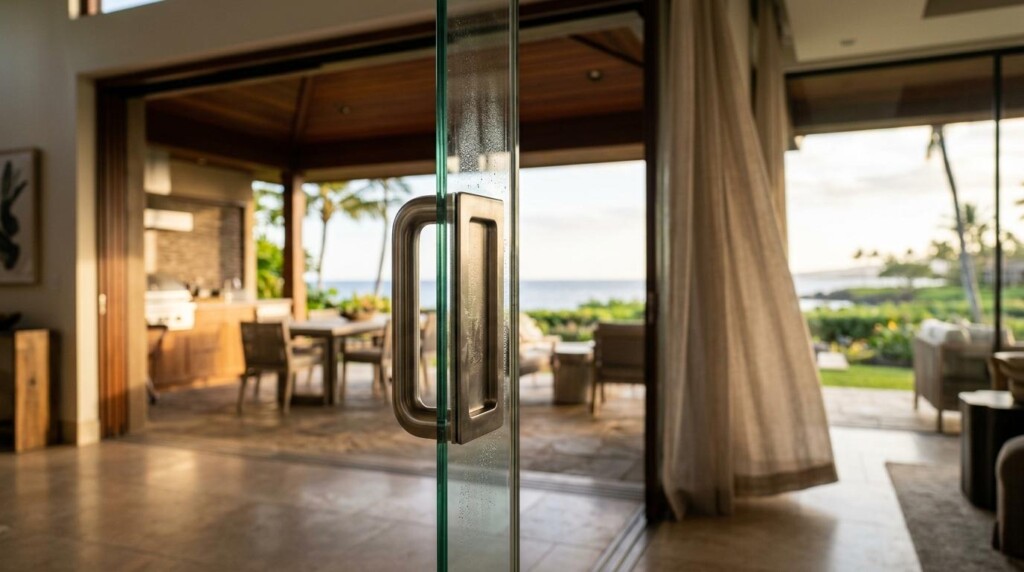
Indoor-outdoor design is essential because Hawaii’s climate rewards homes that breathe. In Waikoloa and Kona, lanais, sliding glass walls, and deep roof overhangs can make a villa feel cooler, larger, and more usable all day.
A lanai is not just a patio. In Hawaii luxury real estate, it is a working living space that extends dining, lounging, and gathering outside while still offering protection from direct sun and passing showers. The best villas place the lanai near the kitchen and main living room so your group can move naturally between spaces.
This is where many expensive homes fall short. Open walls look dramatic, but if the home lacks shade, cross-ventilation, and durable materials, the design can turn hot and impractical by noon.
Strong indoor-outdoor design usually includes:
- deep covered lanai space
- large sliding or pocket glass doors
- cross-breezes from trade winds
- outdoor dining near the kitchen
- shaded seating at different times of day
If you see these elements working together, the villa is likely designed for Hawaii rather than copied from a mainland luxury template.
How does a luxury Hawaii villa compare with a resort suite?
A luxury villa gives you more privacy and control, while a resort suite gives you more immediate shared services. On the Big Island, villas in Waikoloa or Mauna Lani often suit families and groups better than booking multiple hotel rooms.
A resort suite wins when you want restaurants, kids’ programming, spa access, and daily service steps away. It also reduces decision-making. You can walk downstairs and let the property structure your day.
A villa wins when your priority is space, quiet, private pool time, or keeping a group together. If you are traveling with 8 to 16 people, the value per bedroom often shifts in the villa’s favor, especially when you factor in a full kitchen, shared gathering space, and no need to split across floors or buildings.
The trade-off is operational. Resorts give you built-in convenience. Villas give you freedom. If your group wants both, the sweet spot is a professionally managed villa inside or near a resort area, where you keep privacy but stay close to dining, golf, and beach access.
How do you check whether the bedroom layout works for families or groups?
You should verify bed count, ensuite access, and room separation before you book. On the Big Island, homes with five bedrooms can vary wildly in comfort, especially for multigenerational groups or executive retreats.
Step 1: Count true beds, not just sleeping capacity. “Sleeps 16” can mean sofa beds, bunks, or cramped doubles. Eight king beds, by contrast, signals a much higher comfort tier and better flexibility for adult travelers.
Step 2: Map the ensuite layout. Luxury travelers usually expect private bathrooms for most or all bedrooms. If two guest rooms share one bath, that is a downgrade even in a beautiful house.
Step 3: Look at room placement. If all bedrooms open into one central hall, sound can travel. If some rooms are separated or on different wings, you get better privacy for grandparents, couples, or co-workers.
Pro tip: a villa can have enough square footage and still fail group travel if the sleeping plan is weak. Layout is what turns size into comfort.
Which amenities separate a true luxury villa from an upscale vacation rental?
The difference comes from amenities that change how you live on-site. A private pool, Wolf or Sub-Zero kitchen equipment, and a Peloton or full gym do more than look impressive. They reduce friction and keep the villa useful from morning to night.
Luxury villas also need the support systems behind the scenes. Fast fiber internet, whole-home audio, beach gear, club access, and pre-arrival service matter because they save time and widen what your group can do without leaving the property.
The amenities that usually mark the real jump are:
- Pool and spa: Private, well-positioned, and ideally heated on request for shoulder seasons or evening use.
- Chef-grade kitchen: Brands like Wolf and Sub-Zero signal capacity for real meal prep, private chef service, and large-group dining.
- Wellness setup: A proper gym, yoga space, or sports-club access separates luxury from a pretty house with dumbbells in a garage.
- Entertainment infrastructure: Sonos, smart TVs, game rooms, and strong Wi-Fi matter more than décor once your group settles in.
- Beach-readiness: Chairs, umbrellas, coolers, and boogie boards sound simple, yet they save money and keep spontaneous beach time easy.
Common misconception: more amenities always means a better stay. Not necessarily. If you will spend most days off-property, pay more attention to location and service than to arcade rooms or extra media spaces.
How does an oceanfront villa compare with an inland or golf-course villa in Hawaii?
Oceanfront villas offer stronger views, privacy, and emotional impact, while inland or golf-course villas often offer lower rates and more sheltered conditions. On the Kohala Coast, your choice comes down to whether scenery or value matters more.
Oceanfront settings usually deliver the best sunsets, the sound of surf, and a more memorable sense of place. That is why they command a premium. Yet they also bring more salt exposure, more wind, and sometimes rocky shoreline instead of easy swimming access.
Inland or golf-course villas can be quieter in the evening and easier on your budget. They may also feel greener and more protected from direct coastal weather. If you plan to drive to beaches anyway and spend your days golfing or exploring, that trade-off can make sense.
Pro tip: oceanfront in Hawaii does not automatically mean sandy beachfront. Many of the island’s most impressive oceanfront homes sit above lava shoreline or coastal trails, with beaches a short walk or drive away.
How do you evaluate service and concierge support before you book?
You can evaluate service by checking what is included, who manages the home, and how pre-arrival planning works. In Hawaii luxury travel, professional management and clear SOPs often matter as much as the house itself.
Step 1: Ask for the exact service structure. Is there pre-arrival grocery stocking, mid-stay housekeeping, chef coordination, airport transfer help, or only a contact number if something breaks? Luxury service should be defined, not implied.
Step 2: Check responsiveness before payment. If questions about pool heat, beach gear, or occupancy rules take days to answer, that pattern rarely improves after check-in.
Step 3: Look for evidence of operational maturity. Professionally managed homes tend to have better maintenance, cleaner check-in instructions, and stronger local vendor networks for chefs, drivers, and in-villa wellness.
A final filter helps: if the villa is positioned as a private resort, the service should make that claim real. If your group can arrive to a stocked kitchen, a working itinerary, and support that feels calm instead of reactive, you have found a property that matches its price.