


A retreat’s return takes shape before the first conversation begins. The most useful corporate retreat success metrics start with a clear outcome, then track what changes in wellbeing, trust, collaboration, and engagement. The setting can give a team room to think, but lasting value depends on what people carry back to work.
It is reasonable to ask whether the time and investment produced meaningful results. A memorable few days can matter, but a thoughtful assessment looks beyond immediate impressions to changes in how people work together and follow through.
This guide explains how to define retreat ROI, choose indicators to measure before and after, and report progress clearly and fairly. You’ll learn to set objectives before choosing a setting, gather useful feedback, and revisit the signals that matter over time. The aim is to give the retreat a clear purpose and its impact time to emerge.
Key Takeaways
- Choose a small number of clear retreat outcomes before planning, so you know what progress should look like.
- Compare before-and-after indicators for wellbeing, trust, collaboration, and engagement to see what may have changed.
- Pair survey scores with participant reflections and follow-through on decisions for a fuller view of impact.
- Revisit the measures over time and share progress clearly, including what still needs attention.
- Give teams a setting that supports focused conversation and informal connection, then assess how well it serves the retreat’s aims.
What does ROI on a corporate retreat really mean?
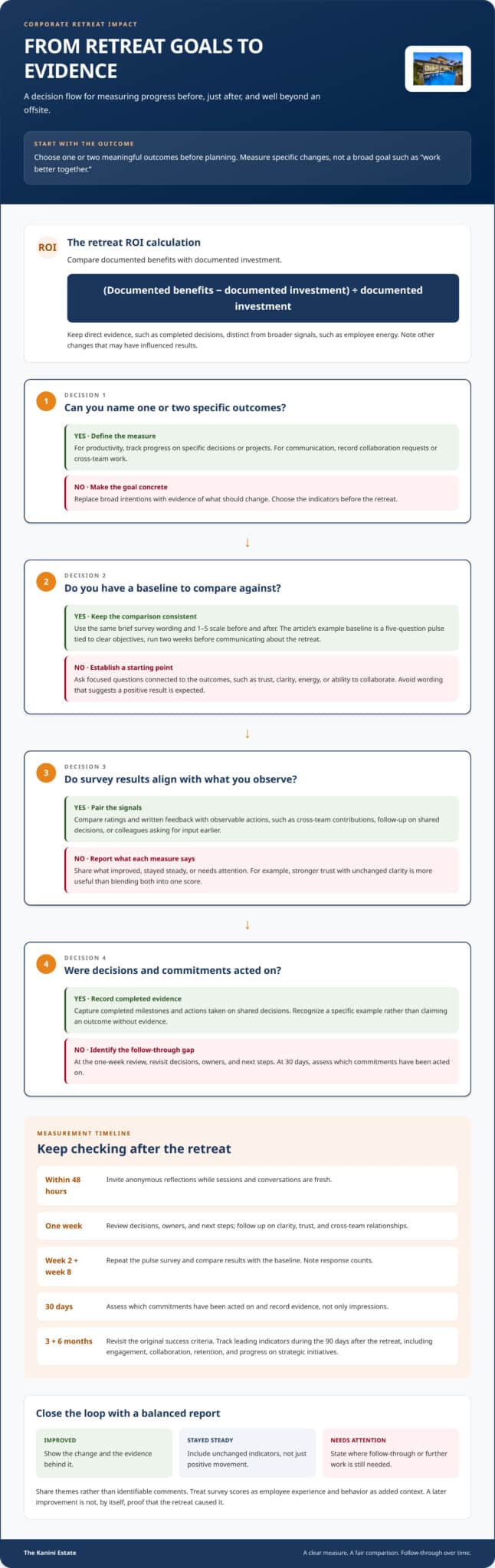
Retreat ROI compares documented benefits with documented investment: subtract the investment from the benefits, then divide by the investment. Common mistakes include judging success by immediate satisfaction alone or claiming the retreat caused every subsequent change.
-
Define Productivity and Communication Outcomes
Choose one or two meaningful outcomes, then decide how to measure each one. For productivity, track progress on specific decisions or projects. For communication, record collaboration requests or cross-team work. Compare the same indicators before and after the retreat. Broad goals such as “work better together” are difficult to assess without evidence of what changed.
-
Consider How the Setting Supports Outcomes
Match the setting to the work the retreat needs to support. A strategy-focused gathering calls for space for concentrated discussion and clear decisions; relationship-building also benefits from time for informal conversation. Consider travel transitions, comfort, meeting spaces, and opportunities to pause. A distraction-free environment can support focus, but the setting alone cannot demonstrate improved outcomes.
-
Track Outcomes Through Follow-Up
Collect participant reflections within 24 to 48 hours of returning, while details remain fresh. Then schedule a 30-minute review one week after the retreat to revisit decisions, owners, and next steps. At 30 days, assess which commitments have been acted on. Record evidence such as completed milestones, not just positive impressions or plans that remain unfinished.
-
Monitor Outcomes Over Time
Revisit the original success criteria at the three-month and six-month marks. Track leading indicators during the 90 days after the retreat, including engagement, collaboration, retention, and progress on strategic initiatives. Compare results with the baseline and note other changes that may have influenced them. This guards against treating a later improvement as proof that the retreat caused it.
For a clear ROI calculation, list documented benefits and the retreat’s documented investment, then apply the formula above. Separate direct evidence, such as completed decisions, from broader signals, such as employee energy. If communication improved but project milestones stalled, report both findings. A balanced account shows where the retreat supported progress and where follow-through still needs attention.
Sharing survey results and celebrating progress
Use the same brief survey before and after the retreat to measure employee engagement and satisfaction. Compare ratings and written feedback, then pair them with observable changes, such as more cross-team contributions during a session.
- Set a useful baseline. Run a baseline pulse survey two weeks before communicating about the retreat. Limit it to five questions tied to clear objectives, such as trust, clarity, energy, and ability to collaborate. Keep each question focused on one idea. For example, ask employees how comfortable they feel sharing concerns with another team.
Use a consistent 1-5 scale, from Strongly Disagree to Strongly Agree. The same wording and scale make later comparisons easier to interpret. Avoid questions that imply the retreat should produce a positive result. Honest answers give the organization a more useful starting point than praise shaped by expectation.
- Invite candid reflections soon after the offsite. Send an anonymous feedback survey within 48 hours of returning, while specific sessions and interactions are still fresh. Ask whether participants gained clarity, felt heard, and made useful connections. Add one open-ended prompt, such as, “What conversation should continue after this retreat?”
Run a follow-up survey within one week after the retreat to assess changes in clarity, trust, and cross-team relationships. Keep the questions aligned with the baseline. If participants report stronger trust but unchanged clarity, share both findings rather than combining them into one overall score.
- Repeat the pulse and watch behavior. Send the same pulse survey at week two and week eight after the retreat. Compare each result with the baseline, and note the response counts so leaders can see how broadly the feedback represents employees. Survey scores describe employees’ experiences; behavioral observations add context.
For example, record whether colleagues from different teams contribute in planning sessions, follow up on shared decisions, or ask for input earlier. These observations do not replace survey responses. Together, they help distinguish a short-lived lift in energy from changes that show up in everyday work.
- Share results with care and recognize action. Present baseline and follow-up results side by side. Explain what improved, what stayed steady, and what needs attention. Protect anonymity by sharing themes rather than identifiable comments. Celebrate a specific example, such as teams acting on a shared decision, instead of claiming the retreat raised productivity without evidence.
A focused, distraction-free setting can give teams room for candid conversation, while follow-up shows whether those conversations carry into work. Consider a retreat setting for focused reflection when planning an offsite around open discussion and shared priorities.
Employee mental health, trust, collaboration, and engagement
Track wellbeing and team dynamics alongside work outcomes. Pair employee feedback with observable actions, such as colleagues sharing concerns or following through on joint decisions.
-
Connect Engagement With Business Outcomes
Choose a work outcome that could reflect stronger engagement, then track it beside employee feedback. The 2020 Edelman Trust Barometer reported that trust in a team is associated with 50% more productivity and 76% more engagement. Treat these as associations, not proof that a retreat caused a change. Compare your organization’s own measures over time.
For collaboration, look for concrete signs: teams exchanging expertise, inviting input, or advancing shared work. Frost & Sullivan reports that teams that collaborate well can increase innovation by 30%. Use this finding as context, not as a forecast for a particular offsite. Define what innovation means for your organization, such as a new process adopted by multiple teams.
-
Review Feedback and Follow-Through
Read employee feedback for signals about trust, energy, belonging, and workload. The American Psychological Association reports that employees in high-trust organizations have 74% less stress and 13% fewer sick days. Those figures describe high-trust organizations, not the effect of a retreat. Use them to frame why trust and wellbeing deserve attention, then assess your own employees’ reported experience.
Next, turn comments into action. If employees say cross-team decisions remain unclear, name an owner to clarify responsibilities and record the next step. Review whether that action happened and whether employees noticed a difference. A positive satisfaction score without follow-through gives only a limited view of engagement.
- Separate wellbeing from a single satisfaction score. A retreat may feel enjoyable while daily pressures remain unchanged. Track distinct signals, such as employees’ reported stress, confidence raising concerns, and ability to get help from colleagues. Tie each measure to a clear purpose. This helps show where the team feels stronger and where support is still needed.
For example, combine a confidential reflection with observations from routine project work. Note whether team members raise risks earlier or share information across groups. These behaviors can add context to survey responses, but should not replace employees’ own accounts.
- Report progress without overstating impact. Present wellbeing, trust, collaboration, and engagement as separate findings. Show what changed, what employees said, and who owns the next actions. If trust scores rise while collaboration remains unchanged, report both. This gives leaders a more honest picture than a single blended rating.
Connect each result to the retreat’s purpose and the organization’s next action. For instance, if employees value clearer priorities but still report friction between teams, keep the priorities visible and assign owners to cross-team commitments. Progress matters when people can see what changed after the conversation.
Selecting measurable before-and-after indicators
Choose indicators that match the retreat’s purpose: strategy calls for measures of direction and decisions; team building calls for measures of trust and connection; training calls for evidence of learning applied at work. Strong corporate retreat success metrics show a baseline, a relevant change, and follow-through.
-
Match Measures to Retreat Purpose
Start with the result the retreat should produce, then select relevant evidence. For a strategic retreat, track whether teams can explain shared priorities and make decisions with clear owners. For team building, measure trust, cross-team connection, and willingness to ask for help. For training, check whether employees use a skill in their work, not just whether they enjoyed the session.
Keep each measure closely tied to the purpose. A strategy retreat may not need a satisfaction score as its leading indicator, and a team-building retreat may not be judged by immediate productivity. Mismatched measures can make a useful gathering look ineffective or make a pleasant experience seem more successful than it was.
-
Compare Before-and-After Indicators
Record a starting point before the retreat, then repeat the same measure afterward. Use a short rating scale for confidence in priorities, trust across teams, or clarity about roles. Pair each rating with a specific prompt, such as asking employees to describe the decision process they will follow. Consistent wording makes comparisons more meaningful.
Combine quantitative results with qualitative evidence. A score can show whether employees report stronger role clarity, while written comments explain where confusion remains. Meeting notes, decision records, and examples of shared work can show whether reported changes appear in practice. Gather reflections within 48 hours if the goal is to capture fresh details, then compare them with later evidence. These corporate retreat success metrics are most useful when they reflect the retreat’s stated purpose.
Keep each measure narrow enough to interpret. If several outcomes change at once, report them separately rather than combining them into one retreat rating.
-
Track Return, Productivity, and Retention
Assess return on investment by connecting documented retreat outcomes with the investment made. For a strategy retreat, evidence may include decisions implemented or initiatives advanced. For training, it may include a skill used in actual work. Attendance and a completed agenda show activity, not the business impact created afterward.
Choose productivity indicators that reflect the retreat’s intended work, such as completed milestones or fewer delays caused by unclear ownership. To assess retention, review employee feedback and retention patterns alongside team connection and workplace experience. These measures can change for reasons beyond the retreat, so record relevant context instead of claiming direct causation.
Finally, assign an owner to each indicator and set a review date. A shared tracking sheet can record the baseline, actual result, evidence, and next action. This helps leaders distinguish a promising early signal from a sustained outcome.
Setting success metrics before a retreat
Set measures before planning the agenda or choosing a setting. Clear objectives give leaders a shared purpose and make later feedback easier to interpret.
- Define two or three specific objectives. State what should be different after the retreat, not simply what the group will discuss. For example, “agree on next quarter’s priorities” names an outcome, while “hold a strategy conversation” describes an activity. A team-building objective might focus on stronger trust between two departments.
Tie each objective to a decision or behavior the organization can observe. If leaders want better collaboration, define what that means in practice, such as teams sharing project updates earlier. Avoid broad aims like “improve culture” unless you specify the change employees should notice.
- Choose a measure and baseline for each objective. Before the retreat, record the current state using evidence suited to the goal. To assess clearer priorities, ask employees to describe the organization’s direction. To assess faster cross-team action, track how often work stalls because responsibilities are unclear. The baseline makes later comparisons more grounded.
Combine counts with context. A completed decision log can show whether leadership agreed on priorities; employee feedback can explain whether those priorities feel clear. A single rating is not the whole story. Each measure should answer a practical question about progress.
- Assign owners and follow-up actions in advance. Name someone to collect each measure and a leader to act on the findings. For example, a project owner can report whether agreed milestones moved forward, while a team lead gathers employee feedback about role clarity. Without an owner, useful information can go untouched.
Set the review dates before the retreat ends. A 30-day milestone gives new commitments a near-term checkpoint, while the three-month review can show whether changes lasted. Write down the evidence each owner will bring, such as a decision record, project update, or recurring team concern.
- Match the setting to the objectives. Decide what the work requires before choosing a place. A strategic conversation may need a quiet, distraction-free environment where leaders can focus on priorities and decisions. Informal connection may also matter when the objective involves trust across teams. Choose a setting for its suitability, not its appeal alone.
For focused retreat work, choose a distraction-free setting for your corporate retreat that supports deliberate conversation and clear thinking. Then make the agenda, measures, and follow-up plan serve the same purpose.
The Kanini Estate: High-quality, distraction-free thinking environment for corporate retreats
The Kanini Estate offers a high-quality, distraction-free environment for corporate retreats, giving teams space to step away from routine and focus on shared priorities. Located in the gated, oceanfront community of Naupaka at Waikoloa on the Big Island of Hawaii, it pairs a luxury vacation rental with an escape to paradise.
Consider The Kanini Estate when your retreat calls for focused conversation, strategic thinking, and time together beyond the meeting agenda. A clear purpose and follow-up plan still shape how you measure impact. The setting supports the work; your chosen indicators show what carries forward.
If this setting suits your retreat plans, contact The Kanini Estate.
Carry the retreat’s purpose into the work ahead
A retreat’s lasting value takes shape in the choices people make afterward. Let your corporate retreat success metrics guide the next conversation, not just record what has passed. When feedback reveals a gap, use it to refine the next commitment, clarify ownership, or make room for a more candid discussion. That continued attention helps the experience become part of how the organization works.
The setting can shape the quality of time together, too. A stay designed for friends and family, or an escape to paradise on the Big Island of Hawaii, offers a different rhythm from daily routines. The Kanini Estate provides a considered place to step away and focus on what the team wants to build next.
Explore a corporate retreat at The Kanini Estate, and begin shaping a gathering around the conversations and progress your team values.
Frequently Asked Questions
Do team retreats actually work?
Team retreats can help when participants use the time to address a real work challenge and carry decisions into their daily routines. A retreat may make room for candid discussion, but attendance alone does not show that the team changed. After a planning retreat, for example, look at whether teams use agreed priorities when making trade-offs. Treat the retreat as one influence among the ongoing actions that shape team behavior.
How Does a Multi-Day Retreat Build Culture and Engagement?
A multi-day retreat gives colleagues more time to connect beyond formal sessions. Informal conversations can help people understand different roles and working styles. To assess whether that experience carries into company culture, look for employees seeking input across teams or including colleagues in decisions. These behaviors offer practical signs of connection, while continued feedback can reveal whether employees feel the change in their everyday work.
How can venue features support a measurable programme?
Venue features support a measurable program when they suit its activities. A quiet meeting area can help a group focus on planning, while shared recreation spaces can encourage informal connection after work sessions. The Kanini Estate is a private vacation rental with a pool, gym, game room, and a two-minute walk to a white-sand beach near Anaehoʻomalu Bay. Match planned activities with the spaces participants will use, then note whether the environment supports the retreat’s purpose.
How do you calculate the cost and return of a company retreat?
Compare the retreat’s documented investment with outcomes the organization can describe or measure. Record relevant expenses such as travel, lodging, facilitation, and employee time. Then identify results tied to the retreat’s purpose, such as an adopted decision or an improved process. Do not assign a financial value to trust or morale without a sound basis. Report those outcomes separately from direct financial results.
How should you assess outcomes after the retreat?
Assess outcomes by comparing follow-through records with what participants said they intended to do. For example, check whether a decision appears in a team’s project plan and whether its owner reports progress. Add context from managers and employees, since a stalled action may reflect shifting priorities rather than an ineffective retreat. Present positive and unresolved findings together so the organization can decide what support or adjustment comes next.
How can a company measure whether a retreat improves team collaboration and communication?
Look at how work moves between colleagues, not only how participants rate the retreat. A team might record whether project handoffs include the right information or whether employees seek another group’s input before a decision. Compare those examples with earlier work patterns and invite employees to describe any friction. Work records and specific feedback together can show where communication feels clearer and where collaboration needs more attention.
How do you measure goal alignment and clarity before and after a corporate retreat?
Ask employees to describe the organization’s priorities and their own role in reaching them, then compare responses from before and after the retreat. Look for shared understanding, not identical wording. Different teams might explain the same priority in distinct ways while agreeing on its purpose and next action. If answers conflict about ownership or direction, that gap can guide leadership’s next conversation.
What post-retreat metrics indicate improved morale, trust, or psychological safety?
Use confidential employee feedback to understand whether people feel respected, included, and able to speak openly. Ask for examples, such as whether someone could question an idea or admit uncertainty during a team discussion. Pair responses with observed patterns, including whose perspectives shape decisions. Positive ratings alone may hide differences across teams, so review written themes alongside any group-level score.