


A vacation-rental damage deposit is a refundable amount a host holds against guest-caused damage, missing items, or certain rule violations. It’s a safeguard, not an extra night’s rent. In the United States, fixed deposits commonly range from $250 to $500 per stay.
It’s reasonable to wonder what a damage deposit covers and when you’ll get it back. A host may collect the money or temporarily hold it on a credit card, then refund or release it if there’s no valid claim.
Understanding what a damage deposit for a vacation rental is can help you read the booking terms with confidence. This guide explains what deposits may cover, how hosts set amounts, and how a refundable deposit differs from a damage waiver or insurance, so you can settle into your stay with fewer unanswered questions.
Key Takeaways
- A deposit may be collected as a refundable payment or placed as a temporary card hold, then returned or released when there’s no valid claim.
- Hosts may set deposits as a fixed amount or a share of the booking total, with the property and stay helping shape the amount.
- Deposits may cover documented damage, missing items, or certain rule violations, but not normal wear and tear.
- Photos, inspection records, and itemized deductions help clarify how a damage claim was assessed.
- Compare refundable deposits with non-refundable damage waivers and insurance to understand how each handles different risks.
What is a security deposit for vacation rental?
A damage deposit for a vacation rental is money a host holds to cover certain losses tied to a guest’s stay, such as guest-caused damage, missing items, or specific rule violations. The rental terms should explain how the deposit is handled, what may be deducted, and when the remainder will be returned.
Refundable Deposit Returns
A refundable deposit is collected for a booking and returned after checkout if there’s no valid claim. It isn’t automatically an added rental charge. A host may deduct an amount for a covered issue, but should explain the deduction and tie it to the relevant cost. Check the stated return timing so you can plan for funds temporarily set aside for the stay.
Card Holds and Booking Friction
A temporary authorization hold reserves funds on a credit card without charging them upfront. If there’s no valid claim, the host releases the hold; if damage occurs, the host may charge the amount justified by that claim. A $500 hold, for example, can make guests pause before completing a booking because it reduces available credit, even though the money may never be charged.
Hosts may collect a deposit through the booking payment method or place a card authorization. Before paying, check the rental terms for the amount, how it’s handled, possible deductions, and the expected refund or release timing. A refundable deposit is generally separate from nightly pricing, but the upfront commitment can still affect your decision to book.
Local laws can govern how deposits are used, where funds are held, and how long a host may keep them. Return deadlines differ by location, with some state rules requiring a refund within 14 to 45 days. A listing’s stated timeline doesn’t override applicable local requirements, so the property’s location matters.
In Colorado, landlords have one month to return a damage deposit, according to the Colorado General Assembly. A written agreement may extend that period to sixty days, but not beyond two months, according to the Colorado General Assembly. These timeframes show why it’s important to distinguish a host’s stated policy from the law that applies to the rental.
A deposit doesn’t automatically limit a guest’s liability to the amount held. If a documented loss costs more than the deposit, the deposit alone may not resolve the full claim. Read the rental agreement’s damage terms before booking, and keep any charge notice or explanation of deductions.
During your stay, promptly report any problem or damage to the owner. If you notice an issue on arrival, take photos or video and share them promptly. This records the property’s condition and can help distinguish existing damage from an issue that occurred during your booking.
Vacation rental security deposit amounts
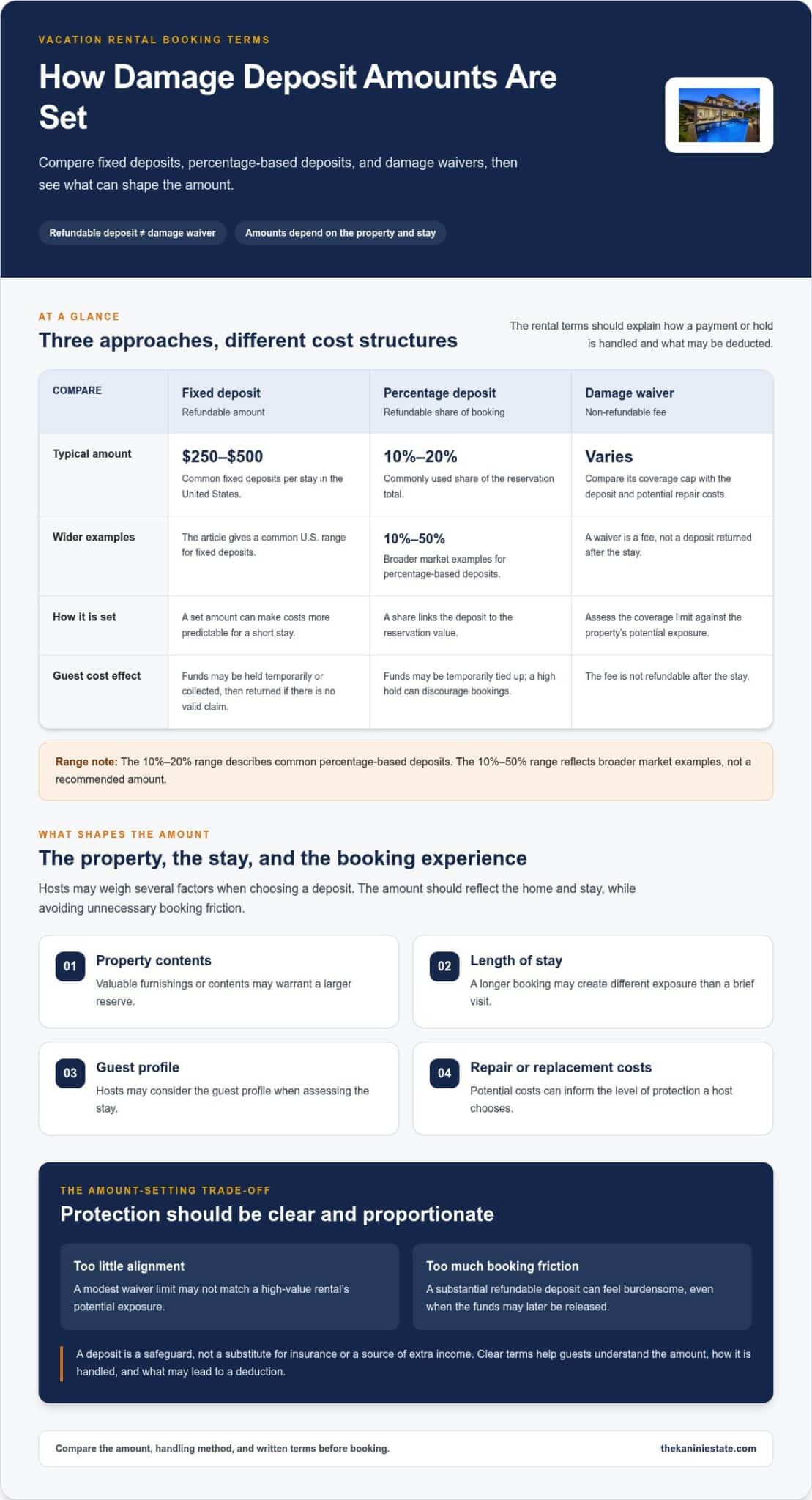
Hosts may set a deposit as a fixed amount or as a percentage of the booking total. The amount depends on the property, the stay, and the booking experience the host wants to provide.
Factors That Shape Deposit Amounts
Choosing a Deposit Amount
Hosts can choose a fixed deposit or calculate it as a share of the reservation total. A fixed amount can make costs more predictable for a short stay, while a percentage links the deposit to the booking value. A host can compare the property’s contents and the stay profile, then choose an approach that provides a reasonable safeguard without adding unnecessary friction.
Some hosts use a percentage when it exceeds their usual fixed amount. The calculation should still reflect the home and the stay, rather than becoming a substitute for insurance or a source of extra income. Clear booking terms help guests understand the deposit before paying and decide whether to complete the reservation.
Typical Deposits and Waivers
Many U.S. vacation-rental hosts set fixed deposits at $250 to $500 per stay. Percentage-based deposits commonly fall between 10% and 20% of the reservation total, while broader market examples range from 10% to 50%.
A damage waiver works differently: it’s a non-refundable fee, not a deposit returned after the stay. Compare the waiver’s coverage cap with the deposit amount and potential repair costs. Photos of the property’s contents can also help explain why a host chose a particular level of protection.
For a high-value rental, a modest waiver limit may not match the property’s exposure, while a substantial refundable deposit can feel burdensome during booking. The trade-off is between an upfront fee and funds temporarily tied up. As you plan a stay, you can also explore a luxury vacation rental on the Big Island of Hawaii and factor its booking terms into your budget.
What damage can a security deposit cover?
A vacation rental security deposit may cover guest-caused property damage, missing items, unpaid charges, or specific breaches of house rules. It isn’t a general fund for routine upkeep. The written rental terms should explain which incidents may lead to a deduction and which costs remain the host’s responsibility.
Can vacation rental hosts charge a damage deposit through Airbnb or Vrbo? Hosts may collect a deposit through the booking payment method or use a card authorization. For an Airbnb or Vrbo booking, review the reservation’s payment terms to understand how the deposit is handled.
What happens if a guest disputes a damage deposit deduction? The host should explain the claim and provide supporting evidence. Compare the explanation with the rental agreement and booking record, then raise the issue through the appropriate booking channel. Connecting the rule, incident, and amount claimed helps keep the dispute focused.
Eligible claims may include damage to furnishings, missing household items, unpaid charges, or a stated house-rule violation. For example, if indoor smoking is prohibited, a documented breach may support a claim under the agreement. The host should identify the relevant rule and loss, rather than relying on a broad statement that the home was left unsatisfactory.
Normal wear and tear differs from guest-caused damage. A host shouldn’t keep funds for routine use, and a deposit isn’t meant to cover every small mishap. The key question is whether the claimed loss falls within the agreement and can be tied to the stay.
Hosts should tell arriving guests about unrepaired damage left by previous visitors. This establishes that an existing issue predates the current booking. After departure, an inspection can identify new damage or missing items; hosts commonly inspect within a few days to a week. The timing can help connect the condition found to the relevant stay.
If a claim involves repair or replacement, the amount retained should generally reflect that cost. A host should itemize the deduction rather than treat the deposit as extra income. Guests can match each listed charge to a specific damaged or missing item and the agreement’s terms.
House rules should explain which violations could lead to partial or full forfeiture. That helps guests distinguish a valid claim from a surprise charge. Before booking, read these terms alongside any separate cleaning charge, since routine cleaning and damage are different costs.
Security deposits compared with damage waivers and insurance
These options can look similar during checkout, but the booking terms determine how each affects you. Compare the financial commitment, claim process, and exclusions before deciding whether the arrangement suits your trip.
Deposit Coverage
Read the agreement for the specific events that qualify for a claim, not just the label attached to the charge. A term may distinguish accidental damage from a rule violation or exclude certain items. That wording matters if a claim later involves damaged furnishings, a missing item, or another incident during your stay.
Check what evidence the host may use and how a claim will be explained. A clearly described process helps guests understand and respond to a decision. If booking documents refer to separate house rules or a waiver, read those terms alongside the rental agreement so you understand the protections together.
When Hosts Use Deposits
The choice often reflects the property’s risk and the booking experience the host wants to offer. A refundable deposit may suit a longer stay or a property with valuable contents, while some hosts may use a protection plan instead. For guests, the practical difference is how funds are handled before, during, and after the stay.
Consider a reservation where a card hold reduces available credit during travel. A non-refundable waiver creates a different cost: you pay the fee even if no incident occurs. The booking terms should make this distinction clear before payment. Neither option replaces reading the specific conditions attached to the reservation.
Insurance adds another layer, but its purpose and terms differ from guest-facing booking choices. Short-term rental hosts need property insurance that specifically covers short-term rentals. Don’t assume a host’s policy covers your belongings or every possible claim. The policy wording determines its scope.
Local requirements can also affect deposit handling, so the property’s location matters. When comparing two rentals, note each hold or fee, covered situations, exclusions, and claim steps. This side-by-side comparison can reveal which booking has clearer terms and better fits your cash-flow needs and comfort with risk.
Definition and purpose of a vacation rental damage deposit
A deposit can affect the total funds you need to secure a stay, even before checkout. A booking may show nightly rates, taxes, cleaning charges, and a separate deposit in different places. Review the full payment summary before confirming so the amount due and any temporarily unavailable funds fit your travel budget.
Compare deposit terms with the length and shape of your trip. A brief visit and a longer reservation may have different booking totals, and a percentage-based deposit can change with that total. For a shared stay, decide in advance who will manage the reservation and how the group will account for deposit-related costs.
Timing matters, too. A card hold may reduce available credit during travel, while a charged deposit can affect your account balance until it’s returned. Plan for that possibility, especially if you’ll use the same card for transportation, meals, or other reservations. The booking terms should explain how the host handles the funds.
Clear terms also make it easier to compare rentals fairly. Look beyond the headline rate and note the deposit, payment schedule, refund timing, and conditions for deductions. A lower nightly price doesn’t necessarily mean a lower upfront commitment once all booking charges are considered. Compare the full cost, not just one line item.
Before reserving, save the relevant terms with your confirmation and note any dates the host gives for releasing or returning funds. If your account still shows a hold after that period, the payment record can help you describe the issue clearly. This simple step can make it easier to manage the reservation alongside other travel expenses.
Treat deposit terms as part of the booking decision, not an afterthought. Read them alongside the cancellation policy and payment schedule, then choose a stay that fits your plans and comfort with the financial terms. Knowing what to expect leaves more room to enjoy the people and place you’re traveling to see.
If a Hawaii escape is part of your plans, explore The Kanini Estate as you consider the setting for your next stay.
The Kanini Estate: Luxury vacation rental on the big island of Hawaii
The Kanini Estate offers a luxury vacation rental on the Big Island of Hawaii, where guests from all over can gather with friends and family or enjoy an unforgettable escape to paradise. For corporate retreats and travelers worldwide, the setting provides a high-quality, distraction-free environment for focused thinking and relaxation.
After weighing deposit terms and protection options, consider what kind of stay will best serve your group. The Kanini Estate is rented as a full property, offering a private setting for families or a professional, distraction-free environment for a destination corporate retreat.
To explore The Kanini Estate for your next getaway, visit thekaniniestate.com or contact the estate management team directly.
Choose Your Next Stay with Confidence
Knowing what a damage deposit for a vacation rental means can help you plan your next getaway. As you compare places, consider both the setting and how clearly the booking terms fit your travel plans. Reviewing those details before reserving leaves more room to enjoy the stay.
Think about the time you want to create, whether that means reconnecting with family, sharing unhurried moments with friends, or finding space to think. Let those priorities guide your choice of retreat. The right setting can turn a stay into a memory you’ll carry home.
If the Big Island is calling, take the next step and explore The Kanini Estate. Picture the days ahead, and begin planning a stay that feels like your own.
Frequently Asked Questions
Do guests see security deposits as a red flag?
Not by itself. A clearly explained, refundable deposit can be a routine part of booking terms. Guests may have more concern if the listing doesn’t explain the amount, how it’s collected, or what could be deducted. Before reserving, compare the listing with the rental agreement. Look for consistent terms, a clear claim process, and a stated refund timeline.
How long can I legally hold a security deposit?
There’s no single deadline for every U.S. vacation rental; applicable local rules set the limit. The provided market guidance reports state deadlines ranging from 14 to 45 days. Colorado’s general landlord rule allows one month, according to the Colorado General Assembly. A written agreement may extend that period to sixty days, but not beyond two months, according to the Colorado General Assembly.
What is the process for handling security deposits?
A clear process starts with written terms before payment. Guests should see the amount, collection method, possible deductions, and expected return timing. The host records the property’s condition, reviews it after checkout, and assesses any claim against the agreement. If funds are retained, the guest should receive an itemized explanation. Keep the booking terms, payment record, and messages together in case you need to review the details.
What is a damage deposit for a vacation rental?
A damage deposit for a vacation rental is money held to address specific losses tied to a guest’s stay, rather than a routine charge for occupying the property. It may be collected as a payment or handled through a card authorization. The distinction matters: an authorization reserves available credit, while a charged deposit temporarily moves funds from the guest’s account.
How much is a typical vacation rental damage deposit?
Common U.S. examples include fixed deposits of $250 to $500 per stay or percentage-based deposits of 10% to 20% of the reservation total. A percentage can change with the booking price, while a fixed amount stays the same across reservations. For a guest comparing listings, calculate the total funds due at booking, including any separate fees, before deciding which terms suit the trip.
Is a vacation rental damage deposit refundable?
Usually, yes, if there’s no valid claim under the rental agreement. A host may retain an amount for a supported deduction and return the balance. A card authorization works differently: it reserves credit, then the host releases it if no charge is due. Check your payment account after checkout and keep the confirmation, since a release and a refund may appear differently.
When must a vacation rental damage deposit be returned?
The deadline depends on the rental’s location and the rules that apply there. The provided market guidance reports state return periods ranging from 14 to 45 days. A stated host timeline doesn’t replace a local legal deadline. Keep the checkout date and deposit terms so you can compare the expected return date with the applicable requirement.
What can a host legally deduct from a damage deposit?
Potential deductions include documented guest-caused damage, missing items, unpaid charges, or certain breaches of house rules. Normal wear and tear isn’t a valid basis for keeping the deposit. A fair claim should connect the deduction to the rental terms and the loss, with an itemized explanation. Routine cleaning alone shouldn’t be treated as damage unless the agreement and applicable rules support the charge.