


A retreat should end with decisions, not just shared understanding. A post-acquisition team integration retreat works best when leaders use it to align strategy and culture, explain what will change, hear employee concerns, and agree how teams and resources will work together. The goal is a shared direction and clear next steps.
It’s natural for people to feel uncertain after an acquisition. Roles, relationships, and familiar ways of working may shift, so gathering alone won’t create trust. Leaders need to make room for honest discussion and demonstrate through their actions the culture they want the combined organization to build.
This guide shows how to plan a retreat around practical outcomes: clarify the deal’s purpose, surface cultural differences, set expectations for change, and support employees through the transition. You’ll also learn how to turn conversations into decisions, assign responsibility, and keep integration moving after everyone returns to work. With thoughtful preparation and a calm, focused setting, a retreat gives both teams room to listen, contribute, and begin shaping a shared future.
Key Takeaways
- Use the retreat to explain the acquisition’s purpose, surface cultural differences, and agree on the behaviors that will shape a shared culture.
- Set clear expectations for role changes, responsibilities, and integration milestones so employees understand what happens next.
- Make space for honest questions and feedback, and identify valued practices from both organizations worth preserving.
- Give an integration leader clear authority, then use regular leadership reviews to resolve obstacles and keep decisions moving.
- Map people, processes, technology, and other resources to decide what to combine and where separate approaches make more sense.
Communicating strategy, culture, and internal processes
Choose a venue with quiet work areas, reliable meeting space, and practical travel access for everyone. Build trust with an agenda that moves from the deal’s purpose to mixed-team listening, culture mapping, and agreed actions.
-
Clarify Roles and Team Leadership
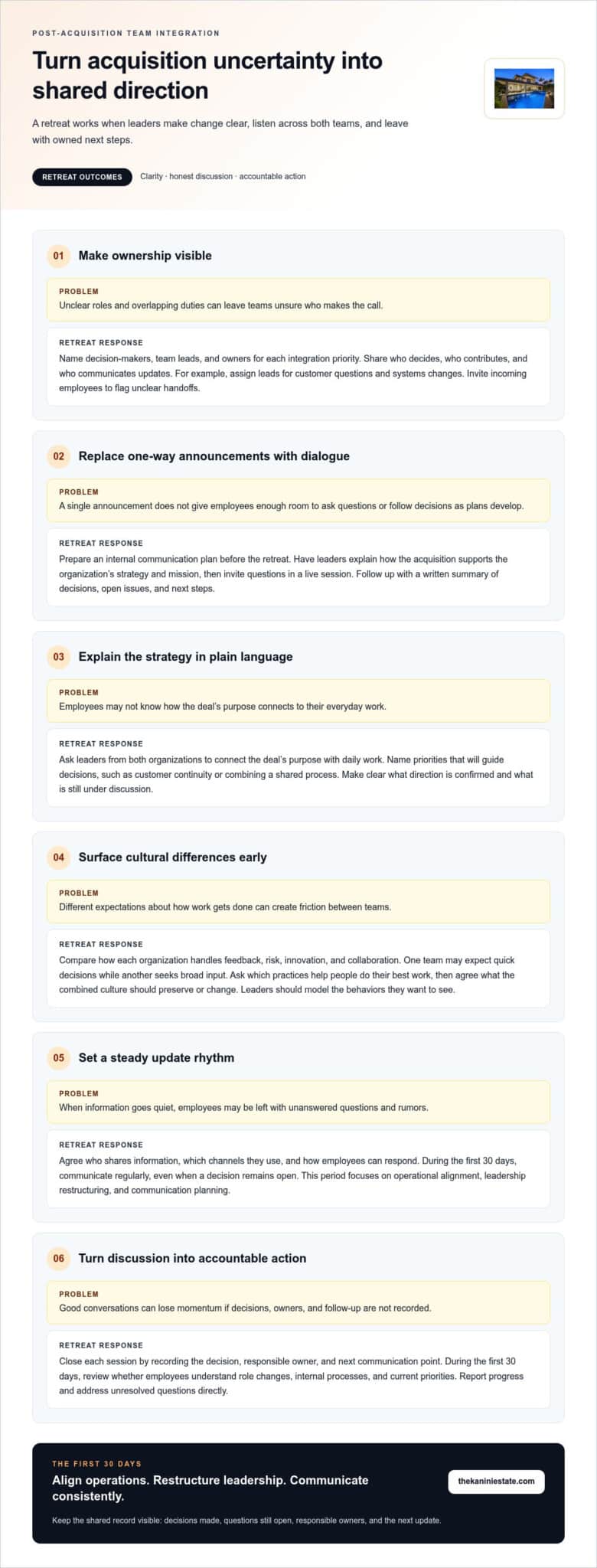
Start by naming decision-makers, team leads, and owners for each integration priority. Share a simple responsibility map showing who decides, who contributes, and who communicates updates. For example, identify one lead for customer questions and another for systems changes. Ask incoming employees to flag unclear handoffs. Avoid overlapping duties unless leaders explain how they’ll resolve competing decisions.
-
Build Employee Buy-In Through Communication
Create an internal communication plan before the retreat, then give leaders visible roles in delivering it. Ask executives to explain how the acquisition supports the organization’s strategy and mission, and invite employee questions in a live session. Follow up with a written summary of decisions, open issues, and next steps. Don’t rely on a single announcement. Repeated, honest updates help employees understand priorities as the integration plan develops.
- Explain the strategy in plain language. Ask leaders from both organizations to connect the deal’s purpose with everyday work. Name the priorities that will guide decisions, such as customer continuity or combining a shared process. Then invite teams to identify what needs clarification. A clear explanation helps employees distinguish confirmed direction from topics still under discussion.
- Surface cultural differences early. Use a guided discussion to compare how each organization handles feedback, risk, innovation, and collaboration. For example, one team may expect quick decisions while another seeks broad input. Ask participants which practices help them do their best work, then record what the combined culture should preserve or change. Leaders should model the behaviors they want others to follow.
- Set a steady update rhythm. Use the retreat to agree who shares information, through which channels, and how employees can respond. The first 30 days focus on operational alignment, leadership restructuring, and communication planning. Set regular updates during that period, even when the message is that a decision remains open. This prevents silence from filling the gaps with rumor.
- Turn discussion into accountable actions. Close each session by recording the decision, responsible owner, and next communication point. During the first 30 days, review whether employees understand role changes, internal processes, and current priorities. Leaders should report progress and address unresolved questions directly. This gives both teams a shared record to revisit after the retreat.
Supporting employee satisfaction and long-term performance
Employee support should continue beyond the retreat, especially as customer work and daily roles shift. Use these steps to clarify the transition, protect valuable talent, and help both teams move forward.
- Build a practical employee support plan. Involve HR early in merger integration to map workforce needs, key roles, and cultural concerns. At the retreat, invite employees from both organizations to identify what helps them work well. For example, record valued team practices before changing reporting lines or processes. This helps leaders preserve useful strengths while addressing transition pressures.
- Answer the per-employee cost question with a budget framework. There is no single U.S. rate for every corporate integration retreat. Estimate costs by considering lodging, travel, meals, facilitation, retreat length, and employee support needs. For example, a group traveling from multiple locations may have different travel needs from a team based near the venue. Set the budget around the retreat’s purpose and participants.
- Map employee concerns to concrete support. Ask HR to gather questions before the retreat, then group them by topic, such as role changes, benefits, workload, or reporting lines. Assign a leader to answer each topic and note any follow-up. If an answer depends on a later decision, explain when the next update will come. Clear responses help employees understand what to expect during integration.
- Pair training with the work employees must do. Identify new tools, processes, and customer handoffs that require practice. Use short, role-based sessions rather than broad presentations. For example, let employees rehearse a customer transition using a realistic inquiry and a clear escalation path. Then gather feedback to identify training gaps. This connects learning to daily tasks and helps teams serve customers consistently.
- Protect key talent through meaningful involvement. Acquired employees may not have chosen to join through a traditional hiring process, so give them a voice in shaping the combined team. Ask experienced staff to demonstrate valuable practices, mentor colleagues, or help refine workflows. Retention takes more than a message. Visible opportunities to contribute show employees how their expertise fits the organization’s future.
- Make leadership support visible after the retreat. Schedule follow-up conversations where managers can hear concerns and review workload, training, and team connections. Leaders should act on recurring issues instead of asking employees to repeat them. A distraction-free setting can give teams room to focus on these discussions; a corporate retreat environment can support that shared work.
- Track signs of progress, not just attendance. At each follow-up, review employee questions, training needs, unresolved customer handoffs, and collaboration between legacy teams. Compare those notes with the retreat’s agreed actions. If the same issue keeps appearing, assign an owner and adjust the support plan. This keeps employee experience connected to long-term performance as the organization moves forward.
Executive sponsorship and integration leadership
Hold the retreat after leaders develop the integration strategy, ideally before the acquisition closes. This gives both teams time to discuss priorities before execution begins.
- Name an accountable integration leader. Choose someone with authority, resources, and access to senior decision-makers. The CFO is a common choice because the role connects financial goals with expected synergies. Give the leader a written mandate covering decisions, escalation paths, and progress reporting. Without clear authority, teams can leave the retreat with tasks but no way to resolve competing priorities.
- Bring both organizations into the planning room. Form a working group with leaders and representatives from relevant functions, such as HR, finance, operations, and marketing. Include people who handled due diligence, since they can carry forward knowledge about risks and potential synergies. Before the retreat, ask each representative to bring one priority, one concern, and one decision requiring executive support.
- Use a checklist to shape the retreat. Start with the integration plan, then identify decisions the group must make together. A practical checklist can cover strategic goals, decision owners, dependencies, employee questions, customer impacts, and unresolved risks. Mark each item as decided, assigned, or still open. For example, if teams need to combine a process, name the lead who will compare both methods and report back.
- Set a phased direction for the work. BCG describes three phases: setting the direction, capturing the value, and building the organization. Use the retreat to agree on the intended outcome of each phase and the work that belongs there. In direction-setting, leaders define objectives and priorities. During value capture, owners advance agreed synergies. Organization-building then addresses the structures and connections that support the combined company.
- Turn retreat decisions into regular reviews. Set a recurring meeting where senior leaders review progress, unblock owners, and record decisions. Brixey and Meyer’s unification team meets weekly during the first quarter after an acquisition. Use a similar rhythm only if it fits your integration plan. Keep each review focused on open actions, emerging risks, and decisions that need executive attention.
- Plan the retreat step by step. First, define outcomes and gather input from both organizations. Next, select participants who can make or carry out decisions. Then share the agenda and relevant due diligence findings. During the retreat, assign an owner and next action to each decision. Afterward, circulate the record and schedule the first leadership review. This sequence connects discussion to execution.
If integration begins to derail the business, review completed activities and determine what has and has not worked. The CFO is responsible for maximizing financial synergies after the transaction plan has been developed.
Setting expectations about organizational change
Use the retreat to turn uncertainty into clear objectives, milestones, and ways to work together. Effective team-building activities include mixed-team exercises that map a customer journey or solve a shared process challenge.
-
Set Post-Merger Integration Objectives
Choose a small set of objectives before the retreat, then test each against the merger’s purpose. For example, an objective might be to maintain a smooth customer handoff while teams combine related workflows. The first 100 days after an acquisition are a critical period, so identify what must stabilize first. Avoid promising that every team, system, or practice will change at once.
- Separate urgent changes from longer-term work. Sort proposed changes into immediate, planned, and deferred categories. A reporting-line decision may need early clarity, while a shared work method may require input from both organizations. Use this exercise to show employees what changes first and why. A written sequence gives managers a consistent way to explain what happens next.
- Use team activities to expose practical differences. Put employees from both organizations into mixed groups and ask them to map a customer journey, from first contact through resolution. Have each group mark handoffs, decision points, and friction. Then compare the maps and choose one improvement to test. This gives teams a useful shared task instead of relying on social activities alone to build connection.
-
Define Goals and Success Criteria
Turn each objective into a measurable goal with an owner, a milestone, and a clear sign of completion. For example, a customer-transition goal could require one agreed contact path and a named team responsible for handoffs. Define how leaders will assess progress during the 100-day plan. Avoid goals such as “work better together,” which offer no clear way to judge progress.
- Explain what will remain distinct. Integration does not require combining every part of both organizations. At the retreat, ask leaders to name where shared work creates value and where separate approaches make more sense. For example, teams may align customer reporting while preserving a specialist workflow. Document the reason for each choice so employees understand that separation can be intentional.
- Set expectations for uncertainty and review. Identify decisions that remain open, the person responsible for resolving each one, and when employees will receive an update. The first 100 days can guide early priorities, but complex integration work may continue beyond that period. Tell teams which milestones mark stabilization and which signal later progress. This helps employees plan without treating every open question as a setback.
Combining operations, capabilities, and resources
Use the retreat to map how work, systems, and skills should connect. Give each discussion a business objective, a decision owner, and a clear next step.
- Map the work before combining it. Ask representatives from both organizations to outline one core process, such as handling a customer request. Compare each step, approval, and handoff. Mark differences that affect speed, service, or accountability. This map gives the combined entity a practical view of process overlaps and where distinct methods serve different needs.
- Choose integration based on value. For each shared function, identify the benefit of combining it and the risk of doing so. A common reporting process may improve visibility, while a specialized service workflow may need to remain separate. Record the reason behind each choice. This connects integration decisions to objectives instead of treating uniformity as the goal.
- Give technology its own workstream. Ask IT leaders to list everyday tools, such as email and office applications, alongside mission-critical CRM and ERP platforms. Then map dependencies, data flows, and users affected by each change. Prioritize technology and data alignment early. A missed system dependency can interrupt routine work even when the broader integration plan appears sound.
- Sequence changes around operational risk. Use the first 100 days to execute key integration tasks across IT, HR, and business processes. Identify changes needed to secure operations, then assign an owner and a transition plan to each. Avoid switching multiple connected systems at once without a clear sequence. Teams need to know which process remains active during each change.
- Set realistic milestones for core operations. Financial systems, supply chains, and customer operations should be fully integrated within six to twelve months. Use that timeframe to define interim milestones, dependencies, and accountable teams. For example, finance can map reporting requirements before system consolidation begins. Track progress against each milestone, not simply against a single final completion date.
- Match resources to the work ahead. Ask leaders to identify critical skills, capacity gaps, and tools needed for every priority. For example, a combined customer-support process may need staff trained across both organizations’ products. Assign people and resources before setting delivery dates. This makes the direction practical and helps prevent integration tasks from becoming extra work without clear ownership.
- Preserve strengths while capturing efficiencies. Disney’s acquisition of Pixar offers a useful example: Pixar retained creative autonomy while Disney integrated key operational efficiencies. Discuss which capabilities should remain distinct and which shared resources could support both teams. Write down the rationale, the owner, and the next review point. To give these decisions room for focused discussion, plan your corporate retreat in a distraction-free setting.
The Kanini Estate: Luxury vacation rental on the big island of Hawaii
The Kanini Estate offers a high-quality, distraction-free setting for corporate retreats. Located in a premier, gated oceanfront community, this luxury vacation rental gives teams space to focus on post-acquisition team integration priorities and thoughtful conversation. Ocean views and a private pool, hot tub, gym, and game room provide room to unwind between sessions.
Choose this retreat setting when your group needs focused planning as well as meaningful connection. The Kanini Estate is a full-property luxury vacation rental for corporate groups, friends, and families seeking time together. Its private setting supports strategic discussions, while the serene surroundings offer a restorative change of pace between sessions. Explore the property and submit a booking request through The Kanini Estate’s website.
Carry the shared direction into the next chapter
A retreat can mark the beginning of a more deliberate way of working together. Its value grows when leaders keep listening, make room for new perspectives, and let employees help shape how the combined organization moves forward. The next step is to create space for those conversations, away from familiar routines and daily distractions.
A post-acquisition team integration retreat can also give colleagues the chance to connect beyond their immediate roles. In a quieter setting, teams can build trust, explore fresh ideas, and begin creating a shared sense of purpose. The Kanini Estate offers a peaceful escape on the Big Island of Hawaii, making it a distinctive setting for a corporate retreat or time together with friends and family.
When you’re ready to consider a retreat setting, contact The Kanini Estate to discuss your retreat. A thoughtful beginning can help your teams move forward with greater confidence and connection.
Frequently Asked Questions
What are the goals of a post-acquisition team integration retreat?
A post-acquisition team integration retreat should help teams agree on how they will make decisions and work together. Beyond sharing the acquisition’s purpose, participants can create a short working agreement covering decision rights, meeting norms, and how to raise disagreements. For example, teams can decide who resolves a customer issue when responsibilities cross departments. A practical agreement gives employees a shared reference point for everyday collaboration.
How can leaders address culture clashes and employee concerns during a retreat?
Leaders can address culture clashes by discussing specific work situations rather than labeling either organization. Ask mixed groups how they would handle a missed deadline, a customer escalation, or a decision needing quick approval. Compare approaches and identify where expectations differ. Give employees a private way to submit sensitive concerns, then respond without naming individuals. This makes difficult topics easier to discuss with care.
What are the risks of holding a post-acquisition integration retreat?
A retreat can pull key people away from customer and operational work, or let senior voices dominate the discussion. It can also create false expectations if leaders present tentative ideas as final decisions. Protect essential coverage, set clear boundaries around sensitive information, and label proposals as confirmed, under review, or undecided. Without these safeguards, employees may leave more confused than clear.
How do you measure the success of a post-acquisition team retreat?
Measure success by whether the retreat improves how teams work together afterward, not by attendance alone. Track practical signals such as repeated handoff errors, delays in cross-team decisions, or unresolved issues moving between departments. Ask participants whether collaboration feels easier, then compare their feedback with those work patterns. If the same friction continues, revisit the working agreement and adjust responsibilities or decision paths.