


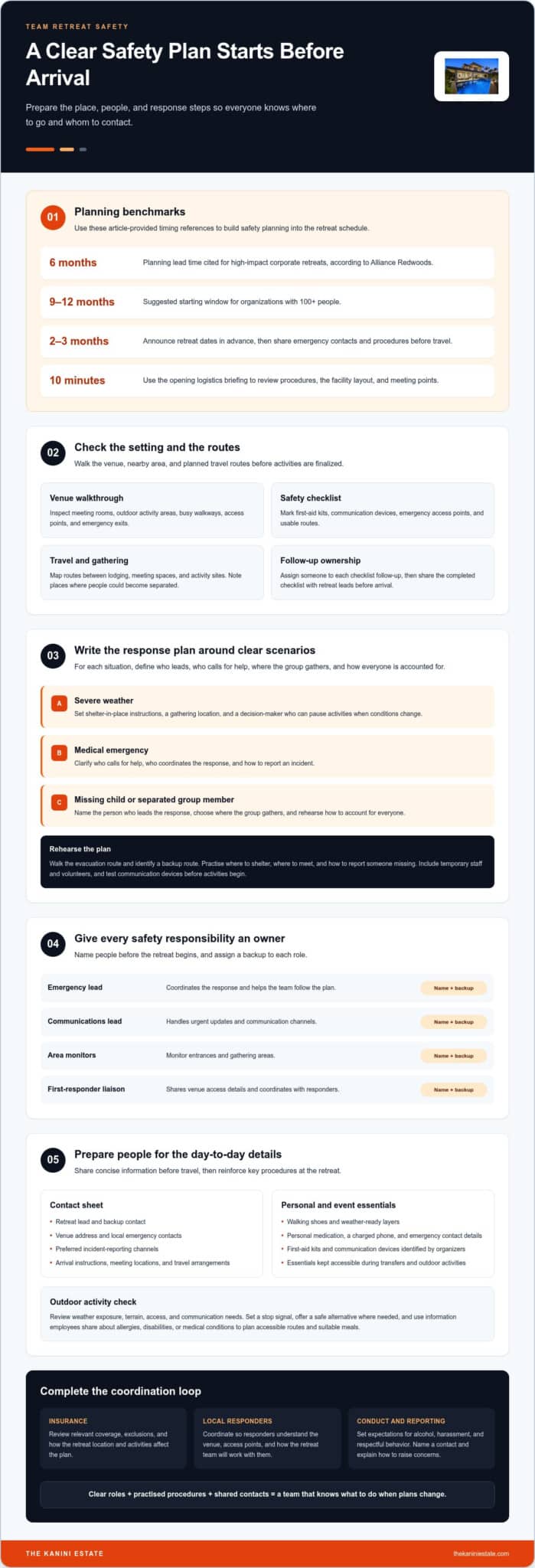
Ensuring team member safety on a retreat starts with assigning clear roles before anyone arrives. Name an emergency lead, a communications lead, people to monitor entrances and gathering areas, and a liaison for first responders. Assign a backup to each role. A thoughtful approach to ensuring team member safety on a retreat makes responsibilities clear, even if someone is unavailable.
A retreat should feel spacious and restorative, not uncertain. Ensuring team member safety on a retreat also means assessing the venue and travel routes, planning for severe weather and medical emergencies, reviewing insurance, and coordinating with local emergency services. This guide explains how to prepare and rehearse an emergency plan so everyone knows whom to contact and what to do. With responsibilities settled, your group can focus on the retreat itself.
Key Takeaways
- Walk the venue, nearby area, and travel routes to spot access concerns, emergency exits, and communication gaps before the retreat begins.
- Prepare clear response steps for severe weather, medical incidents, and a missing child, then rehearse how the team will communicate.
- Assign named leads for entrances, emergencies, first-responder communication, and urgent updates, with backups for key roles.
- Review the organization’s insurance for relevant coverage, exclusions, and how the retreat’s activities and location affect the plan.
- Coordinate with local emergency services so responders understand the venue, access points, and how the retreat team will work with them.
Pre-event assessment of the venue, surrounding area, and travel routes
Start with the setting, then test how the group will move through it. The venue layout, nearby services, travel plan, and scheduled activities all shape your safety checklist.
For a United States retreat, document hazards, reporting routes, and emergency response steps as part of the employer’s safety planning. Assign a lead to share those procedures before meetings and activities begin.
Set expectations for alcohol, harassment, and conduct before travel. Name a contact for reporting concerns, explain how the team will respond, and reinforce respectful behavior throughout the retreat.
-
Assess the Venue, Area, and Travel Routes
Walk through the venue, its surroundings, and each planned travel route before choosing activities. Note remote or unfamiliar locations, access points, busy areas, and places where the group could become separated. Map the routes between lodging, meeting spaces, and activity sites. Provide clear directions and a practical way for everyone to report a delay or concern while travelling.
-
Walk Through the Venue and Use Safety Checklists
Inspect every space the group will use, from meeting rooms to outdoor activity areas. Mark exits, emergency access points, first-aid kits, communication devices, and busy walkways on a checklist. Check that routes remain usable during activities and gatherings. Assign someone to each follow-up task, then share the completed checklist with retreat leads before arrival.
-
Pack for Safety at the Retreat
Tell employees what to bring based on the location, forecast, travel plan, and scheduled activities. A useful list may include suitable walking shoes, weather-ready layers, personal medication, a charged phone, and emergency contact details. Ask everyone to keep essentials accessible during transfers and outdoor activities. Organizers should also identify event supplies, such as first-aid kits and communication devices.
-
Choose a Comfortable Venue for the Group
Match the venue’s capacity and layout to the group size, planned meetings, and activities. Look for comfortable accommodations, good food, and amenities that help employees rest and focus. Consider how shared spaces support privacy, movement, and different needs. Group culture matters, too: a supportive environment makes it easier to raise challenges, respect boundaries, and encourage everyone to participate.
-
Set Practical Conduct and Logistics Before Arrival
Send a concise briefing with arrival instructions, meeting locations, travel arrangements, and the safety contact. Explain conduct expectations, including how to report harassment and alcohol-related boundaries, before the first gathering. Give attendees a clear way to raise concerns without waiting for a group discussion. For example, specify whom to contact if someone feels unwell, uncomfortable, or separated from the group.
Planning for weather, medical emergencies, and lost children
Build a written plan around likely disruptions, named decision-makers, and clear actions. Include weather changes, medical incidents, missing children, accessible participation, and meals.
-
Create a Safety and Crisis Response Plan
Write a response for severe weather, medical emergencies, and a lost child. For each scenario, name who leads, who calls for help, and where the group gathers. Include shelter-in-place instructions and a way to account for everyone. Start early: according to Alliance Redwoods, high-impact corporate retreats need six months of planning; organizations with 100+ people should begin nine to twelve months ahead. Set the response plan alongside the agenda.
-
Share Emergency Contacts and Procedures
Give every employee a concise contact sheet before travel. Include the retreat lead, a backup contact, the venue address, local emergency contacts, and the preferred incident-reporting channels. Explain what to do if a child is missing, someone becomes ill, or weather interrupts an activity. Announce retreat dates 2 to 3 months in advance, then use a 10-minute opening logistics briefing to review procedures, facility layout, and meeting points.
-
Plan Emergency Drills and Evacuations
Walk the evacuation route with staff before the retreat and identify a backup route. Rehearse where to shelter, where to meet, and how to report that someone is missing. Include temporary staff and volunteers in drills, and test communication devices before activities begin. A short role-play helps employees practise who gives instructions and who checks attendance, rather than relying on hurried decisions during an actual incident.
-
Prepare for Outdoor Activities
Review each outdoor activity for weather exposure, terrain, access, and communication needs. Set a clear stop signal and identify who can pause the activity when conditions change. For team-building exercises, explain boundaries and offer an alternative for employees who cannot participate safely. Ask privately about allergies, disabilities, and medical conditions, then use the information employees share to plan accessible routes and suitable meal options.
For a focused off-site meeting, consider a distraction-free corporate retreat setting as one part of a wider safety plan. Match the surroundings and planned activities to your group’s needs.
Assigning safety roles and responsibilities
Assign each safety task to a named person before the retreat begins. A clear structure for ensuring team member safety on a retreat helps leaders focus on solving problems instead of deciding who should act under stress.
- Name one safety lead and one backup. The lead coordinates the response, keeps the plan accessible, and decides when to pause an activity. The backup takes over if the lead is unavailable. Share both names before the first workshop. For example, include them on the event schedule and contact sheet so employees can find the right person without searching through messages.
- Assign specific tasks to specific people. Choose someone to manage entrances, another person to observe crowd movement, and a designated contact to speak with first responders. Name someone to relay urgent updates to the group. Describe the action, not just the title. “Call emergency services and give the venue address” is clearer than “handle emergencies.”
- Set a simple reporting route. Tell employees who should receive reports about an unattended bag, a guest in distress, or an access concern. Give them a primary contact and an alternate. The communications lead should know how to receive urgent updates, pass them to the safety lead, and share instructions. This keeps reports moving without asking every leader to manage the same incident.
- Cross-train people for essential roles. Pair each key task with someone who can cover it if the assigned person is away. For example, train the entrance lead’s backup to manage access and direct arriving guests. Before outdoor activities, prepare staff to recognize threats, manage crowds, de-escalate tension, and provide basic first aid. Practising scenarios helps each person remember their role.
- Match responsibilities to the retreat plan. Review the guest list, schedule, location, and sensitive discussions before deciding whether extra security support is appropriate. Senior leaders, confidential strategy sessions, international travel, or a history of threats may shape that decision. If specialists are involved, define how they will coordinate with the internal safety lead. The plan should protect people, information, and property without disrupting the workshop.
- Invite every employee to contribute. Explain how to report concerns and recognize people who report them promptly. A participant who notices a distressed guest or blocked entrance can alert the assigned lead early. Remind the group who handles urgent updates during meetings and activities. To ensure team member safety on a retreat, make these roles easy to remember and use throughout the event.
Checking that the organization is properly insured
Review insurance before signing retreat contracts or confirming activities. Compare the organization’s policy documents with the location, travel arrangements, attendees, and planned events, then record who handles questions and claims.
- Gather the current policy documents. Ask the organization’s finance or risk lead to collect declarations, coverage summaries, endorsements, and exclusions. Note policy dates and named insureds. A certificate of insurance provides a snapshot, while the policy wording explains terms and exclusions. Keep the full documents accessible to the person managing the retreat, not only in the office filing system.
- Compare coverage with the retreat activities. List each planned activity, such as workshops, guided outings, swimming, or group transport. Compare that list with policy language about covered operations, locations, and participants. For example, a policy written for office work may describe activities differently from a retreat agenda. Record questions about exclusions, conditions, or endorsements for follow-up.
- Review employee travel and medical response needs. Identify who is travelling, how they will travel, and which expenses the organization expects insurance to address. Review relevant workers’ compensation, business travel, accident, or medical coverage documents. Don’t assume one policy answers every travel or injury question. Policy terms, employee status, location, and the circumstances of an incident all affect how coverage applies.
- Clarify responsibilities with the venue and activity operators. Read contracts for insurance language, indemnity terms, and responsibility for damage or injury. Compare any requested certificate with the organization’s policy details. For a guided activity, record which party handles equipment, instruction, and incident reporting. Clear written communication can surface a problem before signing makes the agreement harder to change.
- Check property and liability considerations. Consider organization-owned equipment, rented items, confidential materials, and possible claims involving guests or third parties. Identify which policies address each concern, and note any exclusions or deductibles. For example, policy wording may treat a laptop used during a workshop differently from a participant’s personal belongings.
- Document decisions and share the right details. Create a brief insurance record with policy contacts, relevant coverage notes, claim-reporting steps, and contract requirements. Limit access to sensitive policy files, but give retreat leaders the instructions they need. If the organization changes the venue, transportation, or agenda, repeat the comparison. This final review keeps your understanding of insurance aligned with the actual retreat plan.
Coordination with local emergency services
Coordinate with local responders before the corporate retreat, not during a crisis. Share practical site information and agree on how the retreat’s safety lead will communicate urgent updates.
- Identify the right local contacts. Find the appropriate police, fire, and emergency medical contacts for the venue. Record the venue’s full address, entrance instructions, and a clear description of the meeting location. If the retreat includes off-site team-building activities, note each location separately. Give the contact list to the safety lead and backup so either person can act if an emergency arises.
- Share the site details responders need. Prepare a simple site map showing entrances, access roads, meeting spaces, outdoor activity areas, and possible gathering points. Mark gates or access restrictions that could affect arrival. For example, describe which entrance an ambulance should use and where a staff member can meet responders. Keep the map aligned with the current program and send updated details if the schedule or location changes.
- Ask about coordination before the event. Contact local emergency personnel with the retreat dates, venue details, and planned activities. Explain critical features, such as remote meeting areas or outdoor routes. Discuss how responders prefer to receive incident information and whether a joint drill is practical. Their local knowledge can help the organization identify access challenges and make staff training more relevant.
- Agree on a clear handoff during an incident. Assign one retreat lead to greet responders, share the reported issue, and provide the site map. A second person can guide the group away from the response area and keep the planned meeting point clear. Decide who will communicate updates to employees. This division lets emergency personnel focus on the situation while retreat staff support safe movement and accountability.
- Review the plan after each activity or change. Before an off-site outing, confirm the location, travel route, staff contacts, and return plan with the event lead. If weather changes the program or a workshop moves rooms, update the response details and inform the people coordinating with responders. After the retreat, record what worked and what caused delays. Use those notes to strengthen the next corporate safety plan.
As you plan the setting and program, explore a focused environment for a corporate retreat alongside your emergency coordination planning.
The Kanini Estate: Luxury vacation rental on the big island of Hawaii
The Kanini Estate offers a high-quality, distraction-free thinking environment for corporate retreats, where your team can step away from the usual workplace rhythm and focus together. As you choose a setting, consider how the surroundings support your retreat goals and planned safety procedures.
For groups seeking time with friends and family, The Kanini Estate also offers a private escape. Its setting can give a retreat a sense of calm and space, while your organization remains responsible for planning emergency roles, insurance, and coordination with local responders while ensuring team member safety on a retreat.
If this setting suits your retreat, contact The Kanini Estate to learn more.
Shape a retreat your team can settle into
A well-planned retreat gives people room to think, connect, and return to work with fresh perspective. Choose a setting that suits your group’s purpose, then build the experience around thoughtful preparation. A calm environment and clear expectations can go hand in hand, allowing colleagues to focus on meaningful conversations while knowing how to raise a concern.
For a gathering that brings colleagues together beyond the usual workplace, consider a private escape on Hawaii’s Big Island. The Kanini Estate offers a setting for time with friends and family, as well as corporate retreats shaped around focused thinking. Its ocean, sunrise, and sunset views add a memorable sense of place. Your organization can carry its safety planning into the retreat, while making space for connection and perspective.
Take the next step toward planning a retreat that feels considered from arrival onward. Explore The Kanini Estate for your retreat, and give your team a setting in which to gather with care and confidence.
Frequently Asked Questions
What Makes A Successful Employee Retreat?
A successful employee retreat turns a clear purpose into useful conversations and follow-through. Set objectives before building the agenda, then connect each workshop to a decision, skill, or team challenge. Make room for quiet reflection and informal connection, not just presentations. For example, close a strategy session by recording owners and next steps, then revisit those actions after employees return to their regular work.
What is Considered Corporate Retreat Security?
Corporate retreat security is the planning and support used to protect people, information, and property away from the workplace. Depending on the group and agenda, it can include controlled access to meeting spaces, credential checks, transportation coordination, discreet security specialists, and a crisis response plan. A retreat discussing confidential strategy may need tighter access arrangements than a general team workshop. Tailor measures to the location, attendees, and activities.
What safety risks should organizers assess before a team retreat?
Assess risks related to the location, schedule, participants, and information being shared. For example, consider whether a remote activity could leave employees without reliable communication, or whether a private discussion could be overheard in a shared space. Review travel between venues, weather exposure, crowd movement, and potential conflict or harassment concerns. Then prioritize risks by likely impact and assign a practical response to each.
What first-aid supplies and medical support are needed for a team retreat?
Provide an accessible first-aid kit, identify who will respond to an injury, and make the process for requesting professional medical help clear. Match supplies and support to the activities, venue, and needs employees choose to share. For example, an outdoor program needs a plan to reach an injured participant, not just supplies in a distant meeting room. Keep emergency contacts and incident-reporting instructions easy to find.
What safety standards should retreat venues meet?
Choose a venue with usable exits, clear emergency access, working communication devices, and an accessible layout for the planned program. Confirm that meeting rooms and activity areas suit the group’s size and movement needs. Ask how staff share emergency instructions and how guests can report a hazard. A venue walkthrough can reveal practical concerns, such as a blocked route or a gathering area that conflicts with event traffic.
How can organizers vet transportation providers and ensure safe travel to a retreat?
Match each transport plan to the route, schedule, passenger needs, and retreat locations. Set a clear pickup point, arrival contact, and process for reporting delays. Share the itinerary with employees and keep a current passenger list with the trip lead. For off-site activities, clarify who communicates route changes and how the group will reconnect if separated. Allow flexibility between activities to avoid rushed boarding or confusing handoffs.
What insurance and liability waivers are recommended for a company retreat?
Review the organization’s insurance documents against the retreat’s location, travel, and planned activities, and note relevant exclusions. A waiver is a separate document, not a substitute for understanding coverage or reducing hazards. Its wording and use can have legal consequences, so have qualified counsel tailor it to the organization and activity. Keep signed documents with the retreat records, and explain how to report an incident.
What are the legal workplace safety obligations for employers at off-site retreats in the United States?
For a United States retreat, document hazards, reporting routes, and emergency response steps as part of the employer’s safety planning. Assign a lead to share those procedures before meetings and activities begin.